WorkBuddy Beginner's Guide: How This Chinese AI Agent Works For You
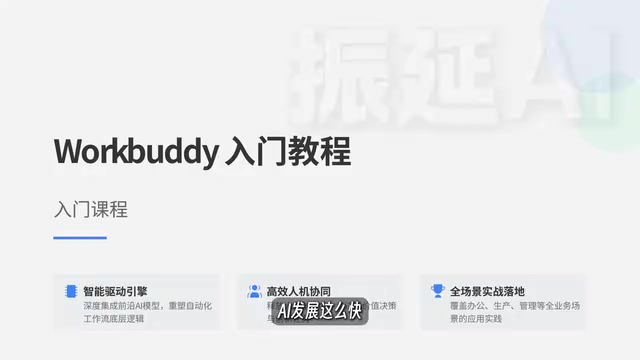
WorkBuddy is a Chinese AI Agent that executes tasks directly on your computer — not just offers advice.
This article introduces WorkBuddy, a Chinese AI Agent positioned as a domestic alternative to Codex. Unlike traditional LLMs that only output suggestions, AI Agents have a full perceive-decide-act loop, letting them operate your computer, invoke tools, and batch-process files within authorized limits. WorkBuddy stands out for its low setup barrier, compatibility with Chinese workplace apps like WeCom, affordable pricing, and built-in Connectors, Skills, and Expert features. The article also cautions readers to mind permission boundaries and data security when authorizing AI to act on their behalf.
From "Q&A Bot" to "Digital Employee"
Most people who've used AI for years are still stuck in the same loop: you send a request, the AI gives you some suggestions, and you still have to do the actual work yourself. There's an obvious gap between that experience and having an assistant that actually gets things done for you.
WorkBuddyAd is designed to bridge exactly that gap. Based on demonstrations by a Bilibili content creator, it can be understood as a Chinese domestic alternative to Codex — an AI Agent that can directly operate your computer on your behalf. It's not positioned as a chat tool, but rather as a "digital worker" that, within the limits of your authorization, can control your machine, invoke tools, and deliver finished results.
Here's a real example from the video: given a messy document with inconsistent punctuation and mixed font styles, a traditional LLM will tell you how to fix the formatting — but you still have to do it manually. WorkBuddy's approach is different. You send it the request, hit send, and it automatically locates the target document on your desktop, reformats the headings and body text, and handles everything while you wait. If there are multiple files, give it a unified standard and it will batch-process them all.
The Fundamental Difference Between AI Agents and Traditional LLMs
This demo may seem simple, but it highlights a core distinction between two classes of AI. Traditional LLMs excel at Q&A, analysis, and recommendations — their output stays at the "information" level. AI Agents, by contrast, focus on execution: pushing a task through to a final result within the boundaries you've confirmed and authorized.
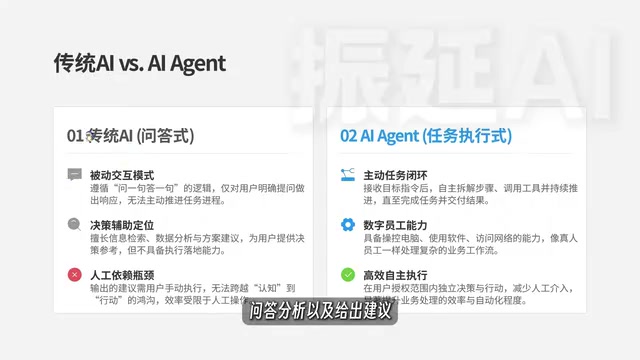
Using the video's analogy, an Agent is more like a digital employee who handles things on your behalf: it can operate your computer, invoke various tools, and deliver finished outcomes rather than a how-to guide. Whether it's drafting proposals, building spreadsheets, analyzing data, generating content, creating posters, or taking over your browser to operate software — in theory, it can put the finished product in front of you in one go.
It's worth noting that WorkBuddy is not the only option. Codex and other workflow-capable agents all point in the same direction. The dividing line between them and traditional AI is simple: can they actually step in and do the work for you?
From a technical architecture standpoint, the key difference between AI Agents and traditional LLMs lies in whether they have a closed-loop "perceive → decide → act" capability. Traditional LLMs (like GPT, Claude, etc.) are fundamentally text prediction systems — they receive input and generate output, and that's where the process ends. Agents go further by adding tool-calling (Tool Use) and environment interaction: they can read and write files, control browsers, call external APIs, and decide their next action based on execution results. This "autonomous planning + multi-step execution" mechanism allows Agents to decompose complex tasks into sub-steps, iterate in loops, and keep going until the goal is met — rather than generating a block of advisory text and stopping. OpenAI's Codex, Anthropic's Claude Computer Use, and various Chinese Agent products are all essentially wrapping this execution framework around a standard LLM.
Why Beginners Should Start with WorkBuddy
The content creator offered several concrete comparison points to explain why entry-level users are better served by starting with this kind of domestic Agent.
Low Barrier to Entry, No Complex Setup
These tools are straightforward to get started with: search for the product name, download it, and deploy it locally. No need to configure a VPN, no complex environment setup — it's reasonably beginner-friendly.
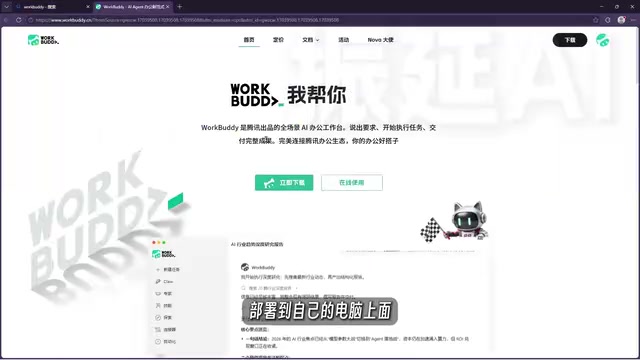
By comparison, tools like Codex offer greater flexibility but also demand more technical background — understanding code, configuring environments, and setting up workflows. For most beginners, choosing a tool that's easy to deploy and compatible with common Chinese workplace software is the more practical starting point.
Connectors: Authorizing AI to Join Your Workflow
WorkBuddy provides a "Connectors" feature, which is essentially a gateway for authorizing the AI to use a specific application or service. For example, connect it to WeCom (Enterprise WeChat) and it can help reply to messages or compile chat records into documents. The value of Connectors is that the AI doesn't just know how to do something — it can actually participate in completing the entire workflow within the scope you've permitted.
Under the hood, Connectors typically work via OAuth authorization or API key integration — the user grants the AI tool a specific permission token, and the AI can then make requests or interact with the interface on the user's behalf. The logic is similar to a mobile app requesting "read contacts" permission, with the key difference being that the AI actively initiates actions rather than passively waiting. Understanding this helps you grasp the permission boundaries: the broader the scope of a Connector's authorization, the more the AI can do for you — but the greater the potential risk of unintended actions. It's advisable to start with read-only permissions during initial use and test behavior before gradually expanding the scope.
Skill Marketplace and Experts: Professional Capabilities On Demand
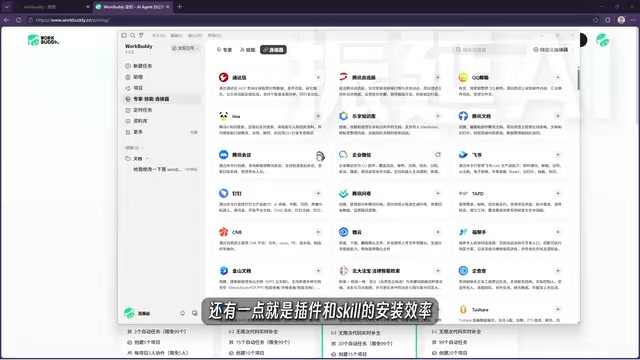
The tool includes a Chinese-language Skill marketplace where common capabilities can be installed locally in one click. A "Skill" is essentially a pre-packaged professional tool or work capability. There's also an "Experts" concept — think of them as digital employees in specific roles. If your team needs a senior developer to build a workflow from scratch, you can find the corresponding Expert and invoke them with a single click.
Affordable, Sufficient for Everyday Use
On the pricing side, new users receive credits upon registration, and daily quotas are available. For light users, this is generally enough to experiment and handle basic tasks. Many overseas alternatives require paid subscriptions and need to be used heavily before delivering real value.
A Measured Assessment
Agent-class tools do represent a genuine shift in AI applications — from "assisting" toward "doing" — but when evaluating your options, don't be swayed by "the best tutorial" or "domestic alternative" labels. The real question is whether the tool fits your actual work context. If your day-to-day involves high-frequency, repetitive tasks like document formatting, spreadsheet analysis, or content generation, the automation value of these tools will be immediately apparent. If your needs lean toward deep programming or highly customized workflows, a higher-flexibility option like Codex may be more appropriate.
It's also worth approaching the idea of "authorizing AI to operate your computer and software" with some care. Connectors and automated execution mean handing over a slice of your operational control to an AI. When sensitive scenarios like WeCom or local files are involved, it's worth staying mindful of permission boundaries and data security. Having a tool that works for you is a good thing — but the phrase "within the scope you've confirmed and authorized" is precisely the premise on which that works.
Summary
The core value proposition of Chinese AI Agents like WorkBuddy is advancing AI from "giving advice" to "delivering results." Low barrier to entry, compatibility with Chinese workplace software, and accessible pricing make it a practical first step for everyday users who want to experience what a "digital employee" feels like. For anyone curious about automated workflows, the best move isn't to save it for later — it's to start with one real, small task and see what it can actually do.
Related articles

AI-Generated Posters Don't Have to Be Ugly: What Actually Determines Design Quality
AI posters often look cheap — but the problem is usually how they're used, not the tools themselves. Here's how human-AI collaboration and better prompting can transform output quality.

MiniMax Code Open-Sources to Rival ZCode; Claude Code Gains AGENTS.md Compatibility
MiniMax Code open-sources to rival ZCode; Claude Code 2.1.277 adds AGENTS.md compatibility. Daily roundup covering AI coding tools, Ascend chip roadmap, and Rust supply chain security.
The Elias Thorne Phenomenon: Why AI Chatbots Keep Fabricating the Same Fictional Person
Why do AI chatbots keep inventing a fictional person named Elias Thorne? This article unpacks LLM hallucination mechanics, training data bias, and model collapse risks.