WorkBuddy Deep Dive: A Practical Guide to China's Codex-Rival AI Agent
WorkBuddy is a Chinese AI agent rivaling Codex that autonomously operates computers to complete office tasks.
WorkBuddy is a Chinese AI agent tool positioned by Pony Ma as the third strategic product after QQ and WeChat. Benchmarked against Codex but more user-friendly for domestic users, it requires no complex configuration. Unlike traditional LLMs that only provide suggestions, WorkBuddy can directly operate computers and invoke office tools within the user's authorized scope — automatically formatting documents, batch processing files, creating animated PPTs, and analyzing sales data to generate reports. It supports multi-agent parallel collaboration, deep integration with domestic office ecosystems, comprehensive security controls, and affordable costs with free credits for new users. It also offers a Chinese Skill marketplace, multi-role expert agents, multi-model switching, and MCP extension interfaces.
When AI Learns to Do the Work Itself: What Exactly Is WorkBuddy
Positioned by Pony Ma as the third strategic product after QQ and WeChat, what makes WorkBuddyAd so special? Simply put, it's a domestic AI agent tool benchmarked against Codex — its interface and interaction logic are largely consistent with Codex, but it's far more friendly to Chinese users: no complex configuration, low device requirements, and free credits are provided.
The most critical difference is that it directly integrates with commonly used domestic office software. Tasks that previously required constant switching between multiple applications can now be handled by it all in one place: organizing materials, generating documents, analyzing spreadsheets, completing repetitive operations — it doesn't just chat with you, it actually gets work done.
According to a tutorial shared by a Bilibili creator, many people open WorkBuddy and only ask a few simple questions, treating the agent as an ordinary chat window. The tool is clearly powerful, yet they only scratch the surface — which is a real shame.
Codex is an early code generation model launched by OpenAI, later integrated into the GitHub Copilot system. Its typical form is "understanding context in an editor and directly generating or rewriting code." Calling WorkBuddy a "Codex rival" emphasizes the interaction paradigm rather than specific features: both adopt a model of "input a natural language request → AI directly produces usable output" rather than a Q&A conversational format. Around 2025, OpenAI further evolved Codex into a cloud-based agent capable of autonomously executing tasks — a positioning consistent with WorkBuddy's "digital employee" concept. However, Codex still targets developer scenarios and requires prerequisites like a code environment and API configuration; WorkBuddy migrates the same paradigm to general office scenarios, replacing the command line with connectors and English documentation with a Chinese interface. That is the real meaning of "domestic benchmarking."
The Divide Between Traditional AI and AI Agents
A straightforward example illustrates the point. Suppose you have a Word document with messy formatting and punctuation errors. A regular large model will tell you how to fix the layout, but all the actual editing steps still require manual operation — the AI only provides ideas, not execution.
WorkBuddy is completely different. You simply enter your document organization request in natural language, click send, and within the authorized scope, it will automatically locate the target document on your desktop and fully automate the formatting, beautification, and standardization. No manual intervention is needed throughout the process — just wait for the final product. The revised document has clear heading hierarchy and clean formatting. It supports not only single-file optimization but also batch processing of dozens or even hundreds of documents once a unified standard is set.
The core difference lies here: traditional large models focus on Q&A analysis and solution output, while the core of an AI Agent is to fully execute tasks within the user's authorized scope — delivering results, not text suggestions. It's more like a round-the-clock digital employee that can autonomously operate a computer, invoke office tools, plan workflows, and directly deliver complete work outcomes.

The core definition of an AI Agent can be understood from three dimensions: first, autonomy — it can plan steps on its own based on goals rather than waiting for step-by-step instructions; second, tool invocation — it interacts with the external environment by reading and writing files, operating software, and accessing interfaces; third, closed-loop execution — from perceiving the task to delivering results, no human intervention is needed in intermediate steps. The industry typically describes its workflow as a "perception—planning—action—feedback" loop: the agent first understands the task state, then breaks it down into sub-steps, invokes the appropriate tools to execute, and adjusts the next step based on results. This is fundamentally different from the single-round mapping of "input prompt—output text" in traditional large models. Authorization boundaries therefore become a key design consideration — the greater the agent's permissions, the stronger its capabilities, but also the larger its risk exposure. This is why Agent products generally introduce high-risk instruction interception and user authorization mechanisms.
Multi-Agent Parallelism: From Solo Work to Team Collaboration
Document processing is just a basic function. A beautifully animated PPT shown in the tutorial was also automatically created by WorkBuddy after providing requirements.
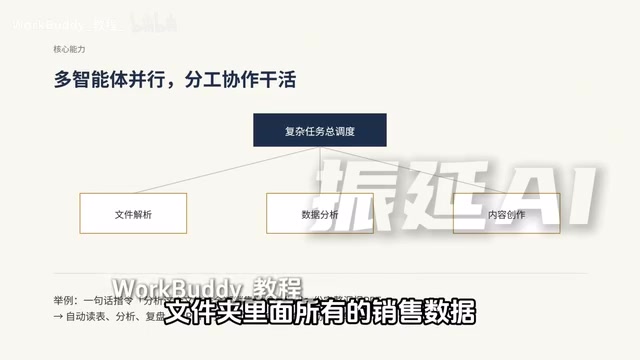
When facing complex tasks, WorkBuddy supports multi-agent parallel work. It automatically breaks down the workflow and mobilizes multiple "digital employees" to collaborate, each handling file parsing, data analysis, content creation, and other tasks. For example, you can directly instruct it to analyze all sales data in a folder, automatically review and summarize, and generate a report PPT — the entire process is completed autonomously without manually switching between applications.
This capability greatly reduces the office workload and is one of the key features that distinguishes it from ordinary agents. Competing products like Codex offer greater freedom but require professional foundations such as code environment configuration, making the barrier very high and unsuitable for beginners.
Four Core Advantages: Why Beginners Should Choose It First
Extremely low barrier to entry. Zero-experience users can simply search for the official website in a browser to download and install. The local deployment process is simple and intuitive, requiring no professional technical background.
Deep integration with the domestic office ecosystem. The platform's exclusive connectors serve as authorized entry points to various office software, allowing binding with tools like WeCom. Once authorized, it can automatically organize chat content, compile meeting minutes, and assist with work messages, breaking down barriers between AI and daily office work to form a complete office loop.
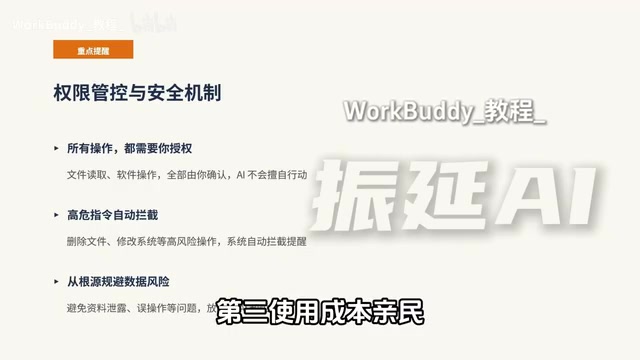
Comprehensive security controls. All file reading and software operations require user authorization, and high-risk instructions are automatically intercepted, fundamentally avoiding data leaks and operational errors.
Affordable cost. New users receive credits upon registration and can claim free credits daily, fully meeting daily light office needs. Compared with overseas agents that mostly require paid subscriptions for heavy use, this tool is more suitable for ordinary office workers.
Advanced Capabilities and Skill Ecosystem
WorkBuddy features a built-in Chinese Skill marketplace, where various pre-built professional skill plugins support one-click installation to expand AI office capabilities as needed. The platform also includes expert agents for multiple roles, covering development, HR, operations, sales, administration, and more — one-click invocation to assist with corresponding professional work.
Two advanced features worth noting: first, multi-model switching, compatible with multiple domestic large models that can be flexibly swapped based on business needs; second, MCP Service extension interfaces that can connect to custom business tools, expanding the AI's work boundaries and adapting to personalized office needs.
MCP stands for Model Context Protocol, proposed and open-sourced by Anthropic at the end of 2024. Its goal is to standardize the way large models connect with external tools and data sources. Previously, each tool integration often required separate adaptation code — N models connecting to M tools meant N×M workloads. After MCP standardized this interface, the model side and tool side each implement it once and can interoperate. For users, this means agents can mount databases, internal systems, third-party APIs, and other custom capabilities on demand without waiting for vendors to adapt each one. WorkBuddy's support for MCP Service extension interfaces essentially opens this standardized channel, enabling enterprises to connect their own business tools so that agents can call internal systems within the authorized scope to complete tasks closer to actual workflows.
Who Should Use WorkBuddy
For professionals across industries, WorkBuddy balances ease of use, low cost, and localization. It doesn't require you to know how to code or tinker with environment configurations, yet it can genuinely replace repetitive and tedious office work. If you're looking for an AI tool that can truly "get its hands dirty" and do the work, it's worth a try — but with one caveat: don't just use it as a chat window.
Related articles

How Big Can Stars Really Get? The Physical Limits of the Largest Stars
Red supergiants are the largest stars by volume, with radii up to 2,000 times the Sun, engulfing the inner solar system. But there is no precise upper limit on stellar size—models predict up to 15,000 solar radii. The most massive blue stars are far smaller than red supergiants—biggest and heaviest are two different things.

Apple HomeView Smart Display Full Feature Breakdown: Wall-Mount or Desktop, $299
Apple launches HomeView, a $299 smart display with wall-mount and desktop options, 12MP camera for facial recognition, smart home control, music playback, and recipe step-by-step cooking. Full breakdown of watch faces, apps, privacy, and cooking integration.

Where Did the Promised New Studio Go? Craft Computing Answers After Five Years
Craft Computing's host responds to viewer questions: the new studio promised five years ago was shelved as construction costs soared from $30,000 to $75,000, and was replaced by a 168-square-foot garage conversion.