WorkBuddy for Absolute Beginners: Building Agents That Work for You
A three-stage AI agent path: from office user to workflow builder, then to one-person company deliverer.
The article breaks down the onboarding path for AI agent products like WorkBuddy with a three-stage framework: using AI for documents, data analysis, and communication; becoming a builder via workflow platforms like Coze to turn industry experience into reusable assembly lines; and engineering practice with tools like Codex and Cursor. It stresses that AI lowers the floor, not the ceiling, hence Python basics for reading and fixing AI code. It also frames a "one-person company": website storefront, operations and marketing agents for leads, AI programming for delivery, AIGC for materials.
AI agent products like WorkBuddy are turning "let AI work for you" from a concept into everyday practice. An instructor with eight years of software development experience—three of them focused on large model algorithm development—has systematically broken down the complete path to getting started with these tools on Bilibili. His core judgment: AI lowers the floor of the barrier to entry, but it does not automatically raise your ceiling—understanding this is what determines which level you should aim for.
A Three-Stage Path: From User to Builder
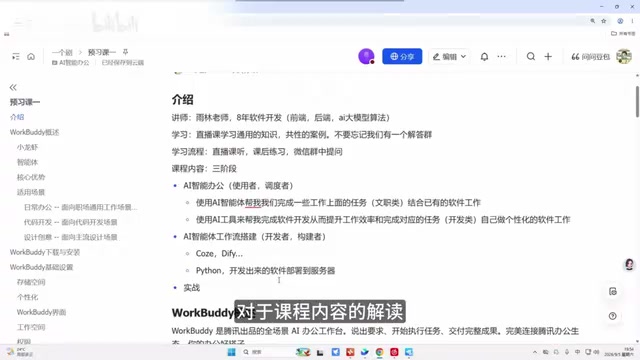
The course's top-level design isn't complicated—it's essentially a path of progressive capability: first use ready-made tools to complete tasks, then learn to orchestrate workflows, and finally do engineering practice. The three stages correspond to three identities—tool user, workflow developer, and project deliverer.
Stage One: AI-Powered Office Work
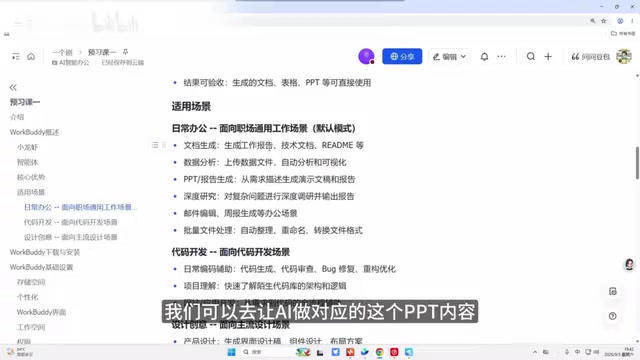
This stage addresses text and data work. Document generation covers Word-type content such as work reports, technical documents, training materials, papers, and bid proposals; chart and reporting work extends to financial stock data analysis, company earnings analysis, and e-commerce product analysis (click-through rate, revenue, traffic, and other dimensions), with AI producing visualizations and accompanying document reports, then generating PPTs for presentations—including performance reviews, promotion reports, cost reports, and product launch materials.
Daily communication and coordination fall within scope too: information collection, work plan creation, and partial replies on Feishu, email, DingTalk, and WeCom can all be handed over to AI for a degree of management. In the instructor's words, this stage is equivalent to "hiring yourself an assistant"—the key is learning how to communicate with this assistant.
Stage Two: From User to Builder
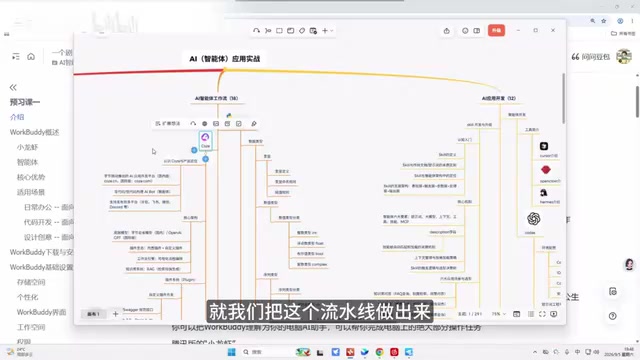
The keyword for stage two is "vibe coding"—using AI tools to complete software development. The logic is straightforward: for needs that existing products can't solve, build one yourself with AI. This layer corresponds to products like Coze workflows.
The instructor addressed the question of whether Coze is already outdated: being "outdated" applies to ordinary users—products like WorkBuddy that complete tasks with a single sentence are indeed more popular; but Coze is aimed at developers, letting you go from user to producer—turning industry experience into an assembly line where you input starting content, AI processes it step by step and returns results, and you can publish it for others to use.
On whether you can do development without knowing code, his answer is yes, but with limits: "AI lowers the floor, but it doesn't raise the ceiling." Programmers using AI for code development will always be stronger than non-programmers; likewise, finance professionals using AI for financial work will be stronger than outsiders. That's why the course covers Python basics—not to have you write programs from scratch, but to enable you to read AI-generated code, judge what it's doing, give adjustment instructions, and gradually approach the quality produced by real programmers. The course also covers server deployment so the software you build can actually be used by users.
Coze workflows is an AI agent development platform launched by ByteDance, where users visually drag and drop to connect large models, plugins, knowledge bases, and other nodes into automated processes. Unlike general assistants that "complete tasks in one sentence," workflows require developers to explicitly break down task steps and define each node's inputs and outputs—essentially writing programs in a graphical way. Its value lies in solidifying industry experience into reusable, distributable assembly lines: input raw materials, the process handles them step by step according to preset logic and returns results, and it can be published as a Bot for others to invoke. This also explains why it's aimed at developers rather than ordinary users—higher barrier to entry, but in exchange for controllability and transferability.
Vibe coding was proposed by former Tesla AI director Andrej Karpathy in early 2025, referring to developers describing intent in natural language and having AI generate code, with humans iterating mainly through running results and error feedback rather than writing line by line. Its core shift is turning programming from "writing syntax" into "reviewing intent"—the human role changes from coder to requirements describer and quality gatekeeper. This is exactly why the course emphasizes Python basics: reading AI-generated code, judging whether logic is correct, and giving precise correction instructions all require basic code reading ability. Vibe coding lowers the barrier to producing runnable programs, but code quality, architectural soundness, and security still depend on the user's judgment.
Stage Three: Engineering Practice
Stage three enters business scenario implementation with AI products like Codex, Cursor, and Claude, doing pure project practice. The instructor emphasizes that practice isn't only in stage three—every knowledge point earlier is paired with a practical application point, and stage three simply strings them into a complete project.
Cursor is an AI-native code editor built on VS Code, supporting codebase-level context understanding, multi-file collaborative editing, and natural language instruction refactoring; Codex originally referred to OpenAI's code generation model series and now also broadly refers to similar AI programming capabilities; Claude enters programming collaboration in terminals and IDEs through forms like Claude Code. What these tools share is deep embedding in the development environment, able to read the entire project rather than a single file, thereby completing cross-file modifications, debugging, and test generation. Compared to chat-style Q&A, they're closer to a "pair programming" experience. The course places them in the engineering stage because these tools handle real project complexity, requiring users to have requirements breakdown, code review, and version management skills.
Another Reading: Treating the Course as a "One-Person Company" Blueprint
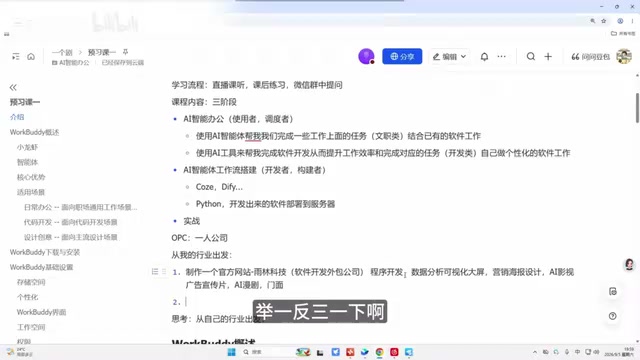
The instructor offers a second framework—the three stages together teach you how to run a "one-person company" (OPC). Using his own industry as an example: after completing stage one, first build an official website as a storefront, with company name and business, such as "Yulin Tech," offering program development, data analysis visualization dashboards, marketing poster design, AI film advertising videos, AI comic dramas, and other services. These require no upfront capital investment—one person with AI tools can complete them.
After receiving requests for CRM management systems or official website development, use tools like WorkBuddy and Codex to generate programs, with the person supervising and correcting until requirements are met, then deploy and deliver. He mentions that some users who saw content about "building a personal workbench with WorkBuddy" didn't know how to do it and came to him to write it for them, quoting 998 or 8188—such demand itself is a monetization path.
The Closed Loop of Operations, Marketing, and Delivery
Once the website is built, you need customers. Operations agents write technical knowledge, software development architecture, and other professional content into WeChat official account articles or Xiaohongshu posts; marketing agents rely on knowledge bases—first letting them know what products you offer and what your sales process and logic are, so they can introduce them to customers. The delivery phase continues with AI programming for software development, using AIGC products like Jimeng to create posters and comic dramas.
The instructor breaks this process into a replicable chain: AI tools handle operations and marketing, AI tools handle software development and delivery, and industry experience can be turned into workflows to sell on Taobao, Pinduoduo, and Xianyu—he mentions that many people are already selling their own skills and workflows. E-commerce practitioners can similarly develop agency operation programs, with "AI employees" handling WeChat official account operations and other work.
Boundaries Worth Noting
This path has two limitations that require clear awareness. First, the capability ceiling: non-programmers can build products with AI, but there's a gap compared to products from professional programmers—Python basics serve to narrow rather than eliminate this gap. Second, tool iteration: product forms like WorkBuddy, Coze, and Codex change quickly, and the truly transferable ability is "how to communicate requirements with AI and how to verify its output," not the button locations of any specific product.
The instructor ends with a thought question: starting from your own industry, how should this "one-person company" path be designed? The answer depends on what industry experience you have that can be converted into workflows or services—this is probably what such courses most want to convey.
One-line Summary
A three-stage AI agent path: from office user to workflow builder, then to one-person company deliverer.
Paragraph Summary
The article systematically breaks down the onboarding path for AI agent products like WorkBuddy, proposing a three-stage progressive capability framework: stage one uses AI to complete documents, data analysis, and communication management—equivalent to hiring yourself an assistant; stage two uses workflow platforms like Coze to go from user to builder, turning industry experience into reusable assembly lines; stage three uses tools like Codex and Cursor for engineering project practice. The author emphasizes that "AI lowers the floor rather than raising the ceiling," which is why the course supplements Python basics for reading and correcting AI-generated code. The article also offers a second interpretation of "one-person company": website as storefront, operations and marketing agents for customer acquisition, AI programming for delivery, AIGC for materials, and industry experience itself can be productized and sold.
Related articles

A 19-Year-Old's Rental Horror Story: Ceiling Collapse, Bug Infestation, and the Lessons It Taught Me
At 19, my first off-campus rental brought bug infestations, no heat, a collapsed ceiling, and a ruined laptop with no renter's insurance. Here are the hard-won lessons for first-time student renters.

Veda Nurse's Cranial Nerve Exam: Why ASMR Role-Play Is Going Viral
Bilibili creator Veda's cranial nerve exam ASMR video goes viral, blending humor and sensory triggers through nurse role-play. This article analyzes its unique appeal and the audience psychology behind ASMR role-play.

LG Cinebeam AI Review: 120-Inch Giant Screen + 3000 Lumens, a New Choice for the Living Room Theater
LG Cinebeam AI projector review: 3000 ANSI lumens, 4K, 100 inches from about 8 cm and 120 inches from about 18 cm. Built-in webOS, AI Concierge voice recommendations, AI Sound Pro 11.1.2 virtual surround, and Game Optimizer—positioned for fixed living room installation, complementing the portable Cinebeam S.