WorkBuddy Hands-On: How AI Agents Turn LLMs from "Giving Plans" to "Getting Things Done"

Given the same prompt, Doubao only drafts a plan while WorkBuddy executes it fully — revealing the AI Agent divide.
Using a demo by Bilibili creator Shanyao Laoshi, the article compares an ordinary LLM with an AI Agent on a batch Word-to-PDF task. Doubao quickly generates a full Python script but cannot touch local files, playing the "advisor" role; WorkBuddy, after user authorization, automatically scans directories and invokes tools, converting and archiving 4 documents in about 7 minutes for just 6.55 credits. The author attributes the gap to product positioning and architecture — Agents add planning, tool invocation, and execution loops atop reasoning. The article also notes WorkBuddy isn't a panacea: it suffices for simple tasks, while complex workflows need more advanced Agents, making task-complexity-to-tool capability matching the key choice.
From "Advisor" to "Executor": The Gap Revealed by a Batch Conversion Task
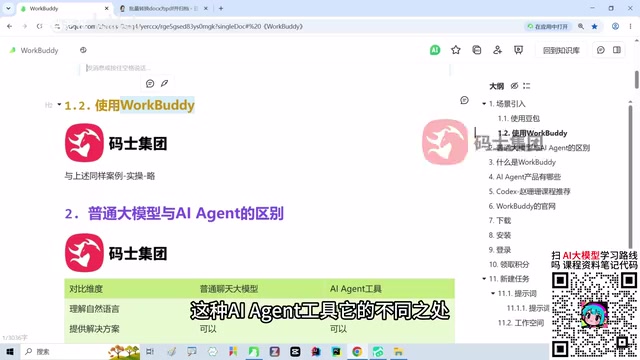
In an episode of her WorkBuddyAd course on Bilibili, creator Shanyao Laoshi used an everyday office scenario to contrast the fundamental difference between ordinary large-model products and AI Agent tools. The task itself wasn't complicated: batch-convert all Word documents in a local directory to PDF and archive them into a single folder.
She first handed this requirement to Doubao. Doubao responded quickly — streaming out a complete Python solution, including dependency installation steps, full code, and instructions for creating new files. The logic was clear and the steps were well-defined. But the problem was this: not a single file in the directory had been touched. Not one step of the conversion had been executed.
This isn't a flaw in Doubao's capabilities but a matter of product positioning. Ordinary large-model products have understanding and reasoning abilities — they can analyze problems and generate solutions — but they lack permission to operate the local file system. It's like an advisor sitting beside you: knows how to do it, can tell you every step, but in the end you're the one who has to get your hands dirty.

AI Agent is the key concept for understanding the difference in this article. A traditional large language model (like Doubao or ChatGPT) is essentially a "text-in, text-out" reasoning engine, and its capability boundary stops at generating content. An AI Agent, by contrast, is built on top of an LLM with an additional wrapper around four components: planning, tool invocation, memory, and execution — enabling it to interact with the environment and close the loop on a task. Specifically, an Agent first decomposes user intent into execution steps, then invokes external tools such as the file system, command line, and browser to carry them out step by step. If it hits an error, it can re-plan. In this article, Doubao produced a Python script but didn't execute it precisely because it is a "model" rather than an "Agent." WorkBuddy can automatically scan directories, invoke conversion tools, and archive results because it possesses a complete Agent execution pipeline. Only by understanding this distinction can one grasp why the same prompt produces completely different outcomes in the two products.
The Core Breakthrough of AI Agents: Beyond Understanding, They Must "Get Their Hands Dirty"
Pasting the same prompt into WorkBuddy produced an entirely different situation. The interface is much like tools such as Codex — enter the requirement, hit send, and WorkBuddy begins automatically scanning files in the target directory. The entire process requires no manual environment checks or command execution from the user; it handles file identification, environment assessment, batch conversion, and archiving on its own.
According to Shanyao Laoshi's demo, four Word documents were all converted to PDF and archived to the specified folder in about seven minutes. The converted files matched the original content, and previews worked normally. The entire task consumed 6.55 credits, and since WorkBuddy gifts 2,000 credits on first login, the cost of completing this kind of batch operation is nearly negligible.
More noteworthy is the self-healing capability during execution. When WorkBuddy encounters a missing environment, it attempts to install dependencies; when a step fails, it re-captures the exception and adjusts its strategy. From answering questions to executing tasks, from offering suggestions to delivering results — this is the watershed between AI Agents and traditional large-model products.

Authorization and Credits: How WorkBuddy Operates
The prerequisite for WorkBuddy to operate local files is that the user grants it default permissions. Once authorized, it can access specified directories, find DOC/DOCX files, and invoke system tools to complete format conversion. This is fundamentally different from purely cloud-based large-model services — an Agent runs in the user's local environment, directly manipulating files and the command line.
Regarding credit consumption, tasks of different complexity correspond to different credit expenditures. The batch conversion task in the demo consumed 6.55 credits, and the creator mentioned that referring a new user to register earns a 650-credit reward — which explains why a flood of WorkBuddy referral forwards appeared in WeChat Moments.

Local permission authorization is the technical prerequisite for whether an Agent-type tool can "get its hands dirty." Purely cloud-based services like Doubao run on the vendor's servers and physically cannot access the user's hard drive. WorkBuddy, by contrast, runs as a client on the user's computer and can request system permissions such as file read/write and process invocation just like an ordinary program. When a user grants default permissions on first use, it's equivalent to issuing the Agent an "operating pass" — only then can it access specified directories, find DOC/DOCX files, and invoke system conversion components. It should be emphasized that this kind of authorization also brings security considerations: the scope of permissions an Agent receives directly determines which data it can touch, so the industry generally recommends explicitly excluding sensitive directories. The permission model and credit model together constitute the operating boundary of an Agent product — the former determines "can it be done," the latter determines "is it worth doing."
Not a Panacea: The Applicable Boundaries of AI Agents
Shanyao Laoshi clearly pointed out an easily overlooked fact in her course: WorkBuddy is not the only AI Agent product, nor is it the optimal solution for every scenario.
If your work scenarios are relatively simple — file format conversion, batch renaming, simple archiving and organization — a tool like WorkBuddy is more than sufficient, with a low learning curve. But when the workflow involves more complex multi-step collaboration, cross-system operations, or domain-specific logic, you may need to consider more advanced AI Agent products.
This layered awareness matters. Public evaluations of WorkBuddy are polarized: some regard it as an efficiency godsend, others say it can't solve complex problems. Both claims are correct — the key lies in matching task complexity with tool capability.
In the video, the creator quoted an observation from WeChat Moments: "Refer it to another person, and after they use it, you get 650 credits" — indirectly reflecting that WorkBuddy's usage rate is already climbing rapidly.
Task complexity stratification is a frequently overlooked dimension when evaluating Agent products. The industry typically divides automation tasks into three tiers. Tier one is single-step deterministic operations (format conversion, batch renaming) with clear rules and high fault tolerance, which a general-purpose Agent can handle. Tier two is multi-step orchestration (cross-application data sync, conditional branching) requiring the Agent to have strong planning and exception-recovery capabilities. Tier three is complex cross-system, cross-domain workflows (such as enterprise-level RPA or R&D pipelines), which often require dedicated orchestration platforms or custom Agents. WorkBuddy performed excellently in the demo, placing it between tier one and tier two. This also explains why market evaluations are polarized — those who measure it by simple tasks find it a godsend; those who measure it by complex tasks find it insufficient. The key to judging whether an Agent suits you isn't whether it's "powerful," but which tier your tasks fall into.
The Essence of AI Agents: From "Answering Questions" to "Delivering Results"
Back to that batch conversion scenario. Doubao produced a Python script; WorkBuddy directly produced four PDF files. The former tests the user's execution capability; the latter tests the Agent's task understanding and tool-invocation capabilities.
This difference may not seem significant, but it compounds continuously in daily work. Every time a similar task arises, an ordinary large-model user must go through the cycle of "understanding the solution → configuring manually → executing the script → checking results," while an Agent user only needs to describe the requirement, authorize, and wait for the result. What's saved isn't just time, but cognitive load.
WorkBuddy can do far more than format conversion. According to the description in the demo, it connects to the local file system, the command line, and various tools, and in theory can handle any task combination requiring "understanding requirements + operating a computer." This is where AI Agents truly excite — they aren't just smarter chatbots but digital assistants that can actually get things done.
Of course, there's still a long way to go from "can do things" to "can do complex things well." The direction WorkBuddy represents is certain: large models are moving from the information-output end toward the task-execution end — and 2026 may be the year this shift accelerates.
Related articles

How Big Can Stars Really Get? The Physical Limits of the Largest Stars
Red supergiants are the largest stars by volume, with radii up to 2,000 times the Sun, engulfing the inner solar system. But there is no precise upper limit on stellar size—models predict up to 15,000 solar radii. The most massive blue stars are far smaller than red supergiants—biggest and heaviest are two different things.

Apple HomeView Smart Display Full Feature Breakdown: Wall-Mount or Desktop, $299
Apple launches HomeView, a $299 smart display with wall-mount and desktop options, 12MP camera for facial recognition, smart home control, music playback, and recipe step-by-step cooking. Full breakdown of watch faces, apps, privacy, and cooking integration.

Where Did the Promised New Studio Go? Craft Computing Answers After Five Years
Craft Computing's host responds to viewer questions: the new studio promised five years ago was shelved as construction costs soared from $30,000 to $75,000, and was replaced by a 168-square-foot garage conversion.