WorkBuddy in Action: How AI Agents Achieve Office Automation

WorkBuddy as an AI Agent directly executes tasks, demonstrating its essential difference from LLMs via a batch Word-to-PDF case.
The article uses Bilibili creator Ms. Shanyao's hands-on test to compare Doubao and WorkBuddy on the same batch Word-to-PDF task. Doubao only produced a Python script without touching the files; WorkBuddy automatically scanned, checked the environment, installed dependencies, converted and archived 4 PDFs in ~7 minutes for ~6.55 credits, with 2,000 free credits for new users. It highlights the core difference: LLMs stop at generating solutions, while Agents extend to tool calls, file operations, and delivering results with self-correction—though WorkBuddy isn't universal for complex workflows.
From LLMs to AI Agents: WorkBuddy's Positioning
Over the past two years, LLM products like Doubao, DeepSeekAd, and ChatGPT have become deeply integrated into daily work and study. They excel at understanding requirements, generating solutions, and can even write complete Python scripts. But a fundamental limitation has always persisted: they only provide answers, they don't take action.
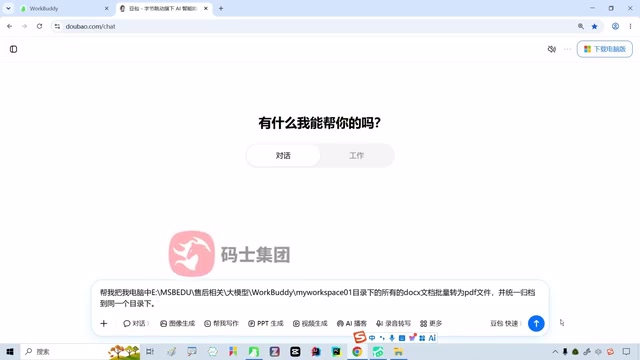
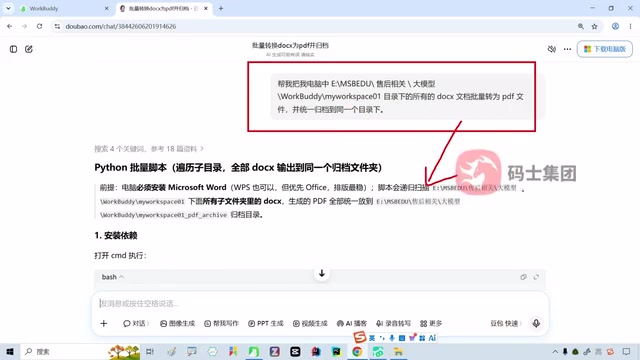
Bilibili creator Ms. Shanyao illustrated this pain point with a real-world scenario. She had a batch of Word documents stored in a directory on her local E drive and wanted to batch-convert them to PDF and archive them together. After sending her request to Doubao, it quickly provided a complete Python script, complete with helpful annotations like "step one: install dependencies, step two: run the code." But the files in the directory remained untouched—Doubao played the role of a consultant. The plan was there, but execution was still up to the user: install the environment, adjust the paths, run the script—not a single step could be skipped.
This is precisely where AI Agents come in. As an AI Agent tool, WorkBuddyAd not only possesses the understanding and reasoning capabilities of an LLM, but also connects to the local file system, command line, and various tools, turning solutions directly into actual results.
LLMs, AI Agents, and tool calling are three concepts often used interchangeably, but they operate at different levels. An LLM (Large Language Model) refers to a neural network trained on massive corpora with language understanding and generation capabilities, whose output takes the form of text; its capability boundary stops at "generation"—it cannot directly read or write local files or run programs. An AI Agent, on the other hand, is an execution framework wrapped around an LLM, typically composed of a planning module, a memory module, and a tool-calling module: the planning module breaks down user goals into steps, the memory module preserves intermediate states, and the tool-calling module accesses the file system, terminal commands, browsers, or third-party APIs through predefined interfaces. So-called "tool calling" (Function Calling / Tool Use) refers to the model outputting a function name and parameters in an agreed-upon structured format, which an external program actually executes and returns results for, feeding them back to the model for continued reasoning. It is precisely this mechanism that allows Agents to "think while doing" in multi-turn loops, translating language capabilities into operations on the real environment.
Hands-On Demo: Full Batch Word-to-PDF Workflow
Ms. Shanyao pasted the same request—"batch-convert all DOC and DOCX documents in the specified directory to PDF and archive them into the same folder"—into WorkBuddy's input box, clicked send, and authorized access. What followed stood in stark contrast to Doubao.
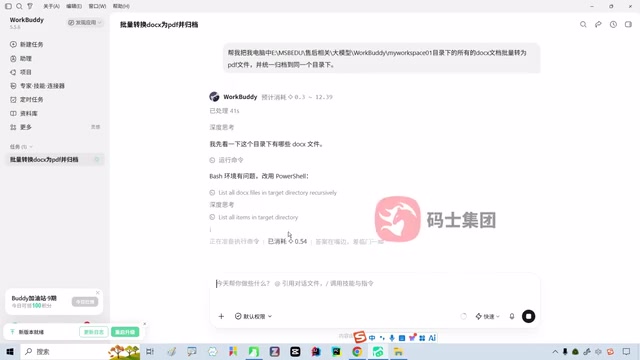
WorkBuddy first automatically scanned the target directory, listed the file inventory, and checked the runtime environment. Throughout the process, the interface displayed task progress and credit consumption in real time. According to the video demo, the initial consumption was 0.42 credits, increasing gradually as the task progressed. While waiting, the creator joked, "Go play on your phone, scroll Douyin for a bit"—this detail precisely illustrates that the Agent autonomously executes tasks in the background, and the user only needs to wait for results.
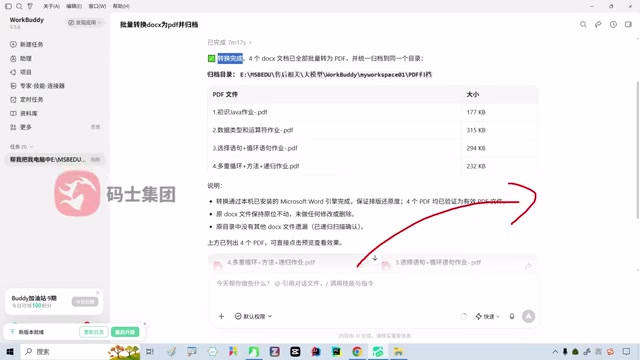
About seven minutes later, all four PDF files were generated and archived, and WorkBuddy also provided a preview feature. The entire process consumed approximately 6.55 credits, while new users receive 2,000 credits upon registration—enough to complete a large number of similar tasks. Ms. Shanyao verified that the generated PDFs matched the content of the original documents, confirming the conversion was accurate.
The Core Difference Between AI Agents and LLMs
This comparative experiment clearly revealed the essential difference between the two types of tools. The workflow of an ordinary LLM product is "understand the question → analyze → generate a solution," whereas the AI Agent's chain extends to "understand the task → enter the work environment → call tools → operate on files → check results → deliver the finished product."
Specifically in WorkBuddy's performance, it demonstrated several noteworthy capabilities during execution: when it detected missing dependencies in the environment, it would proactively install them; when a step failed, it would attempt to recapture and handle it. This self-correction capability means users don't need to pre-configure the environment—the Agent resolves execution-level obstacles on its own.
Ms. Shanyao summed it up bluntly in the video: the essence of Agent tools like WorkBuddy is a shift from "answering questions" to "executing tasks," and from "giving suggestions" to "delivering results." For office scenarios with clear operations and fixed workflows like Word-to-PDF conversion, the Agent's advantages are particularly prominent—users only need to describe their needs in natural language, and leave the rest to it.
Self-correction and environment adaptation are what distinguish Agents from scripts. Traditional batch conversion scripts require the runtime environment to meet conditions in advance—Python installed, python-docx and docx2pdf (or LibreOffice) already installed, path parameters correctly filled in. If any link is missing, it will directly error out and exit. The Agent's difference is that it treats error messages as new input: when a command returns "ModuleNotFoundError," it infers that a dependency is missing and calls the package manager to install it; when a path doesn't exist, it re-scans the directory structure and corrects the parameters; when a file conversion fails, it retries individually or switches to a fallback approach. This "observe—judge—adjust" loop is essentially a repeated interaction between the LLM's reasoning capabilities and the tool's returned results. The practical benefit it brings is: users no longer need to worry about environment configuration, version conflicts, and path details—they only need to describe the goal. The trade-off is longer execution time and a certain degree of uncertainty in results, which means human verification steps should be retained.
Cost and Use Case Analysis
WorkBuddy uses a credit system, consuming about 6.55 credits for a single batch document conversion. New users receive 2,000 credits, which at this consumption rate can support hundreds of similar tasks. The video also mentions that referring new users earns approximately 650 credits in rewards—this mechanism also explains why more and more people are sharing referrals on social media.
However, Ms. Shanyao also honestly pointed out a key limitation: WorkBuddy is not a universal solution. If your work scenario involves complex workflow orchestration, deep multi-system integration, or highly customized automation needs, WorkBuddy may fall short, and you may need to consider more specialized AI Agent products. The logic of tool selection is always matching by need—for simple, repetitive document processing and file management tasks, WorkBuddy is more than sufficient; complex business scenarios require evaluating stronger solutions.
From a broader perspective, WorkBuddy represents a category of product form that is rapidly iterating. The creator mentioned in the video that this tool "gets updated every few days," with interface and features changing frequently. This shows both that competition in this space is fierce and that users need to stay attentive and adapt to new versions in a timely manner. For ordinary office users, now is a great time to explore and try AI Agent tools—starting from a specific, low-risk scenario to experience the upgrade from "conversation" to "execution."
One-line Summary
WorkBuddy as an AI Agent can directly execute tasks, demonstrating its essential difference from LLMs through a batch Word-to-PDF case study.
Paragraph Summary
Based on Bilibili creator Ms. Shanyao's hands-on test, the article compares the performance differences between LLM product Doubao and AI Agent tool WorkBuddy on the same batch Word-to-PDF request. Doubao only output a Python script while files remained untouched; WorkBuddy, after authorization, automatically scanned the directory, checked the environment, installed missing dependencies, executed conversions, and archived results—generating 4 PDFs in about 7 minutes, consuming roughly 6.55 credits, with the 2,000 credits gifted to new users supporting hundreds of similar tasks. The article distills the core difference between the two types of tools: the LLM's chain stops at "generating a solution," while the Agent's chain extends to "calling tools—operating on files—delivering the finished product," with self-correction capabilities. It also notes that WorkBuddy is not universal—complex workflow orchestration and multi-system integration still require more specialized solutions, and tool selection should follow the logic of matching by need.
Related articles

Chain of Thought Isn't Just for AI: How Humans Can Use CoT to Improve Thinking Quality
Chain of Thought isn't just a prompt trick for large models. Starting from a Hacker News discussion, this article analyzes why CoT works for human thinking too, breaks down actionable ways to transfer it, and highlights the key differences between human CoT and machine CoT.
Cloudflare Teams Up with OpenAI: Closi…
Cloudflare Teams Up with OpenAI: Closing the Loop from Vulnerability Discovery to Defense with AI
Cloudflare uses OpenAI Daybreak to investigate security vulnerabilities and generate reviewable remediation plans, while developers use Codex to boost coding efficiency and quality.

Orca Multi-Agent Orchestration in Practice: A Guide to Parallel Collaboration with Claude and Codex
Orca is Stable AI's free open-source agent workbench supporting 34 agents like Claude Code and Codex in parallel. Learn its Git worktree isolation, multi-model orchestration, and mobile management.