WorkBuddy Spoon-Feeding Tutorial: A Beginner's Guide to Agent Development

Breaking down the course structure and applicability of Bilibili creator's WorkBuddy zero-foundation Agent development tutorial.
Based on public information about the WorkBuddy zero-foundation Agent development tutorial released by Bilibili creator "Mingjing and Diandian," this article breaks down its course framework and teaching approach. After a month of research, the creator found that most Agent tutorials "don't explain things thoroughly," so he spent three months producing this course using a three-part structure of Fundamentals, Advanced, and Practical Application plus a bonus section: Fundamentals teaches environment setup step by step, Advanced covers RAG, knowledge base construction, and intelligent retrieval, Practical connects the knowledge to complete a first Agent project, and the bonus section includes a mind map and hundreds of GB of materials. The article concludes that the course provides a clear learning path reference for zero-foundation learners, but the actual teaching quality, completeness of code demonstrations, and quality of the resource pack still need to be verified by learners themselves, and it reminds readers that "knowledge monetization" is promotional messaging.
WorkBuddy Spoon-Feeding Tutorial: A Beginner's Guide to Agent Development
Bilibili creator "Mingjing and Diandian" has released what it bills as "the most complete on Bilibili" introductory WorkBuddyAd Agent development course, branded with the tags "spoon-feeding level," "zero foundation," and "from beginner to mastery," and claims to consolidate all the core knowledge points of AI Agents. Is this course worth the time of zero-foundation learners? How is its content structured? Based on publicly available video information, this article breaks down its course framework and teaching approach, offering a reference for readers who want to get started with Agent development.
Course Positioning: Filling the Gap of Tutorials That "Don't Explain It Thoroughly"
According to the creator's introduction at the start of the video, before preparing the course he completely emptied his mind from the perspective of an "AI Agent newbie" and spent a month browsing AI Agent tutorials across numerous websites. His conclusion: most tutorials "neither explain things properly nor carefully." This became the starting point for the course—to create systematic content that zero-foundation beginners can easily understand while also being able to follow along with hands-on practice.
This pain-point assessment is not unfounded. Public tutorials in the Agent development space do indeed suffer from polarization: either they lean toward conceptual popular science without runnable code, or they throw out engineering-grade projects that assume readers already have a programming background. The creator tries to find a balance between the two, lowering the barrier with "vivid and engaging explanations plus hands-on case demonstrations." The entire course took three months to complete, and the creator emphasizes that its goal is to "frantically output knowledge points every single second," enabling learners to improve their Agent skills through actual practice and ultimately monetize what they learn.
Three-Part Course Structure: A Progressive Design from Fundamentals to Practice
The course is divided into three parts—Fundamentals, Advanced, and Practical Application—plus a bonus section. This "fundamentals—advanced—practice" three-stage structure is fairly common in programming tutorials, but the creator has drawn clear boundaries for the content of each stage.

Fundamentals: Environment Setup and Basic Applications
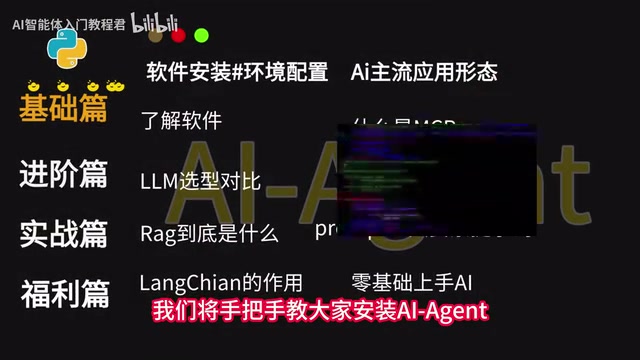
The core task of the Fundamentals section is to "teach everyone step by step how to install AI Agent" and to learn the basic applications of Agents. For zero-foundation learners, environment configuration is often the first stumbling block they encounter, so placing it at the very front of the course and presenting it in a step-by-step manner fits the actual pace of beginner learning.
Advanced: RAG and Agent Hands-On Training
The Advanced section covers RAG (Retrieval-Augmented Generation), knowledge base construction, intelligent retrieval, Agent hands-on training, and large model applications. RAG is currently a high-frequency scenario for Agent deployment, and including it in the advanced stage shows that the course doesn't stop at "getting a demo to run" but attempts to cover an Agent's ability to retrieve and invoke knowledge in real business contexts.
RAG (Retrieval-Augmented Generation) is a technical architecture that combines an external knowledge base with a large language model: when a user asks a question, the system first retrieves the document fragments most relevant to the question from the knowledge base, then splices these fragments as context into the prompt and hands them to the large model to generate an answer. Its core value lies in mitigating the problems of "outdated knowledge" and "making things up (hallucination)" in large models, allowing the model to answer based on private data in a specific domain without retraining the model. The typical RAG process includes several steps: document chunking, vector embedding, vector database storage, similarity retrieval, and context injection. Among these, "vector embedding" refers to using an embedding model to convert text into high-dimensional vectors so that semantically similar content is closer together in vector space, thereby enabling retrieval by semantics rather than keywords. For Agent development, RAG gives Agents the ability to invoke external knowledge and is a high-frequency solution for building enterprise-level Q&A, document assistants, and similar applications.
AI Agent refers to a software system that uses a large language model as its "brain" and is capable of autonomously perceiving tasks, planning steps, invoking tools, and iterating execution until a goal is completed. Unlike single-turn Q&A chatbots, Agents typically have several key components: a model core responsible for reasoning and decision-making, a set of callable tools (such as search, code execution, and database queries), a memory mechanism (storing conversation history and intermediate results), and task planning and reflection capabilities. Common implementation paradigms include ReAct (alternating reasoning and action) and Plan-and-Execute (plan first, then execute). Understanding these components helps grasp the role of each part in the "first intelligent Agent project" of the course's practical section: environment setup is for connecting models and tools, while the RAG in the Advanced section serves as the Agent's knowledge retrieval tool.
Practical Application: From Environment Setup to Your First Intelligent Agent Project
The positioning of the Practical section is to "take you step by step from environment setup to getting started with your first intelligent Agent project." From the description, this stage walks through the entire project process, connecting the knowledge points from the first two parts.
Bonus Section: Mind Maps and Learning Resource Packs
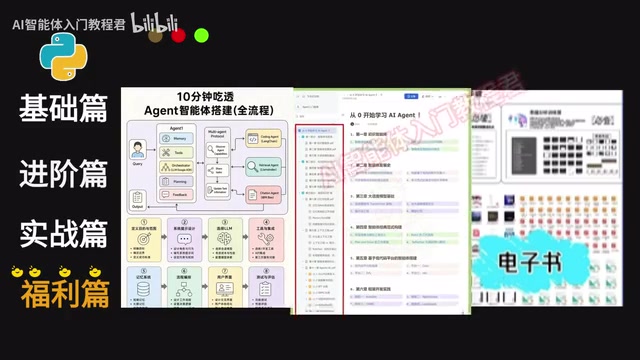
At the end of the course, bonus resources are included: an introductory mind map, a learning resource pack, hundreds of GB of materials, e-books, videos, and more.
Who This Course Is For, and What to Watch Out For
Based on public information, the target audience for this course is very clear: learners with no programming background who want a systematic introduction to Agent development. The three-part structure plus the step-by-step installation segment does indeed lower the entry barrier. The creator's repeated emphasis on combining "zero-foundation easy understanding" with "keeping up with hands-on practice" also shows that the course design considers the balance between theory and practice.
However, based solely on the introduction at the start of the video, it's not yet possible to judge the actual teaching quality. A few points learners should verify for themselves while watching include: whether the RAG and Agent practical sections include complete code demonstrations, whether the project cases are reusable, and the actual quality and update status of the content in the "hundreds of GB resource pack." In addition, the "knowledge monetization" mentioned in the video is part of the course's promotional messaging; learners should still prioritize mastering runnable technical skills.
For zero-foundation readers who want to get started with Agent development, this course offers a clearly structured learning path reference: first tackle the environment and basic concepts, then move into core capabilities like RAG, and finally connect the knowledge through a complete project. Even if you don't follow this course, this progressive order itself is worth borrowing.
One-line Summary
Breaking down the course structure and applicability of Bilibili creator's WorkBuddy zero-foundation Agent development tutorial.
Paragraph Summary
Based on public information about the WorkBuddy zero-foundation Agent development tutorial released by Bilibili creator "Mingjing and Diandian," this article breaks down its course framework and teaching approach. After a month of research, the creator found that most Agent tutorials "don't explain things thoroughly," so he spent three months producing this course using a three-part structure of Fundamentals, Advanced, and Practical Application plus a bonus section: Fundamentals teaches environment setup step by step, Advanced covers RAG, knowledge base construction, and intelligent retrieval, Practical connects the knowledge to complete a first Agent project, and the bonus section includes a mind map and hundreds of GB of materials. The article concludes that the course provides a clear learning path reference for zero-foundation learners, but the actual teaching quality, completeness of code demonstrations, and quality of the resource pack still need to be verified by learners themselves, and it reminds readers that "knowledge monetization" is promotional messaging.
Related articles

Zero-Cost Local Jarvis: Open-Source Voice Cloning and Task Automation in Practice
AI Workshop shows how to build a zero-cost local Jarvis with Ollama and Voice Studio: local model switching, open-source voice cloning, file retrieval, and tool-calling tests, with setup steps and hardware trade-offs.

Mistral Large 4 Released: 1T-Parameter MoE Tops Western Open-Source Leaderboard
Mistral releases its flagship Mistral Large 4: a 1T-parameter MoE architecture activating only 49B parameters at inference, trained from scratch on 3,800 Grace Blackwell GPUs, topping the Western open-weight leaderboard with third-party endorsements in law, finance, and cybersecurity.

Mistral Large 4 Review: Can Europe's Strongest Open-Source Model Challenge the US and China?
Mistral Large 4 (L-Charm) review: trillion-parameter MoE, standout cybersecurity benchmarks but behind Kimi K3 in software engineering, 3,800 GPUs, a key step for European sovereign AI.