WorkBuddy Step-by-Step Guide: Build Your Own AI Agent Work Assistant

AI Agents upgrade large models from "giving solutions" to "doing the work for you."
The article starts from the limitation that chat large models like Doubao and DeepSeek "have only brains, no hands or feet," using a batch docx-to-PDF scenario to show that chat models can only provide Python code and steps, unable to read local files, invoke software, or execute commands. AI Agent tools like WorkBuddy shift the interaction chain from "human execution" to "Agent execution": users describe goals in natural language, and the Agent reads directories, converts files, and archives them. It's friendly to non-technical users and suits professionals, developers, and light-automation users alike; the learning focus is developing "Agent thinking"—breaking tasks into instructions an Agent can understand.
Why Do You Need an AI Agent Work Assistant?
Many people are already used to relying on large model tools like Doubao, DeepSeekAd, and Tongyi Qianwen to solve everyday problems. They're genuinely smart—they can understand requirements and propose solutions. But they share one fundamental limitation: they have brains but no hands or feet.
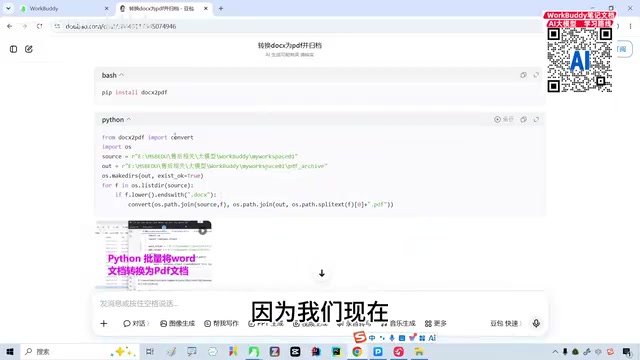
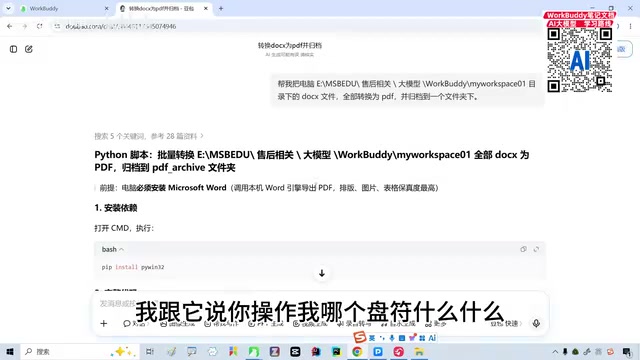
The video's author illustrates this with a very concrete scenario. He has a folder full of .docx documents and wants to batch-convert them to PDF and archive them in a designated directory. He copies the directory path to Doubao and states the full requirement. How does Doubao perform? It accurately understands the request and even provides a Python script and detailed execution steps.
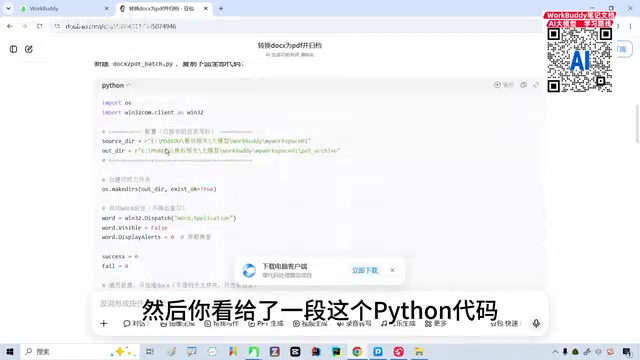
The problem is that Doubao gives you an "operating manual," not an "operation result." For users unfamiliar with Python, installing dependencies and running scripts is itself a barrier. More importantly, it can't directly read files on your computer, can't invoke local software, and can't run the commands for you.
This is the core problem that AI Agent tools like WorkBuddyAd are built to solve: not only understand your requirements, but also directly operate your file system, execute commands, invoke software, and ultimately deliver the results to you.
The core difference between a large language model (LLM) and an AI Agent lies in whether it has "action capability." An LLM is essentially a probabilistic model trained on massive text; it takes a prompt and outputs text, running entirely on cloud servers, with no access to the user's local file system, clipboard, installed software, or OS commands. An AI Agent layers a "tool invocation + task planning" framework on top of an LLM: the model first decomposes the goal, decides which tool to call (read/write files, execute shell commands, call APIs), then decides the next action based on the tool's returned results, looping until the task is complete. Therefore, an Agent's capability ceiling depends not only on how smart the underlying model is, but even more on which tool permissions it has been granted. This is also why, for the same instruction "convert docx to PDF," a chat model can only reply with code, while an Agent can directly produce the files.
What Is WorkBuddy: From "Chat Assistant" to "Execution Assistant"
WorkBuddy's positioning can be summed up in one sentence: an AI Agent that can actually get work done on your computer.
The difference from traditional chat large models lies in the boundary of capability. A chat model's capability stops at "generating text," while an Agent's capability extends to "executing actions." Tell it "convert all the docx files in this directory to PDF," and it won't give you code to run yourself—it will directly read the directory, perform the conversion, and output the results.
This difference sounds simple, but the resulting experience gap is qualitative. In the video author's own words, "once you use it, it just feels smooth"—the smoothness doesn't come from the model being smarter, but from the interaction chain shifting from "human execution" to "Agent execution." You only need to describe the goal; the intermediate steps are handled by the Agent.
It's worth noting that the author emphasizes this tool is equally friendly to non-technical people. You don't need to know Python, don't need to configure an environment, and don't need to memorize command-line arguments. Being able to describe your requirements in natural language is enough.
What is an "Agent execution chain": A complete Agent task typically consists of four stages—perception (reading directories, parsing files), planning (breaking "batch convert and archive" into sub-steps like enumerating files, converting each one, and moving them to the target directory), execution (invoking local tools or scripts), and verification (confirming the output files exist and are correctly formatted). The biggest difference from traditional scripts is that this chain is dynamically generated by the model at runtime rather than hard-coded in advance, so it can handle users' ad-hoc changes to requirements. Correspondingly, its risks come from the same place: the Agent has real file and command permissions, so accidental deletion, overwriting, or command execution can all happen. In practice, it's recommended to operate in an isolated working directory, back up important files first, and prioritize tools that support operation confirmation or permission sandboxing.
Hands-On Scenario: Batch File Format Conversion
Returning to the docx-to-PDF requirement from the beginning, the workflow with WorkBuddy goes roughly like this:
- Open WorkBuddy and point it to the target folder (my workspace)
- Describe the task in natural language: "Convert all the docx files in this directory to PDF and archive them into a folder"
- The Agent automatically reads the file list, performs the conversion, and organizes the output
Compared with traditional methods, what does this workflow eliminate? It eliminates the hassle of paying for a WPS membership, the step of finding an online conversion tool, and the barrier of writing scripts and resolving dependencies. For ordinary users who occasionally need to handle such tasks, the time cost and mental burden saved are considerable.
The author also mentions a detail in the video: he built a check-in workstation for his child that runs on a phone. This shows that WorkBuddy's use cases aren't limited to office file processing—any task with "clear rules and repetitive operations" can be delegated to an Agent.
The technical principle of docx-to-PDF conversion: A .docx file is essentially a compressed package containing XML that records text, styles, and layout descriptions; PDF is a fixed-layout page description format. The conversion process requires a rendering engine to recalculate pagination, fonts, and graphic positions according to the layout rules in the docx, so conversion quality depends heavily on how well the engine is compatible with Word's layout features—complex tables, comments, and special fonts may deviate. Common implementation paths include calling LibreOffice in headless mode (soffice --headless --convert-to pdf), using python-docx with reportlab for custom rendering, or invoking installed Office via the COM interface on Windows. Understanding this helps judge whether the conversion results produced by the Agent are reliable: if the document layout is complex, manual spot-checking is still needed after conversion.
Who Is WorkBuddy For?
The author emphasizes right at the start that this topic is suitable "whether you're a technical person or a non-technical person." Based on the video content, several typical user groups can be identified:
- Non-technical professionals: Need to handle batch files, format conversion, and organizing/archiving, but don't want to learn programming
- Developers: Delegate repetitive local operations to an Agent to reduce manual execution time
- Ordinary users with light automation needs: Such as family check-ins, daily reminders, and simple workflow orchestration
The core criterion is actually simple: if your daily work includes tasks that are "clear to describe but tedious to do manually," then WorkBuddy is worth a try.
From Tutorial to Implementation: Build Your Own Agent
This video is positioned as a "step-by-step tutorial," meaning it covers the complete path from getting started to hands-on practice. From what's already available, the focus of learning isn't on mastering some complex tech stack, but on developing Agent thinking—learning to break tasks down into instructions an Agent can understand, and learning to judge which tasks are suitable to hand over to an Agent.
The author himself is the best example: right after finishing the lesson, he immediately built a personal workstation. This "learn it and use it" path is precisely the greatest value of Agent-type tools—the barrier is low enough that after one lesson you can start building something of your own.
If you've only used chat models like Doubao and DeepSeek before, you might treat WorkBuddy as an attempt at a capability upgrade. Once you cross the step from "asking it how to do it" to "letting it do it for you," many everyday chores become much easier to handle.
One-line Summary
AI Agents upgrade large models from "giving solutions" to "directly doing the work for you."
Paragraph Summary
The article starts from the limitation of chat large models like Doubao and DeepSeek—that they "have only brains, no hands or feet"—and uses a concrete scenario of batch-converting docx to PDF to show that chat models can only provide Python code and operating steps, and cannot read local files, invoke software, or execute commands, leaving a high barrier for non-technical users. The value of AI Agent tools like WorkBuddy lies in shifting the interaction chain from "human execution" to "Agent execution"—users only need to describe goals in natural language, and the Agent handles reading directories, completing conversions, and archiving. The author emphasizes that the tool is equally friendly to non-technical people, requiring no Python knowledge or environment configuration; it suits non-technical professionals, developers, and ordinary users with light automation needs, and the learning focus is developing "Agent thinking"—the ability to break tasks down into instructions an Agent can understand.
Related articles

After the Right to Vote Was Lost: The Hidden Costs to American Democracy
Exploring how restrictive state voting laws, Supreme Court erosion of the Voting Rights Act, and partisan gerrymandering affect voter participation and fair representation after Democrats failed to pass the John Lewis Voting Rights Advancement Act and the Freedom to Vote Act.

Two Critical PHP Vulnerabilities Nearly Took Down the Internet: A Warning About the Fragility of the Web's Foundation
Two critical PHP vulnerabilities nearly shook the entire internet. This article analyzes why PHP vulnerabilities have such strong leverage effects, what real-world obstacles the patch chain faces, and what lessons infrastructure-level software security governance offers.
Musk Sounds the Alarm for Europe: A Wa…
Musk Sounds the Alarm for Europe: A Wave of US Tech Replacement Is Coming
Steve Blank's blog post sparks Hacker News debate: Musk's actions are prompting Europe to reconsider its reliance on US technology. This article sorts through the core arguments, the feasibility and divisions over replacing the US tech stack, and the practical impact on developers' technology choices.