WorkBuddy Step-by-Step Tutorial: Build an AI Agent Workflow from Scratch
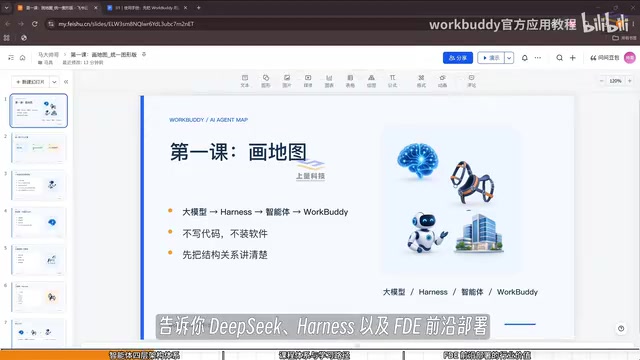
A concept map explaining large models, Harness, agents, and FDE, plus a hands-on WorkBuddy path to monetization.
The article introduces Bilibili creator "Hailang's" WorkBuddy course, mapping AI applications into four layers: large models, the Harness engineering control layer (context management, tool calling, task loops, permission control), multi-agent platforms like WorkBuddy, and FDE engineers who handle the last mile. WorkBuddy is positioned as a "domestic alternative to Codex" desktop agent workbench that directly controls a computer to handle files, data, and documents. The creator also shares a four-step monetization path, a 28-point, ten-lesson course system, and notes that FDE roles are in high demand with strong salaries.
In today's world of endless AI tools, one core question keeps puzzling ordinary users: how do you get large models to actually "do the work" instead of just chatting? Bilibili creator "Hailang" (海浪) attempts to answer this with the WorkBuddy course series. Using a single "concept map," he connects large models, Harness, agents, the WorkBuddy platform, and FDE engineers, offering beginners a clear path from understanding to hands-on practice.
Four Concepts, One Map
The course doesn't rush into operations. Instead, it starts by clarifying a four-layer structure. At the very bottom is the large model, responsible for language understanding, logical reasoning, and content generation—DeepSeekAd and ChatGPT belong to this layer. But a large model is like a wild horse: untamed, it can't be ridden.
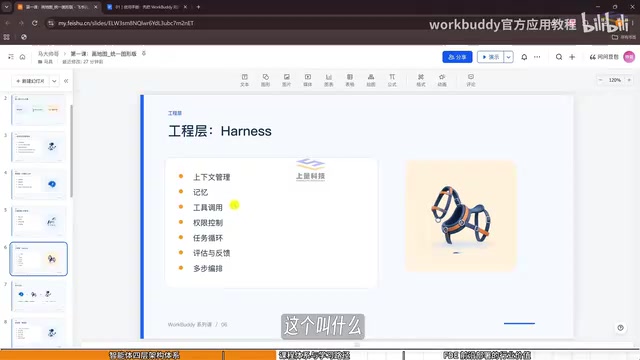
The second layer is the Harness (literally "tack"), the engineering control layer. The creator uses a vivid metaphor: only by fitting a horse with a saddle, reins, and whip can it travel a thousand miles a day. In AI terms, context management and memory, tool calling (Skill), task loops, and permission control all fall under the Harness. Once a large model is fitted with this "tack," it becomes an agent that can reliably get work done.
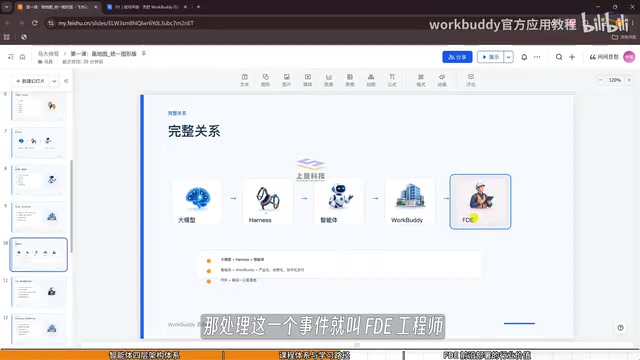
The third layer is an agent platform like WorkBuddy. It's no longer a lone fighter but integrates many agents collaborating to solve complex problems—the equivalent of "large-scale combined operations." The fourth layer is the FDE (Forward Deployed Engineer), responsible for bridging the "last mile" from large models to real business deployment.
Harness comes from equestrianism, originally referring to horse tack (saddle, bridle, stirrups, etc.). In AI engineering, it refers to the control and execution framework wrapped around a large model. It doesn't change the model's parameters but constrains and guides its behavior through external mechanisms: context management determines what information the model "sees," memory mechanisms preserve information across turns, tool calling (Skill) converts the model's language output into actual operations on files, APIs, and software, task loops let the model repeatedly plan and correct based on execution results, and permission control limits the resources it can touch. What the industry often calls agent frameworks (like LangChain and AutoGPT) are essentially concrete implementations of the Harness. Understanding this layer is key to distinguishing a "chatbot" from an agent that "gets work done."
What Can WorkBuddy Do?
The creator positions WorkBuddy as a "domestic alternative to Codex"—a desktop-level AI agent workbench. Its features: simple setup, low device requirements, a free tier, and compatibility with commonly used domestic office software. Unlike ordinary large models that only offer ideas, WorkBuddy can directly control a computer to complete tasks: breaking down tasks, handling files, organizing data, and generating documents, all executed automatically. Poster design, video editing, e-commerce ads, and more can all be handed off to it.
A Four-Step Path to Monetization
The creator shares his own hands-on experience: five orders in three days, earning 600 yuan. Not a big sum, but each monetization path is clear enough. He distills it into four steps: first, learn the basic operations; second, complete one full case end to end; third, build a portfolio; fourth, list your services on platforms to take orders.
Many people get stuck at the first step because no one explains the steps, no one shares the methods, and no one warns them where the pitfalls are. To address this, the creator put together a practical course of 28 knowledge points covering the basics, case studies, advanced topics, and industry applications—from basic operations to real office scenarios, along with workflow-building processes and Skill resource packs.
FDE: The Key Role in AI Deployment
One notable perspective in the course is its explanation of the FDE engineer. The creator argues that from large models to agents to platforms, there are many connection points that need to be bridged—and that's the FDE's job. FDEs need two capabilities: on the technical side, professional expertise and toolkits; on the business side, communication skills—the ability to structure enterprise needs and propose solutions.
According to the creator's observations, FDEs are currently in high demand, with both big and mid-sized companies competing for them, and salaries reaching hundreds of thousands to over a million yuan. Of course, not everyone needs to become an FDE, but learning WorkBuddy can help you kick that door open and first solve the work problems at hand—teachers can use it to make PPTs, prepare lessons, and review homework; lawyers can use it to screen risk points and find legal support.
FDE (Forward Deployed Engineer) was first adopted at scale by data intelligence companies like Palantir, referring to engineers stationed at client sites who interface directly with business stakeholders and are responsible for adapting a general platform into a usable solution. Unlike ordinary R&D, the FDE sits at the interface between product and customer: on one hand, they must understand the pain points and data realities of an enterprise's actual processes; on the other, they must be able to configure, integrate, and even do secondary development hands-on. In AI deployment scenarios, the FDE's core value lies in translating vague business requirements into executable agent workflows and debugging the Harness, permissions, and toolchain in real environments. This also explains why the role demands both technical expertise and communication skills, and why it commands a clear salary premium given the current scarcity of talent.
Course Structure and Learning Advice
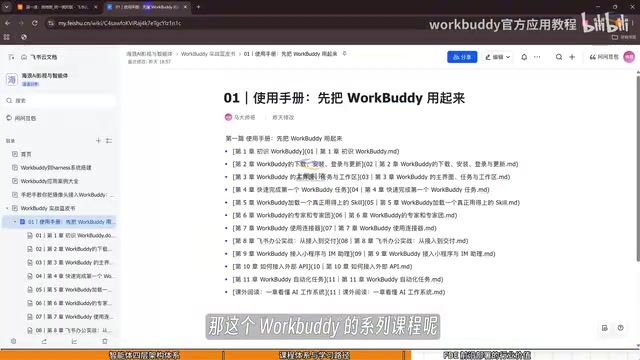
The WorkBuddy series has ten lessons in total, covering installation, connectors, expert skills, automation, Feishu communication, and remote engineering control. There are also advanced modules on Harness customization, FDE deployment, and AI commercialization. The creator suggests that if you want to deeply understand the Harness, you can first read Cybernetics by a former Soviet scholar to build a theoretical framework before diving into practice.
The value of this course is that it doesn't stop at tool operation but breaks AI applications down into understandable structures, so learners know which layer they're on and where to go next. For anyone wanting to progress from "using AI to chat" to "using AI to get work done," this is a starting point worth following.
One-line Summary
A single concept map explains large models, Harness, agents, and FDE, plus a hands-on WorkBuddy path to monetization.
Paragraph Summary
The article introduces Bilibili creator "Hailang's" WorkBuddy course series, which uses a four-layer structure to map out AI applications: the bottom layer is the large model; the second is the Harness engineering control layer (including context management, tool calling, task loops, and permission control); the third is a platform like WorkBuddy that integrates multiple agents; and the fourth is the FDE engineer responsible for the last mile of deployment. WorkBuddy is positioned as a "domestic alternative to Codex" desktop-level agent workbench that can directly control a computer to handle file processing, data organization, document generation, and more. The creator also shares a four-step monetization path—"basic operations → complete a case → build a portfolio → take orders on platforms"—along with a course system of 28 knowledge points across ten lessons, and notes that FDE roles are currently in high demand with attractive salaries.
Related articles

VP ≠ VNP: A Major Breakthrough in Computational Complexity Theory
A study claiming to prove VP ≠ VNP over every field sparks heated discussion on Hacker News. This article analyzes the algebraic complexity background of VP and VNP, the proof approach, community controversy, and its potential impact on computational complexity theory.

Developer Naming Woes: The Technical Names That Drive Us Crazy
Why is technical naming so maddening? From Nginx and Vite to Qt and Sudo, a YouTube creator rants about the chaos of developer naming and pronunciation, revealing the tug-of-war between creators' intentions and community habits, and the cultural roots behind spelling traps like PyPI and GNOME.

Figma Workplace Scandal: Employee Sues CEO for Forcing Confrontation with Harasser
Figma and its CEO are sued by a current employee alleging sexual harassment and discrimination, and forcing the victim to confront her harasser. This article outlines the background, potential impact, and industry reflection.