World First! Ukraine Uses Drones to Evacuate Wounded Soldiers, a New Breakthrough in Battlefield Rescue

Ukraine claims the world's first drone evacuation of wounded soldiers, sparking discussion of the trade-off between speed and reliability.
Ukraine claims to have completed the world's first drone evacuation of wounded soldiers, sparking heated discussion in the Reddit community. Supporters believe drones are faster and that in a battlefield dense with drones the risk is comparable to that of unmanned ground vehicles (UGVs); skeptics point out that drone evacuation has more points of failure, but in emergencies speed comes first. The article analyzes technical challenges such as payload capacity, flight stability, securing the wounded and monitoring vital signs, and electronic warfare interference, and notes that unmanned systems are expanding from reconnaissance and strikes to medical evacuation, potentially forming a complementary rescue system with UGVs in the future. The news remains a unilateral claim by Ukraine, with limited details and verifiable evidence.
Battlefield medical evacuation (casevac) has long relied on ground vehicles or helicopters, but Ukraine recently demonstrated a new approach: evacuating wounded soldiers by drone. According to discussion in the Reddit community, Ukraine claims to have completed the world's first drone evacuation of wounded soldiers, marking a substantive step forward in the use of unmanned systems for battlefield rescue.
Drone Evacuation of Wounded Soldiers: A New Speed-First Option
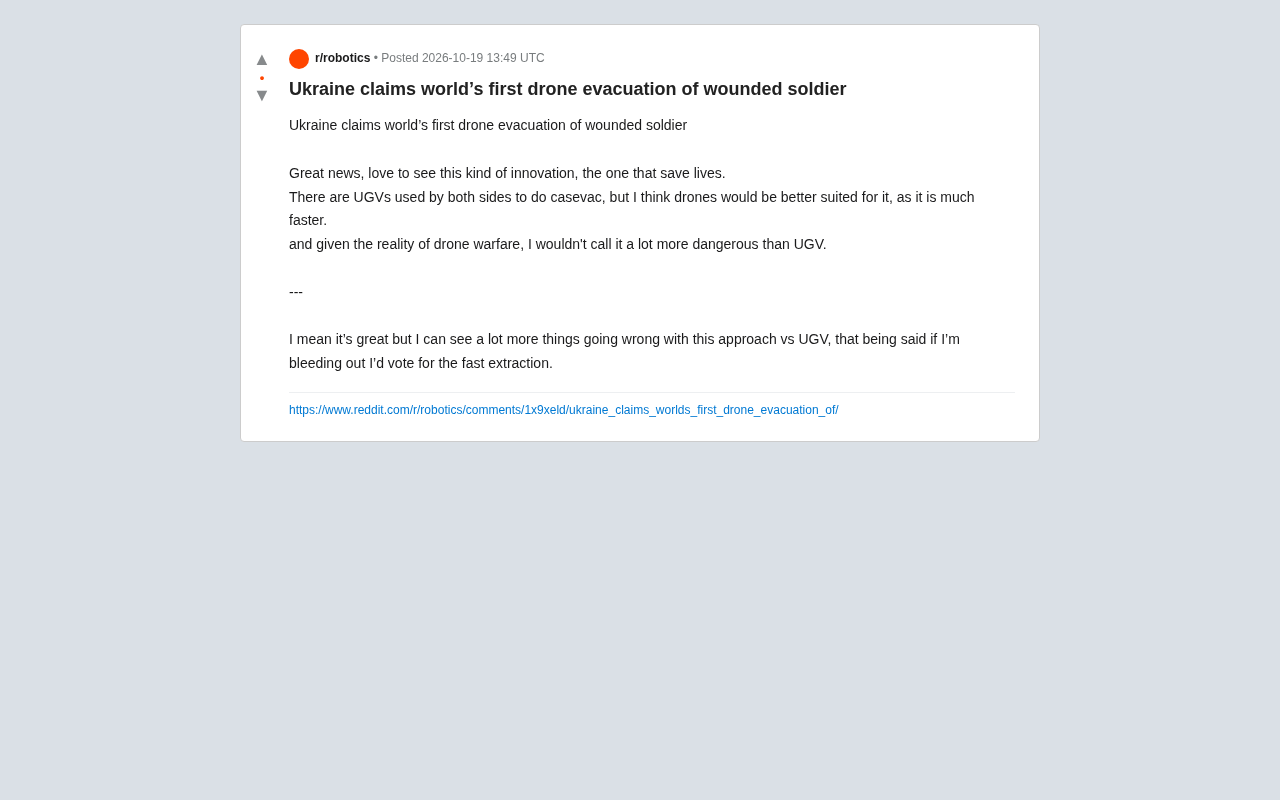
According to the Reddit post, Ukraine claims to have completed the world's first drone evacuation of wounded soldiers. The poster expressed optimism about this, believing that such innovation can save lives. He noted that both Russia and Ukraine are using unmanned ground vehicles (UGVs) for casualty evacuation missions, but drones may be more suitable because they are faster.
"Given the reality of drone warfare, I wouldn't say it's much more dangerous than a UGV," the poster added. This view suggests that on a battlefield filled with drones and electronic warfare threats, the risks faced by ground vehicles and aerial drones are converging, and the speed advantage of drones may become the decisive factor.
Unmanned ground vehicles (UGVs) refer to remotely controlled or autonomous vehicles that travel on the ground without a human driver. In the Russia-Ukraine war, UGVs are widely used to transport ammunition, evacuate wounded soldiers, and even carry weapons. Their advantages include strong payload capacity and the ability to travel close to the ground to reduce exposure risk, but their speed is limited by terrain and obstacles, and if destroyed, the wounded on board may be endangered at the same time. In contrast, drone evacuation of wounded soldiers means securing the wounded on a flying platform to quickly cross the battlefield, but payload and range are hard constraints: typical multirotor drones have payloads ranging from a few kilograms to tens of kilograms, while an adult wounded soldier together with a stretcher and securing equipment often exceeds 100 kilograms, thus requiring large multirotor or fixed-wing platforms, with significantly increased cost and operational complexity.
UGV vs Drone: Each Has Its Pros and Cons
Unmanned ground vehicles (UGVs) have already been used for casualty evacuation on the Russia-Ukraine battlefield. They can carry wounded soldiers and travel relatively stably, but their speed is limited by ground conditions and their ability to evade strikes. Drones, on the other hand, can quickly traverse complex terrain and shorten the waiting time for the wounded.
However, there were also dissenting voices in the comments. One user pointed out: "This is great, but I can see many more ways this can go wrong than a UGV. Then again, if I'm bleeding out, I'd vote for fast evacuation." This reflects the trade-off between practical needs and engineering reliability: in life-or-death moments, speed is often more important than perfection.
Technical Challenges and Battlefield Reality
Drone evacuation of wounded soldiers faces multiple challenges. Payload capacity is the primary issue: ordinary FPV drones can hardly carry an adult wounded soldier, requiring larger multirotor or fixed-wing platforms. Second is flight stability and safety; securing the wounded during transport and monitoring vital signs both require specialized designs. In addition, electronic warfare interference on the battlefield may cut off the drone's control link, causing mission failure.
Despite these risks, as the poster said, in a battlefield environment dense with drones, ground vehicles also face enormous threats. The speed of drones may offset some of the risks, especially for critically wounded soldiers who need emergency evacuation.
Electronic warfare interference is one of the core risks of drone evacuation. On the modern battlefield, satellite navigation signals such as GPS/Beidou and remote control links may be suppressed or spoofed, causing drones to deviate, lose control, or be forced to land. Both Russia and Ukraine deploy large numbers of electronic warfare systems, greatly reducing the effectiveness of drones in key airspace. For manned evacuation missions, this means that interference-resistant autonomous navigation (such as inertial navigation and visual navigation) and safe landing logic after loss of link must be designed. In addition, the securing and vital sign monitoring of wounded soldiers during flight also require specialized solutions, such as shock-absorbing stretchers and remote transmission of physiological parameters; otherwise, turbulence and delays may worsen injuries.
Unmanned Systems Reshaping Battlefield Medicine
Regardless of the details, this claimed "world first" points to a trend: unmanned systems are expanding from reconnaissance and strikes to logistics and casualty evacuation. UGVs and drones each have applicable scenarios, and in the future they may form a complementary rescue system. For the wounded, faster evacuation means higher survival rates, which is precisely the core value of technological innovation.
At present, this news is still a unilateral claim by Ukraine, with limited specific details and verifiable evidence. But the discussion in the Reddit community shows that frontline personnel and observers hold cautious optimism about this innovation. The unmannedization of battlefield medical evacuation may come faster than we expect.
Battlefield medical evacuation (casevac) generally refers to the process of moving wounded soldiers from the combat zone to treatment points. It traditionally relies on ground ambulances or helicopters and follows the "golden hour" principle—the faster definitive treatment is received, the higher the survival rate. The involvement of unmanned systems in evacuation is essentially replacing personnel with machines in high-risk environments, reducing casualties among rescue personnel while compressing evacuation time. However, it should be noted that drone evacuation is currently more of a supplementary means of "point-to-point rapid transfer" rather than a replacement for the complete medical chain; critically wounded soldiers still require en-route monitoring and life support, which limits the scope of application of unmanned platforms.
One-line Summary
Ukraine claims the world's first drone evacuation of wounded soldiers, sparking discussion of the trade-off between speed and reliability.
Paragraph Summary
Ukraine claims to have completed the world's first drone evacuation of wounded soldiers, sparking heated discussion in the Reddit community. Supporters believe drones are faster and that in a battlefield environment dense with drones, the risk is comparable to that of unmanned ground vehicles (UGVs); skeptics point out that drone evacuation has more points of failure, but in emergencies speed comes first. The article analyzes the technical challenges faced by drone evacuation, including payload capacity, flight stability, securing the wounded and monitoring vital signs, and electronic warfare interference, and notes that unmanned systems are expanding from reconnaissance and strikes to medical evacuation, potentially forming a complementary rescue system with UGVs in the future. At present, the news remains a unilateral claim by Ukraine, with limited details and verifiable evidence.
Related articles

Codex for Absolute Beginners: Connect to Domestic LLMs + Four Hands-On Case Studies
A Codex beginner tutorial: three steps to install and connect to the DeepSeek domestic LLM, with CC Switch for provider switching, plus essential plugins, skills, and four hands-on cases.

Claude Detects Early Signs of Sepsis, Reddit User Says AI Saved Their Life
A Reddit user shared symptoms of sudden difficulty urinating and confusion late at night; Claude identified possible sepsis and urged immediate medical care, which doctors confirmed could have been fatal if delayed. Exploring AI's potential and limits in health early warning.

The Goose Programming Language: John Carmack and the Great Abstraction Debate
Starting from the Hacker News post "The Goose Programming Language," we explore the programming language design philosophy sparked by John Carmack and the trade-offs between performance and abstraction.