World Intel MCP: The Open-Source Powerhouse for Giving AI Agents Real-Time Global Intelligence

World Intel MCP Server provides AI Agents with free real-time global intelligence via 132 tools across 30+ domains.
World Intel MCP Server is an open-source MCP server project that helps developers give AI Agents real-time global situational awareness at zero cost. It includes 132 MCP tools covering USGS earthquakes, NASA wildfire monitoring, military flight tracking, undersea cable outages, stock indices, and cryptocurrency prices — all from free public APIs. A 24/7 vector database enables cross-domain semantic correlation, and a built-in dashboard plus integrations with popular editors make it a practical low-cost starting point for building intelligence-aware Agents.
When building AI Agents, one common pain point is giving them a real-time, global view of the world — from financial market fluctuations to geopolitical risks. But tapping into professional data sources usually means steep API costs. An open-source project on GitHub called World Intel MCP Server is trying to solve this problem for free.
A Free Global Intelligence Data Layer
Created by developer Maxxed, the project's core purpose is to provide AI Agents with a broadly comprehensive, real-time intelligence access layer. It comes with 132 built-in MCP tools spanning more than 30 different data domains.
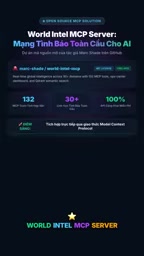
MCP (Model Context Protocol) is a standardized way for large language models to connect with external data and tools. By packaging 132 tools as MCP endpoints, an Agent can call all these data sources through a unified interface — no need to write custom integration logic for each data type. This is the key to the project's practical value: it consolidates scattered public data into capabilities an Agent can consume directly.
MCP (Model Context Protocol) was proposed and open-sourced by Anthropic in late 2024, with the goal of addressing the long-standing "integration fragmentation" problem in AI application development. Previously, developers had to write separate call logic for each data source and tool, resulting in high maintenance costs. MCP defines a standardized server/client protocol that lets large models access file systems, databases, external APIs, and other resources through a unified interface. MCP-compatible clients include Claude Desktop, Cursor, Cline, and other mainstream AI coding and chat tools. World Intel MCP Server is a server-side implementation built on this protocol — developers simply configure the service in any MCP-compatible client, and their Agent can immediately call all 132 tools without writing any additional data integration code.
Data Sources Spanning 30+ Domains
The breadth of data is the project's biggest highlight. According to the documentation, covered data types include:
- Natural disasters: USGS earthquake data, NASA satellite-monitored wildfires
- Geopolitical & military: Military flight schedules, international undersea cable outage events
- Financial markets: Stock indices, Bitcoin and other cryptocurrency prices
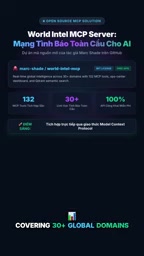
A noteworthy detail: all of this data comes from public APIs and is completely free. For individual developers or budget-constrained teams, this means bypassing expensive commercial data subscriptions and giving an Agent a reasonably complete window onto the world. Of course, public APIs typically come with rate limits and trade-offs in data granularity — practical constraints worth keeping in mind.
Built-In Vector Database and Semantic Search
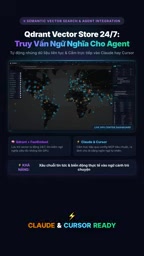
Beyond data access, the project also integrates a 24/7 background-running vector database. This lets the Agent do more than passively pull data — it can perform semantic searches and cross-domain information correlation.

The addition of a vector database elevates this solution from a "data pipeline" to an "intelligence analysis assistant." For example, when an Agent needs to assess overall risk in a given region, it can semantically correlate earthquakes, cable outages, and military activity across multiple sources — rather than querying each one in isolation. This multi-dimensional information correlation capability is central to giving an Agent a true "global perspective."
A vector database is a core piece of infrastructure enabling semantic search in modern AI applications. It works by converting unstructured information — text, events, and more — into high-dimensional numerical vectors via an embedding model, which are then stored and retrieved by semantic similarity rather than exact keyword matching. In an intelligence analysis context, this means an Agent can use a fuzzy semantic query like "regional tensions escalating" to automatically surface related events scattered across multiple data domains — such as unusual military flight activity, undersea cable failures, and seismic events occurring within the same time window. The 24/7 continuous operation design means the vector database ingests new data and updates its index on an ongoing basis, keeping search results current. Common open-source vector database options include Chroma, Qdrant, and Weaviate; refer to the project's GitHub repository for details on which implementation it uses.
Visualization Dashboard and Integration Support
The project also includes an intuitive operations dashboard and supports smooth integration with common tools (such as Cursor-like editors and databases, as mentioned in the original documentation).
Overall, World Intel MCP Server's approach is to take "real-time global intelligence" — something that once had a high barrier to entry — and turn it into a ready-to-use open-source component. For developers who want their Agents to move beyond pure text conversation and develop real-world situational awareness, this is a solid starting point worth exploring.
Summary
This project's significance lies not in the depth of any single data source, but in achieving extraordinary breadth through a free, standardized approach — 132 tools, 30+ domains, a built-in vector search engine, and a visualization dashboard. For developers with limited resources who want to quickly validate the concept of an "intelligence-aware Agent," it offers a low-cost path to experimentation. That said, the stability and compliance of public data sources should still be evaluated before deploying in production.
Related articles

Chain of Thought Isn't Just for AI: How Humans Can Use CoT to Improve Thinking Quality
Chain of Thought isn't just a prompt trick for large models. Starting from a Hacker News discussion, this article analyzes why CoT works for human thinking too, breaks down actionable ways to transfer it, and highlights the key differences between human CoT and machine CoT.
Cloudflare Teams Up with OpenAI: Closi…
Cloudflare Teams Up with OpenAI: Closing the Loop from Vulnerability Discovery to Defense with AI
Cloudflare uses OpenAI Daybreak to investigate security vulnerabilities and generate reviewable remediation plans, while developers use Codex to boost coding efficiency and quality.

Orca Multi-Agent Orchestration in Practice: A Guide to Parallel Collaboration with Claude and Codex
Orca is Stable AI's free open-source agent workbench supporting 34 agents like Claude Code and Codex in parallel. Learn its Git worktree isolation, multi-model orchestration, and mobile management.