WorldCloud: An Agentic Framework for Generating Explorable 3D Open Worlds from a Single Sentence

WorldCloud uses multi-agent collaboration to generate explorable 3D open worlds from a single sentence.
WorldCloud is an agentic framework that generates large-scale, editable, and freely explorable 3D open worlds from a single natural language description. It combines MLLM planning, procedural generation, 2D generative models, and 3D reconstruction through a three-stage pipeline — intent analysis, global terrain generation, and regional object placement — leveraging each technology's strengths while avoiding their individual weaknesses.
The Industry Pain Points of 3D Open World Generation
Whether it's game development, film production, or virtual simulation, high-quality, explorable 3D scenes are indispensable. Yet for years, automated generation of 3D open worlds has remained a persistent industry challenge: traditional methods are either inefficient or produce results that fall short of practical application needs. Many existing solutions can only generate content viewable from fixed angles, or suffer from such poor geometric consistency that they're completely unusable for truly interactive scenarios.
The recently published research paper World Cloud: Agentic 3D Open World Generation at Scale targets exactly this pain point. Its goal is crystal clear — generate large-scale 3D open worlds from a single sentence that are freely explorable, structurally consistent, and editable. For game developers and VR content creators, this capability holds enormous appeal.
Four Major Approaches to Existing 3D World Generation
Before understanding WorldCloud's innovations, it's worth surveying the current landscape of 3D open world generation technologies. The paper categorizes them into four types, each with distinct strengths and weaknesses.
Procedural Content Generation (PCG)
Represented by Infinigen, this approach relies on predefined rules and procedures to generate terrain, vegetation, and buildings. Controllability and scalability are decent, but content diversity is limited by hand-written rules, making it difficult to generate flexible and varied scenes.
Procedural Content Generation is a technique that uses algorithms and mathematical rules to automatically generate game content, with a history dating back to the classic 1980s game Rogue. In modern game industry, PCG is widely used for terrain generation (e.g., Perlin noise, fractal algorithms), vegetation distribution (L-systems), city layouts (Wave Function Collapse), and more. Infinigen is an open-source procedural 3D scene generator developed by Princeton University, capable of generating extremely realistic natural scenes using mathematical functions, including terrain, water bodies, vegetation, and animals. But the fundamental limitation of PCG is that all generation logic must be pre-coded by human engineers — every new scene type or style variation requires extensive rule writing and parameter tuning.
Image and Video Lifting Methods
Represented by products like Marble, these methods first use image or video generation models to produce content from different viewpoints, then lift the 2D content into 3D meshes or 3D Gaussians through depth estimation or multi-view reconstruction. Visual content is rich, but global consistency and geometric fidelity are insufficient. Generating a complete 3D house requires first generating a long video orbiting the house — computationally expensive, with uncovered viewpoints prone to blurriness or geometric artifacts.
Several key technologies underpin this approach. Depth estimation refers to inferring the distance from each pixel to the camera from single or multiple 2D images, thereby obtaining the 3D structure of a scene. Transformer-based monocular depth estimation models (such as DPT, Depth Anything) have made significant progress in recent years, but their depth maps still contain errors in absolute scale and detail precision. Multi-view reconstruction recovers 3D geometry by matching corresponding points across images from different viewpoints using triangulation principles — classic methods include Structure from Motion (SfM) and Multi-View Stereo (MVS). 3D Gaussian Splatting is a novel 3D representation method that emerged in 2023, representing scenes with large numbers of 3D Gaussian ellipsoids carrying color and opacity attributes. It renders far faster than NeRF but tends to produce artifacts in unobserved regions.
Native 3D Diffusion Methods
Such as XCube and BlockFusion, these methods directly learn scene distributions on 3D voxels, distance fields, or 3D Gaussians, generating high-quality geometry and textures in a single diffusion pass. Geometric fidelity and cross-view consistency are superior, but the bottleneck is the scarcity of large-scale 3D scene datasets — insufficient training data limits content diversity.
The core idea of diffusion models is to generate new samples by gradually adding noise to data and then learning the reverse denoising process, having achieved enormous success in 2D image generation (e.g., Stable Diffusion, DALL-E 3). The primary challenge of extending diffusion models to 3D is choosing the 3D data representation. Voxels are the most intuitive 3D representation, dividing space into regular 3D grids where each cell stores occupancy status and attribute information, but memory consumption grows cubically with resolution. Signed Distance Fields (SDF) implicitly represent geometry using the signed distance from each spatial point to the nearest surface, offering a more compact representation. XCube employs sparse voxel octree structures, while BlockFusion performs diffusion at the local block level — both attempt to balance generation quality and computational efficiency. However, training 3D diffusion models critically depends on large-scale, high-quality 3D datasets, and currently available public 3D scene data (such as Objaverse, 3D-FRONT) falls far short of 2D datasets like ImageNet or LAION in scale and diversity.
Multimodal LLM Agent Methods
Such as Holodeck and SceneWeaver, these leverage MLLM world knowledge for intent understanding, spatial planning, and tool orchestration. Planning capabilities are strong and can directly drive scene construction through natural language, but they lack precise 3D spatial control — adjusting individual object positions is prone to overcorrection due to insufficient spatial scale perception.
Multimodal Large Language Models (MLLM) such as GPT-4V and Gemini can understand and generate not only text but also process images, audio, and other modalities. Using MLLMs as core controllers for agents is one of the hottest directions in current AI research. In 3D scene generation, the advantage of MLLM agents lies in leveraging the vast world knowledge accumulated during pretraining — they know what architectural style a medieval village should have, the vegetation distribution patterns at the foot of snowy mountains, the terrain features typically found around lakes, and so on. Holodeck, jointly developed by the University of Pennsylvania and Allen AI, uses a GPT-4-driven language agent to retrieve and place objects from the Objaverse asset library to construct indoor scenes. The core difficulty with these methods is that language models excel at high-level semantic reasoning but lack reliable perception of precise 3D spatial coordinates (such as inter-object distances, rotation angles, collision detection), leading to issues like floating objects, clipping, or scale inconsistencies.
The strengths and weaknesses of these four approaches are remarkably complementary, and WorldCloud's core idea is precisely to fuse their advantages together.
WorldCloud's Three-Stage Generation Framework: From Global to Local
WorldCloud doesn't attempt to solve everything with a single large model. Instead, it adopts a "global constraints first, then progressive local refinement" design philosophy, with the entire framework divided into three stages.
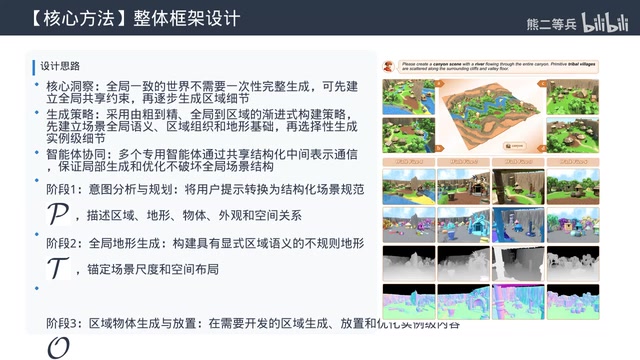
Stage 1: Intent Analysis and Scene Planning
Users typically describe the target scene in just one brief sentence, such as "a medieval village at the foot of a snowy mountain with a lake." But building a complete 3D scene requires extensive detail parameters. To address this, this module employs two agents:
- Intent Analysis Agent: Solely responsible for extracting and normalizing constraints explicitly expressed by the user (scene type, theme, visual style, key regions and objects, spatial relationships), without adding extra content, preserving original user intent to the greatest extent.
- Scene Planning Agent: While preserving user requirements, resolves ambiguities in the description and fills in unspecified information needed by downstream generation according to a predefined Schema.
The final structured scene specification contains three parts — region sets, terrain specifications, and object specifications — serving as semantic and spatial constraints shared by all downstream modules to ensure consistency across generated content.
Stage 2: Global Terrain Generation
Terrain is not just the geometric foundation of a 3D world; it also organizes regional semantics, spatial hierarchies, and environmental content. Many existing pipelines simplify the ground as a flat plane, unable to express complex landforms like mountains, canyons, dunes, or terraces. WorldCloud's terrain generation is subdivided into three steps:
- Terrain Planning: The terrain planning agent generates a structured specification containing layout parameters, asset parameters, material parameters, and terrain parameters, establishing clear interfaces between planning, asset generation, and geometry construction. When necessary, it also invokes search tools to retrieve references or generates scene concept art as visual conditions.
- Terrain Asset Generation: Produces scene layout maps, representative asset images, reusable 3D asset prototypes, and terrain material collections. The layout map uses different colors to encode terrain categories, converting text descriptions into a unified 2D spatial partition.
- Terrain Generation and Optimization: Constructs a composite heightfield through region-weighted summation, allowing different landforms to form continuous terrain with irregular boundaries; then performs global asset scattering, followed by iterative optimization using Blender MCP tools.
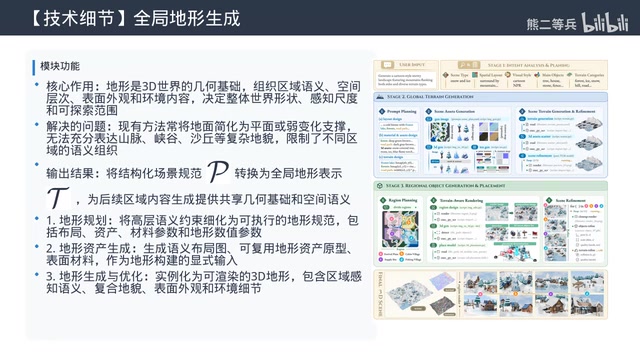
A heightfield (heightmap) is the most commonly used representation in 3D terrain generation, encoding the elevation at each surface point using a 2D grayscale image — higher grayscale values indicate higher elevation. Its advantages include storage efficiency and ease of rendering, with mainstream game engines (such as Unreal Engine and Unity) natively supporting heightfield terrain. WorldCloud's proposed "region-weighted summation for composite heightfield construction" is a key innovation: traditional approaches typically use a single noise function to generate the entire height map, making it difficult to represent drastically different landforms within the same scene (such as the boundary between mountains and plains). The composite heightfield approach generates separate heightfield components for each landform type (mountains, canyons, dunes, terraces, etc.), then blends them through weighted masks corresponding to the layout map, with weights smoothly transitioning at region boundaries — resulting in naturally continuous terrain surfaces with diverse landforms.
You may not have noticed that material generation employs two complementary paths: first, generative texture synthesis, which produces albedo, normal, and roughness maps for complex local surfaces; and second, procedural material generation, which programmatically assembles Blender material nodes to create tileable, parameter-adjustable surface materials for large-scale regions.
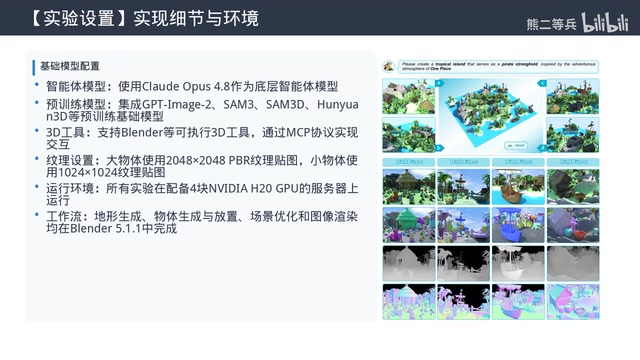
The albedo, normal, and roughness maps mentioned here are core texture channels in the Physically Based Rendering (PBR) workflow. PBR is the standard material model for modern game engines and film rendering, with the core principle of simulating light-surface interaction in a physically correct manner. The albedo map defines the base color of a surface without lighting information; the normal map simulates bumps and fine details by encoding surface micro-orientations, presenting textures like brick joints and wood grain without increasing geometric complexity; the roughness map controls surface smoothness — lower values make surfaces more mirror-like (like polished metal), while higher values produce more diffuse reflection (like rough stone). A complete PBR material typically also includes metallic, ambient occlusion (AO), and height/displacement channels. WorldCloud supports both generative and procedural material creation paths: the former suits small areas requiring realistic detail, while the latter is ideal for ground materials that need seamless tiling over large areas.
It's worth noting that the Blender MCP toolchain used in the framework plays a critical role throughout the process. Blender is the world's most popular open-source 3D creation suite, supporting a complete 3D workflow including modeling, sculpting, animation, rendering, and compositing. MCP (Model Context Protocol) is an open protocol proposed by Anthropic, designed to standardize the communication interface between AI models and external tools, enabling large language models to manipulate various software tools like calling APIs. Blender MCP exposes Blender's functionality as MCP tool interfaces, allowing AI agents to directly execute modeling operations, adjust material parameters, run renders, and inspect scene states in Blender through structured commands. In the WorldCloud framework, Blender MCP acts as a bridge between agents and the 3D editing environment, enabling terrain optimization, asset scattering, object placement, and other operations to be iterated under programmatic control without requiring manual operation by human artists.
Stage 3: Regional Object Generation and Placement
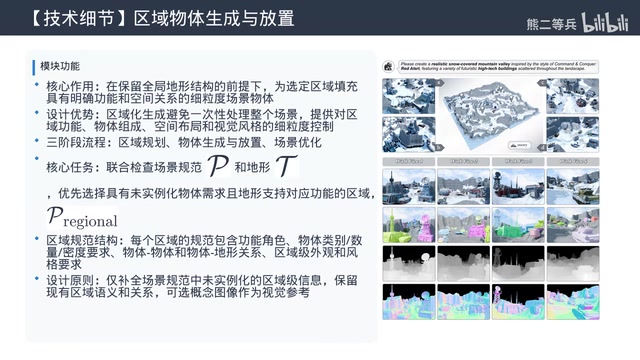
After global terrain is complete, fine-grained objects with specific functions and spatial relationships have not yet been instantiated. The regional planning agent examines the scene specification and terrain, prioritizing regions that "have uninstantiated object requirements and whose terrain can support the corresponding functions" for refinement.
Object generation and placement is split into three steps:
- Regional Synthesis: Generates 2D layout images conditioned on the terrain
- Object Generation: Separates and reconstructs individual 3D instances from synthesized images
- Object Placement: Recovers instance positions in 3D space
This is followed by an agent reorganization stage that resolves object-terrain contact issues.
Multi-Agent Collaboration: A Design Philosophy of Playing to Strengths
The most ingenious aspect of WorldCloud is using agents to orchestrate different tools, letting each technology do what it does best:
- MLLM handles intent understanding and planning
- Procedural generation handles controllable terrain and asset generation
- 2D generative models handle rich visual content
- 3D reconstruction models handle converting 2D content to 3D assets
- Dedicated optimization loops handle consistency issues
This combination neatly avoids each technology's weaknesses: it retains MLLMs' planning capabilities while solving spatial control precision through decoupled planning and generation plus optimization loops; the diversity bottleneck of native 3D diffusion is mitigated by combining 2D image generation with procedural generation, eliminating complete dependence on scarce 3D datasets.
Industrial Value and Future Directions
For industry, WorldCloud's value is particularly notable. Currently, game companies building open worlds still rely heavily on manual asset creation and scene construction — an extremely costly process. WorldCloud outputs independently editable textured meshes that can integrate with existing game engine workflows, essentially providing artists with high-quality drafts requiring only minor adjustments for production use.
More importantly, it supports on-demand region generation — when creating ultra-large-scale open worlds, there's no need to generate everything at once. Content is generated wherever players explore, perfectly matching the needs of open world games and metaverse scenarios.
The concept of on-demand generation is directly aligned with the game industry's "streaming" and "procedural infinite world" techniques. Minecraft's chunk generation mechanism is the most classic example: the game doesn't pre-generate the entire world but instead computes and generates new terrain chunks in real-time as players approach unexplored areas. However, Minecraft's generation is based on simple noise algorithms with limited content diversity. WorldCloud elevates this concept to the AI generation level — each new region's generation considers not just noise distributions but also maintains semantic consistency and geometric continuity with existing regions. This is especially critical for metaverse platforms: an ideal metaverse needs nearly infinite explorable space, and the traditional purely manual approach is completely infeasible in terms of cost. If AI can generate content on demand while maintaining quality, it will fundamentally change the scale ceiling of virtual worlds.
Of course, the framework still has room for improvement. Currently, regional object generation relies on a "2D image editing then converting to 3D" pipeline, which may encounter consistency issues with particularly complex object relationships. The agents' iterative optimization currently uses preset checkpoints — if real-time user feedback could be incorporated in the future, controllability could be further enhanced.
Overall, this "global-to-local" agentic framework provides an extremely promising new direction for large-scale 3D open world generation and is likely to become one of the mainstream paradigms for 3D content generation in the future.
Key Takeaways
Related articles

Amphibious Transforming Drone: Beyond 100x Power Savings, What Are the Real Needs?
Is the amphibious transforming drone just a gimmick? Starting from the 100x power difference of the M4 Morphobot, explore real application scenarios and thesis topic ideas, analyzing boundary conditions where pure drones and pure ground robots both fail.

Warhound Raises $200 Million: Genetically Engineered "War Dogs" Paired with Anduril Gear
Warhound raises $200M, backed by Ben Lamm and Palmer Luckey, to genetically engineer dogs for military and law enforcement use and equip them with Anduril gear. This article analyzes its technology direction, funding logic, and ethical controversy.

Claude API Comes to Google Cloud: IAM Integration and SDK Access Guide
Anthropic hosts the full Claude API on Google Cloud with IAM-controlled permissions and unified billing. This guide covers the Vertex AI and Anthropic-hosted entry points, IAM role configuration, and SDK access.