Would You Let an AI Agent Pay for You? Reflections on a User Survey
The bottleneck of AI agent payments is not technology, but trust structures and authorization mechanism design.
The article centers on a Reddit user survey about AI agent payments and introduces the proposed "virtual card + spending limits + Face ID approval for large transactions" solution. It notes that assistants such as ChatGPT, Claude, and Gemini already have price comparison and purchase recommendation capabilities, so technical payment integration is not the hard part; the real obstacle is users' unwillingness to give up immediate control over every expense. Tiered authorization (automatic for small amounts, manual for large amounts) thus becomes a realistic path to balance convenience and security. The article further analyzes three major constraints on implementation: liability attribution, authorization granularity, and data and privacy, and judges that products will advance gradually from suggestions to prefilling to payment. Whoever first designs the rules for a human-AI jointly managed wallet is more likely to win the next round of AI commercialization.
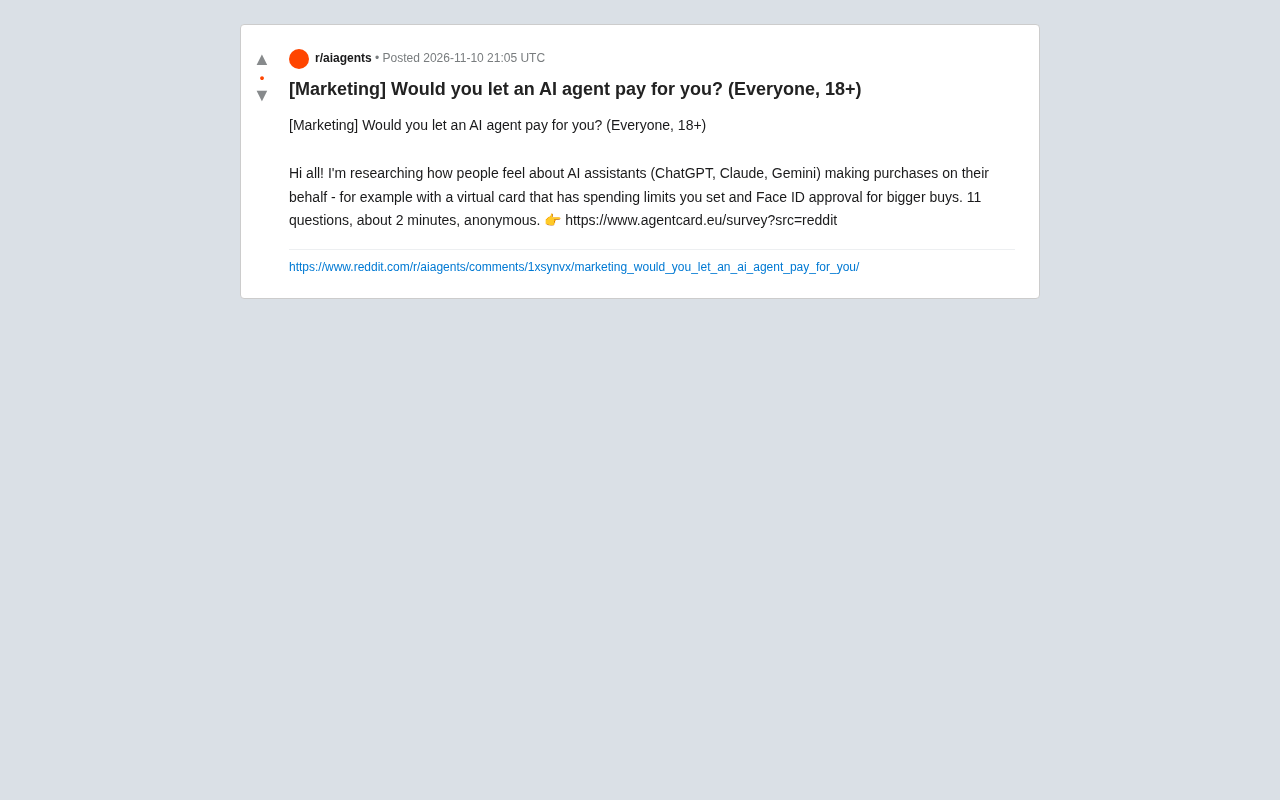
AI assistants are moving from answering questions to spending your money. When ChatGPT, Claude, and Gemini can not only recommend products but also complete payments directly, are users willing to hand over this "virtual credit card"? According to a survey recruitment post on Reddit, researchers are collecting real attitudes toward AI agent payments and have proposed a key design: virtual card + spending limits + Face ID approval for large transactions.
What the Survey Asked
This survey uses 11 questions and an anonymous questionnaire of about 2 minutes to understand users' acceptance of AI agent payments. The post clearly describes a product form: users link a virtual card with a spending cap to their AI assistant; everyday small purchases are completed autonomously by the agent, while larger amounts trigger manual Face ID approval.
This design itself reveals the researchers' judgment—users' concerns about "fully letting go" far outweigh their expectations of convenience, so spending limits and biometric approval are used to set up "brakes." In other words, the question is no longer "whether to let AI spend money," but "under what conditions, how much, and who ultimately makes the final call."
The Trust Gap Is Bigger Than the Technology Gap
Current mainstream AI assistants (ChatGPT, Claude, Gemini) all have the ability to understand product information, compare prices, and generate purchase recommendations. Technically, connecting to payment interfaces is not difficult. The real obstacle lies in the trust structure: letting AI make autonomous consumption decisions means users must give up immediate control over every expense.
The "tiered authorization" approach proposed by the survey essentially divides scenarios between convenience and security: low-value, high-frequency purchases are automated by the agent, while high-value transactions retain manual confirmation. This is similar to today's credit card logic of small-amount password-free payments, except that the decision-maker shifts from a person to a model. Whether users can accept this delegation of authority depends on the transparency of the agent's decisions—why it bought this item, whether the price is reasonable, and how refunds are handled.
Virtual Card refers to a set of card numbers, expiration dates, and security codes generated by a bank or card-issuing service provider that are one-time or limit-constrained. They are linked to the user's real account but can independently set spending caps, validity periods, and use scenarios. They are already widely used in corporate expense management, subscription trials, and other scenarios. Their core value lies in risk isolation—even if the card number is leaked or misused, losses are limited to the preset amount. Using them for AI agent payments is equivalent to issuing the model a "secondary card that can be revoked at any time and has a capped limit," which is also the technical premise that makes the survey's proposal viable.
Face ID approval in this context is not simple login verification, but a transaction-level strong authentication method. Biometrics anchor the "final decision-making authority" to the user's body, technically eliminating the possibility of the agent bypassing approval on its own, while psychologically giving users a sense of control that "large expenses still require my nod." However, biometrics also have applicable boundaries: they are suitable for low-frequency, high-value confirmation scenarios. If every transaction triggered them, it would seriously undermine the experiential value of agent automation. Therefore, the survey proposal limits them to "large-amount" scenarios, complementing the automation of small-amount password-free payments.
Three Practical Constraints on Agent Payment Implementation
Even if user willingness exists, AI agent payments still face multiple constraints.
Liability attribution: When the agent buys the wrong product or encounters fraud, who bears the loss? The spending limit of a virtual card is a form of risk isolation, but it cannot cover decision-quality issues such as "buying the right thing but at too high a price."
Authorization granularity: One-time authorization, authorization by merchant, and authorization by category correspond to completely different user mental models. The Face ID approval in the survey is transaction-level authorization, while everyday consumption may be better suited to rule-level authorization, such as "a monthly cap on subscription-type spending."
Data and privacy: To complete a purchase, the agent must have access to the user's payment credentials, shipping address, and consumption preferences. The boundaries for storing and using this data are a must-answer question before users hand over payment authority.
Agentic Payments is a new concept formed in recent years at the intersection of the payments industry and AI. It refers to a payment model in which AI agents with autonomous decision-making capabilities complete actions such as placing orders, making payments, and renewing subscriptions on behalf of users. It is fundamentally different from traditional automatic deductions (such as membership renewals): automatic deductions execute fixed rules preset by the user, while agentic payments involve the model's contextual judgment of products, prices, and timing, and the decision-making process carries uncertainty. Since 2024, card networks such as Visa and Mastercard have successively launched payment token and credential solutions for AI agents, attempting to establish verifiable and traceable technical standards at the card network level for "machine-initiated transactions." This has also made virtual cards the most realistic implementation vehicle at present.
User Attitudes Determine Product Form
The value of this survey lies in throwing the question back to users rather than having vendors unilaterally define "smart payments." From a product design perspective, the pace of agent payment adoption will most likely follow a gradual path of "suggest—prefill—pay": first let AI help you compare and fill in, then let it automatically place orders within limits, and only then discuss full delegation.
For practitioners focused on AI application implementation, this kind of user survey provides an observation window: the bottleneck of the agent economy is not model capability, but authorization mechanisms, liability allocation, and trust building. Whoever first designs the rules for this "human-AI jointly managed wallet" clearly is more likely to obtain the ticket to the next round of AI commercialization.
One-line Summary
The bottleneck of AI agent payments is not technology, but the design of trust structures and authorization mechanisms.
Paragraph Summary
The article centers on a Reddit user survey about AI agent payments and introduces the researchers' proposed solution: "virtual card + spending limits + Face ID approval for large transactions." It points out that assistants such as ChatGPT, Claude, and Gemini already have price comparison and purchase recommendation capabilities, and technically connecting payments is not difficult. The real obstacle is that users are unwilling to give up immediate control over every expense. Therefore, tiered authorization (automatic for small amounts, manual for large amounts) becomes a realistic path to balance convenience and security. The article further analyzes three major constraints on agent payment implementation: liability attribution, authorization granularity, and data and privacy, and judges that products will advance gradually along the path of suggestions—prefilling—payment. Whoever first designs the rules for a human-AI jointly managed wallet is more likely to win the next round of AI commercialization.
Related articles

Why the FBI's AI Hacker Warning Hinges on a Single Word from Microsoft
FBI says AI tool Artex attacked 2,250+ organizations, but the citation trail leads to Microsoft's wording of "attempted sign-ins." The gap between attempts and breaches reveals the attack's true scale.
Fable 5.2 Powers the Creation of Getsumen Express: A Browser-Based Lunar and Martian Exploration Game
A developer used Fable 5.2 to build Getsumen Express, a browser game where players explore the Moon and Mars, scan real landmarks, shoot aliens, and ride an interstellar train. Built on Three.js and WebGPU for about $730, it showcases AI-assisted development.
agent-mcts: Adding Monte Carlo Tree Search to Claude Code
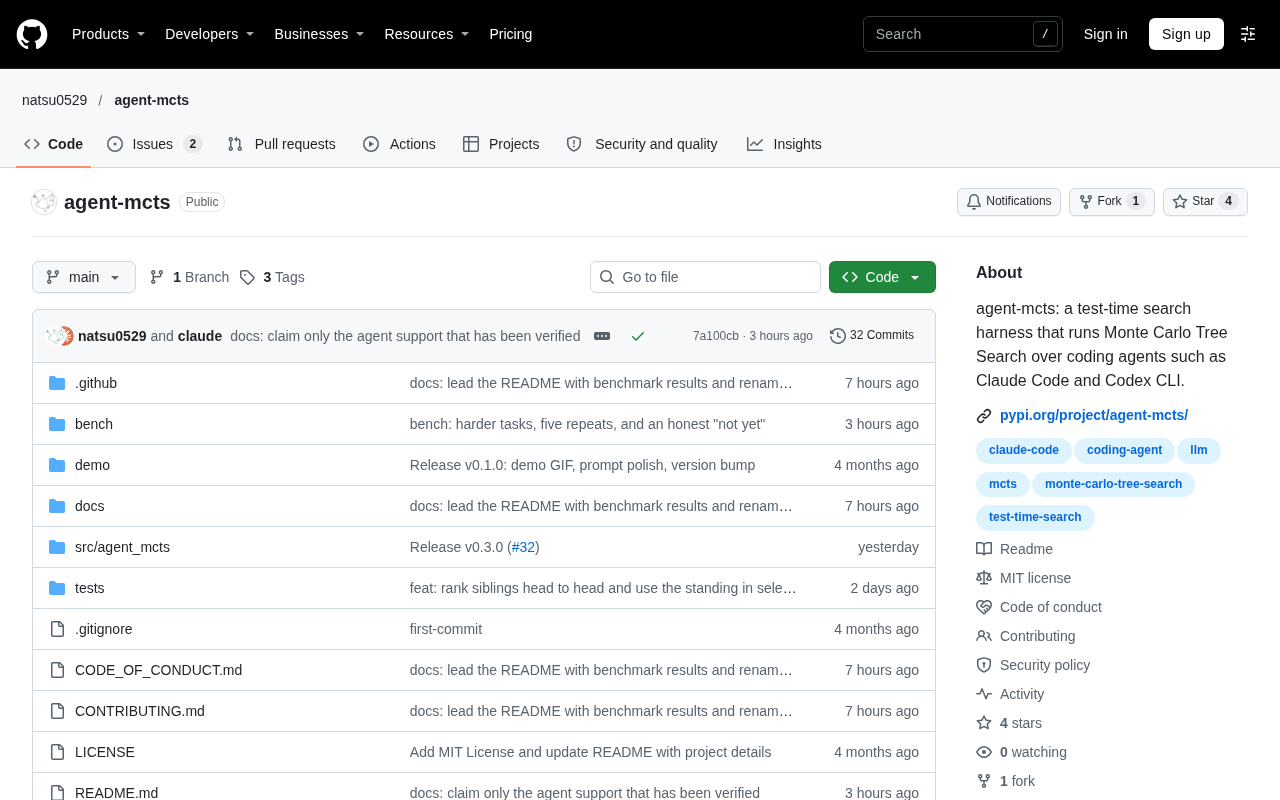
agent-mcts is a Show HN open-source project that layers Monte Carlo Tree Search on top of Claude Code. This article analyzes its technical approach, the significance of MCTS for coding agent decision-making, and the cost and engineering challenges facing search-enhanced agents.