WP Agent Bridge: An MCP Server That Lets Claude Safely Write to WordPress

WP Agent Bridge lets Claude write to WordPress safely via MCP, with dry run previews, confirmation tokens, and rollback.
WP Agent Bridge is a WordPress plugin that runs an MCP server inside your site, letting AI models like Claude operate on content without needing SSH, FTP, or admin credentials. Its security design rests on three layers: scoped tokens that limit what AI can touch, a dry run preview with precise diffs and a one-time confirmation token before any change goes live, and post-execution snapshots with loopback verification and one-click rollback. This combination of least-privilege access, visual review, human confirmation, and reversible execution offers a practical reference model for deploying AI agents in production CMS environments.
When AI Starts Writing Directly to Your Website
The era of AI agents reading and writing data directly is arriving — but the core question has never been "can it be done?" It's always been "is it safe?" WP Agent Bridge answers that question by letting Claude write directly to WordPress while keeping full control in the user's hands.
This is an MCP (Model Context Protocol) server that runs inside WordPress. Its most compelling feature: the entire connection process requires no SSH, FTP, or admin password handed over to an AI agent — which happens to be the biggest security vulnerability in traditional automation approaches.
MCP (Model Context Protocol) is an open protocol introduced by Anthropic in late 2024, designed to provide a standardized interface for interactions between AI models and external tools or data sources. Think of it as the "USB port" for AI — different services simply implement the same protocol spec, and any MCP-compatible AI client (like Claude Desktop) can call them uniformly, without building a custom integration for each service. MCP servers can run locally or remotely, exposing external system capabilities (reading files, querying databases, calling APIs, etc.) to the model in a structured way. WP Agent Bridge embeds this mechanism into the WordPress plugin ecosystem, enabling Claude to invoke WordPress content management features through the standard MCP protocol — without ever touching the underlying server credentials.
Three Steps to Connect
According to the official demo, the entire setup process is compressed into three steps:
- Install the plugin
- Generate a scoped token with defined permissions
- Paste two lines of configuration into Claude's MCP config file
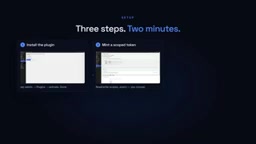
No complex server configuration, no exposed credentials. The token's "scope" design is the key detail — it means you can limit exactly what Claude is allowed to touch, rather than handing it a master key that opens every door.
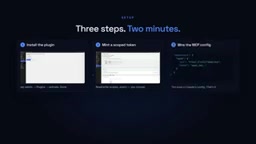
For most site owners, connecting AI to a production environment has always been the highest psychological barrier. WP Agent Bridge reduces that barrier to the level of installing a plugin — with just two lines of config.
Not a Direct Write — First, a "Rehearsal"
What truly reflects this tool's security philosophy is its write mechanism. When you ask Claude to edit your homepage, it doesn't act immediately.
The system first performs a dry run, presenting the changes Claude intends to make as a precise diff (before-and-after comparison). You see exactly what will change — not something happening in a black box.

Once you're satisfied, you return a one-time confirmation token — and only after this step do any real changes take effect. This "rehearse → confirm → execute" flow inserts a human approval checkpoint between the AI and your website. For production environments, this human-in-the-loop design is more pragmatic than full automation.
Dry run is a common safety verification technique in software engineering — it fully simulates an execution process without producing any real side effects, used to expose potential issues in advance. Diff, rooted in version control systems, presents content changes line by line before and after a modification, and is a foundational tool in code review and change management. Bringing both into AI write flows essentially transplants the developer-familiar "change review" mechanism into content management — letting users understand precisely what the AI changed before committing, rather than discovering afterward that a page has an unexplained new paragraph or a missing key module. "Human-in-the-loop" is an important concept in AI safety, referring to the preservation of human judgment and confirmation at critical nodes in automated workflows, preventing the compounding of model errors.
Snapshots, Verification, and One-Click Rollback
Even after a change has been executed, the safety net remains. Every write is snapshot-recorded and verified through loopback requests and logs.
In other words, the system not only records "what changed" — it actively confirms "whether the page is actually working correctly after the change." This self-verification mechanism can catch unexpected side effects from AI operations in a timely manner.

If you're not happy with the result, one call rolls it back to the previous state. This dramatically lowers the cost of letting AI experiment — you don't have to worry that a failed edit will leave your live page in an unrecoverable state.
70 Capabilities, Unified Guardrails
According to the official introduction, WP Agent Bridge provides up to 70 capabilities (abilities) covering a wide range of WordPress operations. And one principle runs throughout: all of these capabilities are subject to the same set of guardrails.
Regardless of which operation Claude performs, the dry run preview, one-time confirmation token, and snapshot-and-rollback mechanism are always in effect. This "unified security policy" design avoids a common vulnerability — where certain high-risk operations bypass the approval process.
What This Means for AI Agent Deployment
Beyond the product itself, WP Agent Bridge's design philosophy is worth studying for anyone interested in AI automation. The biggest obstacle to deploying AI agents on real systems today isn't model capability — it's trust and controllability.
The principles it demonstrates are instructive: least-privilege scope tokens, visual diff previews before changes, explicit human confirmation, and verifiable, reversible execution records. These are precisely the engineering problems that protocols like MCP must solve to actually work in production environments.
A note of caution: the above information comes primarily from official demos. Real-world stability, the specific coverage of those 70 capabilities, and the granularity of token permissions all require validation in actual use. But based on the mechanisms shown, it offers a clear reference model for "how to safely connect AI to a content management system."
Related articles

Vaani Developer Platform: Build Human-Like Voice AI Agents with Zero Code
Vaani Developer Platform tops Product Hunt with 175 upvotes, offering zero-code construction of human-like voice AI agents with flow design, tool and knowledge base connections, real phone deployment, and structured call data output.

Knocket AI: A Lightweight Tool That Lets Visitors Chat with Zero Friction
Knocket AI is a lightweight tool that lets visitors start real-time chats via a website or link without registering, targeting founders, creators, and small teams.

XWiki Launches Open-Source MCP Server: Let AI Read Your Wiki
XWiki's open-source MCP Server extension connects your Wiki knowledge base to AI agents like Claude Code and GitHub Copilot, supporting Q&A, page editing, and structured data—self-hosted to keep data control.