WrenchBoard Open Source Project: Building a Microsoldering Repair Assistant with Claude AI

WrenchBoard is an open-source AI microsoldering consultant tool powered by Claude Opus.
WrenchBoard is an open-source project powered by the Claude Opus 4.7 large language model, delivering AI-driven microsoldering technical assistance to the electronics repair industry. Through fault diagnosis, schematic interpretation, and repair solution recommendations, it lowers the entry barrier for chip-level repair, transforming senior technicians' tacit experience into an interactive knowledge service—representing the broader trend of AI penetrating specialized vertical domains.
WrenchBoard Project Overview: An AI-Powered Microsoldering Technical Consultant
WrenchBoard is an open-source project powered by the Claude Opus 4.7 large language model, designed to create a "virtual senior microsoldering technician" for the electronics repair industry. Whether you're a seasoned repair veteran or a newcomer just entering the field, this AI repair assistant provides professional-level technical guidance and support for microsoldering work.
The project was published on GitHub by developer Junkz3, built with Python, and has already earned 103 stars and 28 forks, generating considerable attention in the electronics repair community.
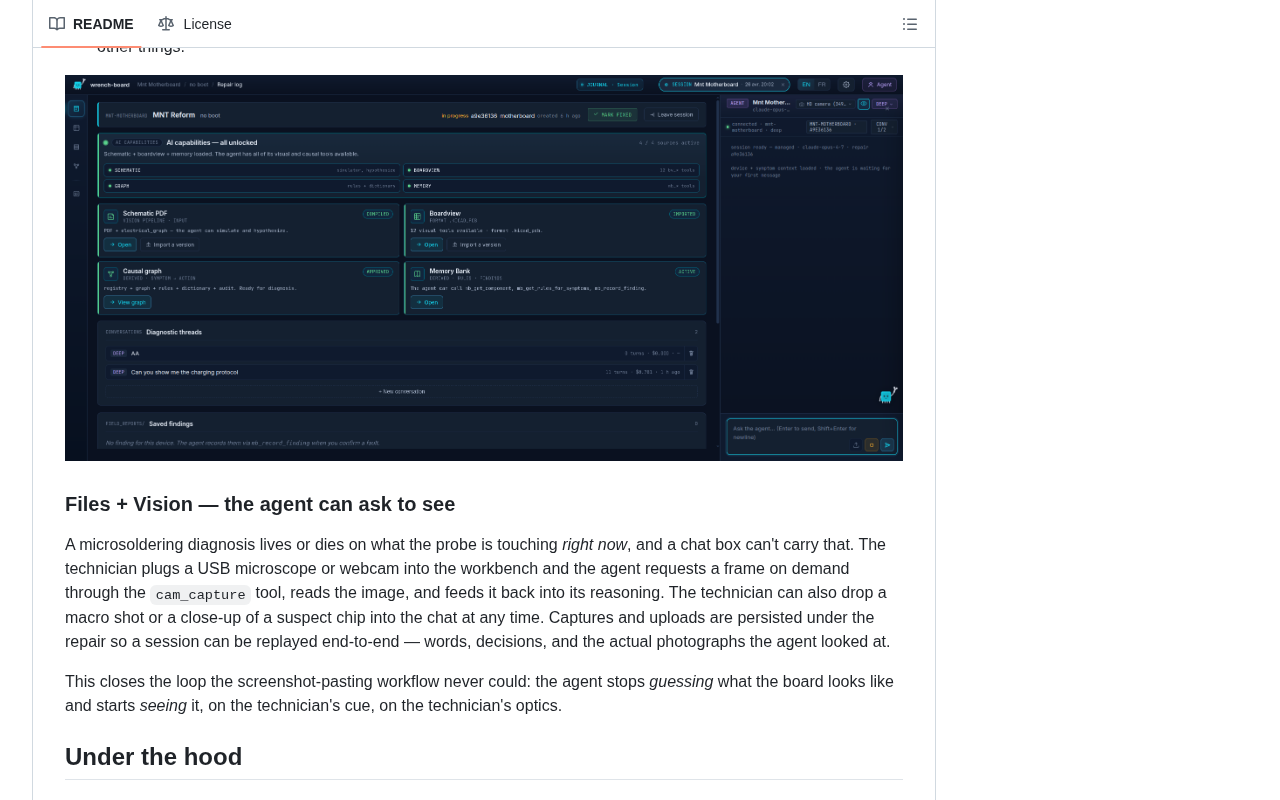
What Is Microsoldering? And Why Does It Need AI Assistance?
Microsoldering is one of the most technically demanding operations in the electronics repair field. It involves performing precision soldering on extremely small circuit board components, commonly seen in smartphone motherboard repairs, laptop chip-level fixes, gaming console repairs, and similar scenarios. Unlike ordinary electronic soldering, microsoldering deals with components typically at the millimeter or even sub-millimeter scale—for example, the power management IC (PMIC) on an iPhone motherboard may have a package size of just 3mm×3mm with pin pitch under 0.4mm. Common microsoldering operations include removing and reballing BGA (Ball Grid Array) chips, replacing tiny capacitors and resistors, and performing jumper wire repairs on broken pads. Technicians typically work under high-magnification stereo microscopes using precision hot air stations (with temperature control accuracy of ±1°C), fine soldering iron tips (with tip diameters as small as 0.1mm), flux, solder paste, and other specialized tools to complete soldering work in extremely confined spaces. Temperature control is particularly critical—too high and you risk damaging surrounding components or causing PCB substrate delamination; too low and you'll create dry joints or cold solder joints.
The learning curve for this skill is extremely steep:
- Identifying problems requires deep circuit knowledge and extensive hands-on experience
- Locating fault points often requires step-by-step troubleshooting using schematics and boardview files
- Actual operations demand exceptional hand-eye coordination and precise control of temperature and soldering duration
Traditionally, training a qualified microsoldering technician takes years of practical experience, and the number of highly skilled technicians in the industry has always been limited. This is the core pain point WrenchBoard aims to address—using AI to bridge the gap in knowledge transfer.
It's worth noting that demand for microsoldering skills is growing rapidly. As modern electronic devices become increasingly integrated, component density on motherboards continues to rise, making traditional "module replacement repairs" (i.e., replacing entire motherboards) prohibitively expensive. Chip-level repair can restore devices at a cost far below board replacement. Taking the iPhone as an example, Apple's official motherboard replacement fee can run 60%-70% of the device's retail price, while a successful chip-level repair typically costs only a fraction of that. This enormous cost differential drives strong demand for microsoldering technicians in the independent repair market.
WrenchBoard's Technical Architecture and Use Cases
Why Claude Opus 4.7 Was Chosen as the Underlying Model
WrenchBoard selected Anthropic's Claude Opus 4.7 as its underlying large language model. Anthropic is an AI safety company founded in 2021 by former OpenAI Research VP Dario Amodei and Daniela Amodei, with their Claude model series built around the core design principles of being "safe, helpful, and honest." The Claude model family currently has three tiers: the lightweight Haiku, the balanced Sonnet, and the flagship Opus. The Opus series is positioned at the highest performance tier, renowned for its powerful reasoning capabilities, ultra-long context windows (supporting inputs of hundreds of thousands of tokens), and deep comprehension of complex technical documentation.
For the microsoldering assistance use case, choosing an Opus-level model is a natural fit. Circuit fault diagnosis is fundamentally a multi-step logical reasoning process—technicians need to hypothesize possible fault points based on symptoms, then progressively verify or eliminate hypotheses through measurement data. This aligns perfectly with the "Chain-of-Thought Reasoning" capabilities of large language models. Additionally, electronics repair involves extensive specialized terminology, circuit topology descriptions, and numerical analysis (such as determining normal ranges for voltage and resistance values), requiring the underlying model to possess excellent technical text comprehension and numerical reasoning abilities. Compared to general-purpose models like GPT-4, Claude Opus has been confirmed by multiple benchmark tests to have advantages in long-text comprehension and instruction following, making it particularly suitable for handling the circuit analysis and fault diagnosis tasks in electronics repair that require deep logical reasoning.
Compared to general-purpose AI chat tools, WrenchBoard—specifically optimized for microsoldering scenarios—can provide more precise, actionable repair recommendations. This optimization is likely achieved through carefully crafted system prompts and domain-specific context injection—pre-loading extensive microsoldering domain knowledge frameworks, common fault pattern databases, and standard repair procedures before model interaction, thereby guiding the model to perform more accurate reasoning and responses within this domain.
WrenchBoard's Core Use Cases
While detailed feature documentation is still being refined, based on its positioning and community feedback, WrenchBoard primarily covers the following core scenarios:
-
Fault Diagnosis Assistance: Based on symptom descriptions and multimeter measurement data, helps technicians quickly narrow down the fault scope. For example, when a technician reports "iPhone won't boot, ammeter shows current jumps to 150mA then drops to zero after connecting power," the AI can leverage this typical current signature, combined with known common fault patterns for that model, to suggest prioritizing checks on specific PMIC pin voltages or specific capacitors in the CPU power supply circuit.
-
Schematic Interpretation: Assists in understanding complex circuit operating principles and signal flow, lowering the barrier to reading technical diagrams. A schematic is a logical connection diagram of a circuit, showing the electrical relationships between components; a boardview is a physical layout map of the PCB, marking each component's actual position and pad coordinates on the circuit board. In chip-level repair, technicians need to frequently switch between these two types of diagrams—first analyzing circuit logic on the schematic to identify suspicious components, then locating their physical positions on the boardview for measurement or replacement. Common boardview tools include OpenBoardView and PhoneBoard. For beginners, facing a schematic containing thousands of nodes can be overwhelming, while AI can help trace signal paths for specific functional modules, significantly reducing the learning difficulty.
-
Repair Solution Recommendations: Provides feasible repair approaches and step-by-step operational guides for specific faults
-
Apprentice Training Support: Offers systematic learning paths and real-time technical Q&A for newcomers
WrenchBoard's Deeper Impact on the Electronics Repair Industry
Lowering the Entry Barrier for the Microsoldering Industry
The electronics repair industry has long faced a talent shortage. The years of experience and judgment accumulated by a senior microsoldering technician can traditionally only be slowly passed down through an apprenticeship model. WrenchBoard's emergence is essentially an attempt to transform this tacit knowledge into an on-demand explicit knowledge service, enabling more people to get started with chip-level repair work more quickly.
The concept of "tacit knowledge" was first proposed by philosopher Michael Polanyi in 1958 and later developed by knowledge management scholar Ikujiro Nonaka into the famous SECI knowledge conversion model. Tacit knowledge refers to knowledge that is difficult to express explicitly in language or text—such as a senior technician's intuitive judgment of "knowing roughly where the problem is just by looking at the current waveform," or the operational experience of "knowing by feel how long the hot air station should dwell in a particular spot." Traditionally, this type of knowledge could only be transferred through long-term apprenticeship and repeated practice, with extremely low efficiency and high dependence on individuals. While large language models cannot fully replicate this body-sensation-based tacit knowledge, they can learn from massive repair cases, technical forum discussions, repair tutorial transcripts, and other data to distill large amounts of "semi-tacit" diagnostic experience and decision logic into a queryable, interactive knowledge service. This achieves a "partial explicitation" of tacit knowledge to some extent—while it cannot replace hands-on practice, it can significantly shorten the learning cycle for beginners from "having no idea where to start" to "knowing what to check and how to check it."
Human-AI Collaboration: AI as Consultant, Humans as Executors
It's worth emphasizing that the core operation of microsoldering—the actual soldering action—still relies entirely on the human technician's hands. AI plays the role of "technical consultant" here, responsible for knowledge retrieval, logical reasoning, and solution recommendations, while final judgment and execution remain with humans. This is a textbook case of AI augmenting human capabilities rather than replacing humans.
This human-AI collaboration model has broad applicability in professional skill domains. Similar patterns have already been validated in medical diagnosis (AI-assisted imaging analysis with doctors making final diagnoses), legal research (AI-assisted case retrieval with lawyers making legal judgments), and other fields. In the microsoldering scenario, this division of labor is particularly appropriate: AI excels at rapidly matching patterns from massive fault case databases, tracing signal paths through complex circuits, and remembering known issues across different device models, while human technicians excel at making flexible judgments based on actual on-site conditions, handling novel faults that never appeared in AI training data, and completing physical soldering that requires fine manual operations. Their complementary capabilities form a repair workflow more efficient than either party alone.
The Community Collaboration Value of Open Source
The project is published on GitHub in open-source form, meaning repair technicians and developers worldwide can participate in improvements and contributions. The 28 forks indicate that numerous developers are already conducting secondary development or device-specific customization based on WrenchBoard, which positively drives the construction of an open technical ecosystem around AI-assisted repair.
The open-source model holds special significance for the electronics repair field. This industry has long suffered from information asymmetry—critical repair materials like schematics and boardview files are often strictly guarded by device manufacturers, and independent repair shops have limited and expensive channels to access these materials. This is an important backdrop to the global "Right to Repair" movement that has gained momentum in recent years. The movement advocates that consumers and independent repair providers should have the right to access the tools, parts, and technical documentation needed for repairs, rather than being forced to rely on manufacturers' official repair services. In the United States, multiple states have passed or are advancing right-to-repair legislation; the EU also proposed a related directive draft in 2023. WrenchBoard's open-source nature is highly aligned with the spirit of the right-to-repair movement—by opening up technical tools and sharing knowledge, it helps independent repair practitioners gain stronger technical capabilities, thereby achieving a more equitable position in competition with manufacturers' official repair systems.
Furthermore, the collaborative model of open-source communities brings continuous knowledge accumulation effects. Repair technicians from different regions and with different specialties can contribute their unique cases and solutions back to the project, continuously enriching and updating the AI assistant's knowledge base. This "crowdsourced" knowledge accumulation far exceeds the capacity of any single individual or organization.
Conclusion: Vertical AI Tools Are Transforming Professional Skill Domains
WrenchBoard represents a trend worth watching: AI is penetrating an increasing number of vertical industries and professional skill domains. Highly experience- and intuition-dependent work like microsoldering was previously considered territory AI could hardly reach. Yet as large language model reasoning capabilities continue to improve, these "last bastions" are being breached one by one—at least at the level of knowledge assistance and decision support, this has already become reality.
This trend is not an isolated case. Similar vertical AI tools are rapidly emerging in other professional skill domains: the automotive repair field has AI-based OBD fault code intelligent diagnosis systems, industrial equipment maintenance has Predictive Maintenance AI platforms, and even traditional craftsmanship fields are seeing AI-assisted material selection and process optimization tools. The common thread among these tools is: they don't attempt to replace humans' core manual skills, but rather enhance overall work quality by augmenting knowledge acquisition and decision-making efficiency. Looking at the technological development trajectory, as multimodal large models (AI models capable of simultaneously processing text, images, and even video) mature, future AI repair assistants will likely support technicians directly uploading circuit board photos or live microscope feeds for AI visual analysis and annotation of suspicious components, further closing the gap between AI assistance and actual operations.
For electronics repair practitioners, understanding and effectively using AI tools like WrenchBoard is no longer optional—it's a required course for enhancing competitiveness.
Key Takeaways
- WrenchBoard is an open-source microsoldering technical assistance tool based on Claude Opus 4.7, serving repair technicians at all skill levels from beginners to veterans
- The project is developed in Python and has earned 103 stars and 28 forks on GitHub, demonstrating positive community response
- AI plays a knowledge consultant role in the microsoldering domain, assisting with fault diagnosis and solution recommendations rather than replacing human hands-on operations
- This project represents the trend of AI penetrating highly specialized vertical domains, with the potential to lower knowledge barriers in the electronics repair industry
Related articles
 Product Reviews
The Programmer's Desk Setup Guide: Building a Workspace That Feels Like Home
Discover how programmers build productive, comfortable workspaces. From multi-monitor setups to ergonomic design, explore the desk philosophy that drives focus and flow.
 Product Reviews
Qoder vs Cursor Real-World Comparison: Which $20/Month AI IDE Is Better?
Hands-on comparison of Qoder vs Cursor AI IDEs: Agent autonomy, human interaction count, and architecture decisions. Qoder needed only 2 interactions vs Cursor's 8.
 Product Reviews
Cursor Cloud Agent Demo: Eliminating Bottlenecks Across the Entire Software Development Lifecycle
Deep analysis of Cursor's Cloud Agent demo showing how cloud VMs, automated test artifacts, and a full-chain control plane systematically eliminate human bottlenecks across the software development lifecycle.