Writing a macOS Driver for a Windows-Only Printer with Claude: AI Reverse Engineering in Practice

A developer leveraged Claude to reverse-engineer and write a macOS driver for a Windows-only HP printer.
A developer used Anthropic's Claude to successfully create a macOS driver for an HP printer that only had Windows support. This case demonstrates how LLMs can accelerate hardware reverse engineering by assisting with protocol analysis, cross-platform code translation between Windows GDI and CUPS architectures, and iterative debugging—lowering barriers to systems-level development and offering a technical countermeasure to planned obsolescence.
Breathing New Life into Abandoned Devices
Somewhere in everyone's drawer or corner sits an "electronic orphan" or two—hardware devices that once cost good money but can no longer be used on modern systems because the manufacturer dropped support. Old printers, scanners, and specialized capture cards are classic examples. They're physically functional; the only problem is: there's no driver compatible with your current operating system.
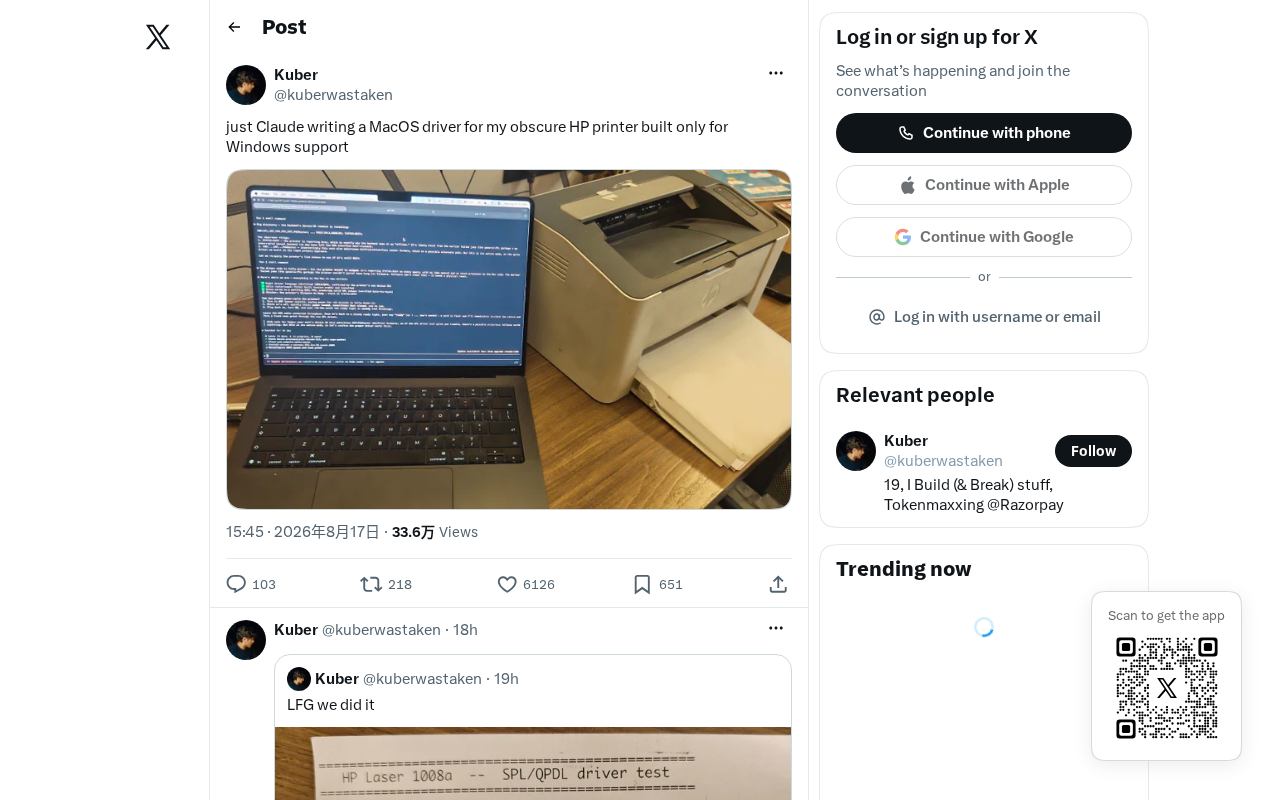
Recently, a post on HackerNews caught the attention of many tech enthusiasts: a developer used Anthropic's Claude to successfully write a macOS driver for an obscure HP printer that only had Windows drivers. While the case seems niche, it reveals the enormous potential of Large Language Models (LLMs) in hardware reverse engineering and low-level system development.
Why Traditional Driver Development Has Such a High Barrier to Entry
Before diving into this case, it's worth understanding why "writing drivers for old devices" is so difficult.
The Complexity of Driver Development
A device driver is the bridge between the operating system and hardware. It requires deep understanding of two domains: first, the hardware device's communication protocols, register mappings, data formats, and other low-level specifications; second, the target operating system's driver framework (such as macOS's CUPS printing system, IOKit, etc.). Both domains are extremely specialized, and combining them typically requires a systems programmer with years of experience.
To appreciate the difficulty of driver development, you need to understand the layered architecture of operating systems. Modern operating systems divide code execution space into Kernel Space and User Space. Kernel-mode code has the highest privileges for accessing hardware and memory—a tiny bug can crash the entire system (a "kernel panic" or blue screen). Device drivers are precisely the code running in this sensitive zone—although macOS print drivers typically exist as user-space filters, the underlying USB communication and device management still involves IOKit, a kernel-level framework. macOS's driver architecture has evolved through multiple iterations: from the early IOKit (a C++-based kernel extension framework) to DriverKit introduced in macOS 11 (which moves drivers to user space for improved security). This means driver developers must not only understand hardware but also keep up with Apple's constantly changing system architecture.
For a major manufacturer like HP, maintaining cross-platform drivers for a long-discontinued niche model has an extremely low ROI, making "Windows-only drivers" a very common business decision. Users who want to use such devices on macOS typically have only two options: give up, or reverse-engineer it themselves—and the latter is too high a bar for the vast majority of people.
The Core Pain Points of Reverse Engineering
Reversing a proprietary printing protocol typically means capturing and analyzing the communication data between the Windows driver and the printer, understanding its instruction set, then reimplementing it using the target system's APIs. This process involves extensive trial and error, protocol guesswork, and low-level debugging—classic "grunt work" that's precisely where AI tools can shine.
Specifically, reverse engineers typically use tools like USBPcap or Wireshark on the Windows side to intercept USB communication packets between the host and printer. Printer protocols roughly fall into several categories: standard protocols (such as HP's PCL—Printer Command Language—and Adobe's PostScript) and vendor-proprietary protocols. Many budget printers, to reduce firmware costs, adopt so-called "GDI printer" or "host-based" designs—nearly all rasterization is handled by the host-side driver, and the printer itself only receives pre-processed bitmap data. The proprietary protocols of these devices often have zero public documentation, making reverse engineering extremely difficult. Engineers need to identify page start/end markers, resolution settings, color mode switches, and other commands from hundreds of captured packets—it's essentially an archaeological dig through binary data streams. It's worth noting that the legal boundaries of reverse engineering vary across jurisdictions—the interoperability exception in Section 1201 of the U.S. DMCA, and Article 6 of the EU Computer Programs Directive, typically provide legal space for reverse engineering done for compatibility purposes.
What Role Does Claude Play in Driver Reverse Engineering?
Based on this case, Claude's value is primarily demonstrated at several levels.
Knowledge Integration and Protocol Analysis
What LLMs excel at most is quickly locating relevant knowledge across massive volumes of technical documentation, code, and protocol specifications, then integrating fragmented information into actionable plans. When a developer faces an unfamiliar printing protocol, Claude can help analyze existing Windows driver behavior, interpret communication data, and infer command meanings—dramatically reducing the time cost of protocol comprehension.
In traditional reverse engineering workflows, analysts typically use disassembly/decompilation tools like IDA Pro or Ghidra to statically analyze Windows driver binaries, reconstructing protocol handling logic from assembly code. This process is extremely time-consuming—an experienced reverse engineer might need weeks to untangle the core logic of a moderately complex driver. The LLM's role here isn't to replace these professional tools, but to serve as an "intelligent research assistant": it can quickly explain common patterns in decompiled code, identify characteristic fragments of known protocols, and correlate USB device VID/PIDs with known driver behavior databases. More importantly, when a developer pastes hexadecimal packet capture data to Claude, it can make reasonable initial inferences about the data structure based on the extensive protocol documentation in its training data—such as identifying common frame header formats, checksum algorithms, or data compression methods. This capability advances reverse engineering from a "complete black box" state to a "semi-informed" state, dramatically shortening the exploration cycle.
Cross-Platform Code Translation
macOS's printing subsystem is based on the open-source CUPS (Common Unix Printing System), with drivers typically implemented through PPD files, filters, and backends. Claude can translate the protocol logic reverse-engineered from the Windows side into code conforming to the CUPS architecture—essentially acting as a translator fluent in two "languages," mapping Windows implementation approaches into the Unix ecosystem.
CUPS has a fascinating history: it was originally created by Michael Sweet in 1997 to provide a standardized printing framework for Unix/Linux systems. In 2007, Apple acquired CUPS and hired Sweet, making it the core of macOS's printing subsystem. CUPS's workflow is a "filter chain"—after a print job is generated by an application, it passes through a series of filters that progressively transform the format: first from PDF (macOS's native print format) to an intermediate raster format (via filters like pdftoraster), then a device-specific filter encodes the raster data into protocol commands the printer understands. PPD (PostScript Printer Description) files serve as device capability declarations, describing the printer's supported paper sizes, resolutions, color modes, and other parameters. For printers with proprietary protocols, the core component a developer needs to write is that final "device-specific filter"—a program that accepts standard raster input and outputs a proprietary protocol data stream. Claude's value here lies in understanding both the Windows GDI print pipeline logic (how to pack, compress, and attach control commands to bitmap data) and the CUPS filter interface conventions (reading from stdin, writing to stdout, obtaining job parameters via environment variables), enabling it to establish mappings between two fundamentally different programming paradigms.
An Intelligent Assistant for Iterative Debugging
Driver development is inseparable from repeated debugging. When print output is garbled, a device is unresponsive, or data formats are wrong, the developer can feed error messages and packet captures back to Claude, which proposes corrective hypotheses. This "human-AI pair programming" model transforms what was once a lonely and lengthy debugging process into a collaboration with an intelligent partner.
The Deeper Significance of AI-Assisted Driver Development
The Barrier to Systems-Level Development Is Lowering
In the past, writing device drivers was considered one of the pinnacle skills in the programmer's hierarchy. This case demonstrates that with AI assistance, developers who aren't driver experts can potentially accomplish work that previously required senior engineers. This doesn't mean AI can completely replace specialized knowledge—developers still need the fundamental ability to capture packets, debug, and understand OS architecture—but AI significantly compresses the distance from "wanting to do it" to "getting it done."
Using Technology to Counter Planned Obsolescence
A point of broader social significance is that practices like this provide a technical countermeasure against "planned obsolescence." When manufacturers drop software support, they often force users to discard still-functional hardware, causing resource waste and e-waste. If AI can help communities extend the life of these devices, it undoubtedly has positive value for both environmental protection and consumer rights.
Planned obsolescence isn't a new concept—as early as 1924, the world's major lightbulb manufacturers formed the "Phoebus Cartel," agreeing to artificially limit bulb lifespan to 1,000 hours. In the electronics era, this practice has evolved into more covert forms: making perfectly functional hardware "unusable" by discontinuing software updates and driver support. According to the UN's 2024 Global E-waste Monitor, the world generates over 62 million tonnes of e-waste annually, a significant portion of which consists of devices that were artificially obsoleted rather than physically broken. In recent years, the EU and multiple U.S. states have been advancing "Right to Repair" legislation, requiring manufacturers to provide repair manuals, diagnostic tools, and spare parts. But legislation often lags behind technological evolution, and the open-source community has long been filling this gap through voluntary action—the Linux kernel contains thousands of community-contributed device drivers, many written specifically to keep hardware abandoned by manufacturers working. AI-assisted driver development can be seen as a continuation and acceleration of this tradition: it not only lowers the barrier to contribution but may also enable more non-specialist developers to participate in hardware life-extension efforts.
A New Solution for Long-Tail Hardware Needs
Obscure printers and aging scanners represent a classic "long tail" problem—users of each specific model may be too few to support commercial driver development. But AI's marginal cost is extremely low, making "custom-building a driver for a single device"—something that was once economically unviable—feasible. This could catalyze a wave of community-driven, AI-assisted open-source driver projects.
Limitations That Require a Rational Perspective
Despite the exciting prospects, excessive optimism isn't warranted.
First, projects like this are highly dependent on the developer's own technical background. The post's author clearly has a foundation in reverse engineering and systems development—Claude is an accelerator, not a magic wand. For ordinary users with absolutely no relevant knowledge, AI-generated code remains difficult to put into practice directly.
Second, drivers involve the system's lowest levels, where code quality and security are paramount. AI-generated code may contain subtle memory errors or stability issues, and the risks of running in kernel mode or semi-privileged environments cannot be ignored—rigorous review and testing are essential.
This point deserves elaboration. Bugs in low-level system code are fundamentally different from application-layer bugs: a memory leak in a web application might just slow down a page, but a buffer overflow in a driver can crash the kernel or even be exploited by attackers for privilege escalation. Historically, a vast number of security vulnerabilities have originated in device drivers—Microsoft has revealed that approximately 85% of Windows blue screen crashes are caused by third-party drivers. A typical risk pattern with AI-generated code is: the code works fine on the "happy path" but isn't robust enough in handling edge cases (such as a device suddenly disconnecting, receiving malformed data, or memory allocation failures). In driver development scenarios, this means a device might work normally 99% of the time but trigger hard-to-reproduce crashes under specific conditions. Therefore, even after AI generates initial code, developers still need to perform systematic verification using AddressSanitizer, static analysis tools, fuzzing, and other techniques—verification work that itself requires specialized knowledge.
Finally, judging by the community engagement on HackerNews, this remains a niche geek exploration, still quite far from being scalable or productized. It's more of an inspiring proof of concept (PoC), pointing in a direction rather than constituting a mature solution.
Conclusion
From the seemingly small matter of writing a macOS driver for an obscure HP printer, we see AI programming capabilities penetrating into hardcore domains like systems-level development and hardware interaction. When LLMs are no longer just writing web apps and scripts but can assist in tackling high-barrier tasks like driver reverse engineering, the capability boundaries of software development are being redefined.
For those old devices gathering dust in drawers, this may be good news: with AI's help, they no longer have to be abandoned by the march of time. And for the broader technology community, this case reminds us—AI's most valuable applications are often hidden in corners overlooked by commercial logic.
Related articles

Gaussian Process Bandit Optimization: Exploration Strategies and Inference Regret Guarantees
Cumulative regret guarantees in Bayesian optimization fail to reflect final recommendation quality. This article examines a new study that provides inference regret guarantees for Gaussian process bandit optimization through exploration query strategies and fill distance analysis, validated on hyperparameter optimization and control tasks.
The Most Detailed Codex Guide on Bilibili: From Installation to Real-World Practice
The most detailed Codex guide on Bilibili: from app store installation to daily work mode configuration, with a real coffee shop project demonstrating file organization, data extraction, dashboard creation, and other practical tasks. Learn to use Plan Mode and desktop pets to leverage Codex efficiently.

Appearance Compensation in Volume Rendering: Why RGB Accuracy Cannot Guarantee Density Correctness
Volume rendering research reveals that volumetric data perfectly reproducing external RGB views may still contain density errors: appearance compensation can double central density and keep external rays unchanged even when L2 error exceeds 14.52%. Density recovery depends on appearance capacity, spatial resolution, and measurement design.