Xiaohongshu MCP Automation Tool: Complete Content Operations Through AI Conversations
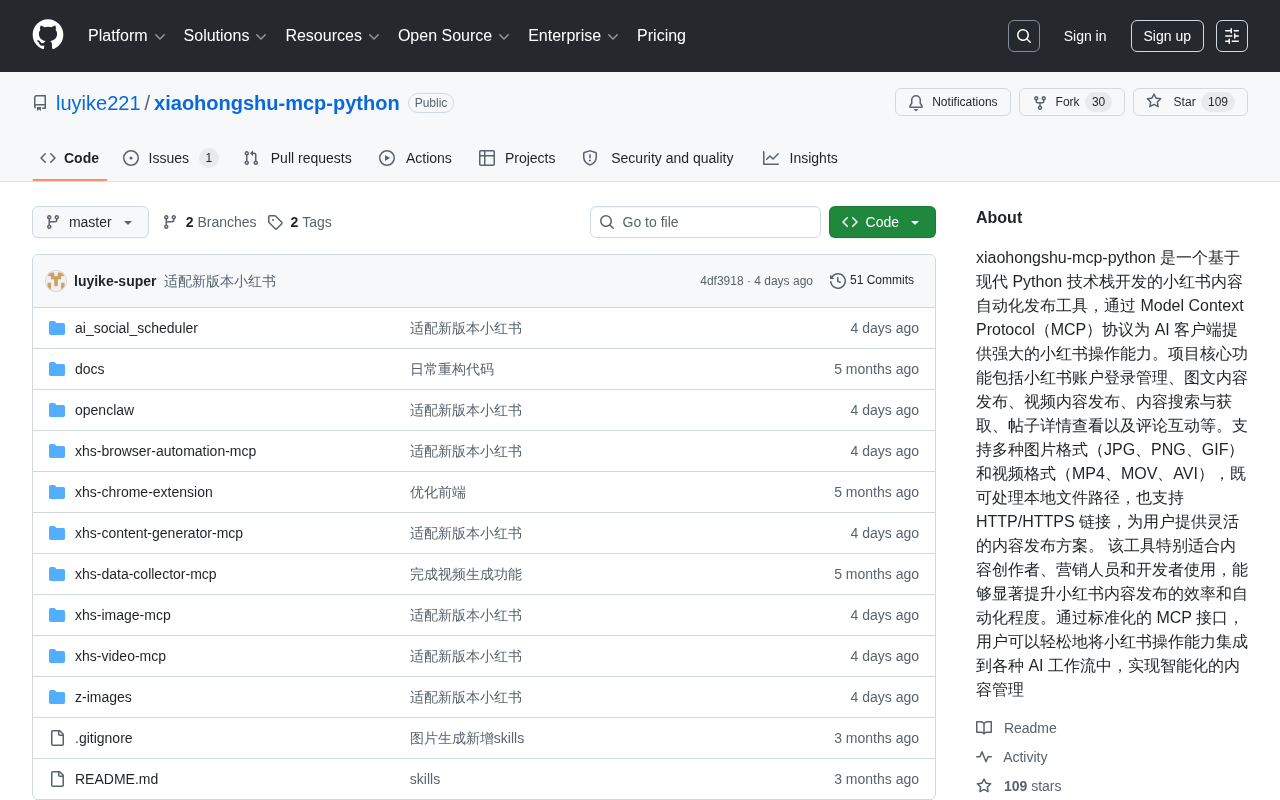
MCP-based Xiaohongshu AI automation tool enabling standardized content publishing, search, and interaction
The open-source project xiaohongshu-mcp-python leverages Anthropic's MCP protocol to provide AI clients with standardized Xiaohongshu operation interfaces, supporting image/video publishing, content search, and comment interactions. MCP acts as the "USB port" of the AI world, decoupling tools from AI clients. The tool suits content creators seeking efficiency, marketing teams running batch operations, and developers needing integration components—though the lack of official Xiaohongshu API introduces platform compliance and stability risks.
Project Overview: Bridging AI and Xiaohongshu
AI Agents and automated workflows are reshaping the way content is created. An AI Agent refers to an intelligent system capable of autonomously perceiving its environment, formulating plans, and executing actions. Unlike traditional RPA (Robotic Process Automation), AI Agents don't just execute fixed processes according to preset rules—they can dynamically adjust strategies based on the reasoning capabilities of large language models. For example, they might automatically adapt copywriting style based on current trends, or optimize the next round of content based on performance feedback. Current mainstream Agent frameworks include LangChain, AutoGPT, CrewAI, and others, all attempting to solve the same problem: how to evolve AI from a "conversational assistant" into an "action executor."
For Xiaohongshu (RedNote) operators, a practical question arises: How do you connect the capabilities of large language models directly to daily Xiaohongshu operations?
The open-source GitHub project xiaohongshu-mcp-python offers a viable solution. Built on the Model Context Protocol (MCP), it provides AI clients with a complete set of Xiaohongshu content automation capabilities—including publishing images/videos, searching content, retrieving post details, and comment interactions.
As of now, the project has garnered 103 Stars and 30 Forks. While not massive in scale, its design philosophy and technical choices are highly representative, reflecting a key development direction in the AI toolchain ecosystem.
What Is MCP? Understanding the USB Port of the AI Toolchain
Model Context Protocol (MCP), formally introduced by Anthropic in late 2024, is an open protocol aimed at standardizing how AI models interact with external tools and data sources.
To use an analogy: MCP is like the "USB port" of the AI world. It defines a unified specification that allows different AI clients like Claude Desktop and Cursor to invoke external tools in the same way.
From a technical architecture perspective, MCP adopts the classic client-server model. The MCP server (i.e., the Xiaohongshu tool discussed here) exposes a set of standardized "tool" definitions, including tool names, parameter structures, and return formats; the MCP client (such as Claude Desktop) communicates with the server via the JSON-RPC 2.0 protocol to discover and invoke tools. The elegance of this design lies in decoupling: tool developers only need to implement the server according to the MCP specification to automatically be compatible with all MCP-supporting AI clients, without needing to adapt for each client individually.
Before MCP, AI tool invocation primarily relied on OpenAI's Function Calling mechanism or custom plugin systems from various frameworks. The problem with these approaches was fragmentation—each platform had its own tool description format and invocation protocol, forcing developers to repeatedly adapt. MCP aims to end this situation, just as USB unified peripheral interfaces. Currently, beyond Anthropic's own Claude, development tools like Cursor, Windsurf, and Cline also support the MCP protocol, and the ecosystem is expanding rapidly.
The core value of this Xiaohongshu MCP tool lies precisely here—it's not an isolated automation script, but a standardized service callable by any MCP-compatible client. In practice, you can have AI help you complete Xiaohongshu content publishing, searching, and interaction operations directly during a conversation.
In other words, conversation is operation, chatting is working.
Core Features: A Complete Loop from Publishing to Interaction
Account Login and Session Management
The tool has built-in automated login flow for Xiaohongshu accounts, which is the prerequisite for all subsequent operations. After login, it automatically maintains session state, eliminating the hassle of repeatedly operating a browser manually.
From a technical implementation perspective, such automated login typically relies on browser automation frameworks like Playwright or Puppeteer. These frameworks can launch a real browser instance (Chromium kernel) and simulate user clicks, inputs, scrolling, and other actions. The key to session maintenance lies in Cookie management—after successful login, the framework captures and persistently stores the authentication Cookies returned by the platform, and subsequent requests automatically carry these Cookies to maintain the login state. Some implementations also employ "browser fingerprint persistence" strategies, fixing User-Agent, screen resolution, timezone, and other browser characteristic parameters to reduce the probability of being identified as an automation tool by the platform's risk control system.
Image/Text and Video Content Publishing
This is the most core module of the entire tool, specifically supporting:
- Image/text publishing: Compatible with common image formats including JPG, PNG, GIF
- Video publishing: Supports mainstream video formats including MP4, MOV, AVI
- Flexible media sources: Both local file paths and HTTP/HTTPS remote links can be used directly
This design is extremely convenient in real-world scenarios. For example, if AI generates a cover image saved locally, or finds a suitable stock image online, both can be directly used as part of the published content without additional format conversion or manual uploading.
It's worth noting that automated multimedia file uploading is technically non-trivial. Platforms like Xiaohongshu typically have strict format, resolution, and file size requirements for uploaded images and videos, and may require specific upload protocols (such as chunked uploads or resumable uploads). The tool needs to automatically handle image compression, video transcoding, thumbnail generation, and other preprocessing steps in the background. For remote URL assets, there's additional logic for file downloading, temporary storage, and cleanup. These seemingly "transparent" processing steps are actually crucial guarantees of tool usability.
Content Search and Community Interaction
Beyond publishing, the tool also covers the "viewing" and "interaction" aspects:
- Keyword search: Search for related content on the Xiaohongshu platform by keywords
- Post detail retrieval: View complete information about a specified post (copy, metrics, etc.)
- Comment functionality: Support commenting on posts
Combined together, AI can not only publish content but also analyze competitors, track trends, and participate in community interactions—basically covering the main aspects of daily Xiaohongshu operations.
Three Typical Application Scenarios
Scenario 1: Efficiency Booster for Content Creators
Creators who need to consistently update on Xiaohongshu can build a workflow like this:
AI generates copy based on trending topics → automatically matches or generates images → one-click publish to Xiaohongshu
From ideation to publishing, the entire process may only require a few minutes of conversational interaction, dramatically compressing time spent on repetitive operations.
Scenario 2: Batch Operations for Marketing Teams
Marketing professionals can leverage this tool for batch, templated content publishing. Meanwhile, the search function can be used to monitor competitor activity and industry trends, feeding this intelligence back to AI for strategy adjustments, forming an "monitor—analyze—execute" operational loop.
Scenario 3: Integration Component for Developers
If you're building an AI Agent or a larger automation system, this project provides a ready-made MCP server implementation that can be integrated directly as a module into your system architecture, saving the cost of developing from scratch.
Technical Implementation and Compliance Considerations
An interesting detail: although the project name contains "python," GitHub shows its primary language as TypeScript. The likely explanation is that TypeScript is used for frontend interaction and build tooling, while the underlying automation logic is implemented in Python. This mixed technology stack is not uncommon in modern development—TypeScript excels at handling asynchronous I/O and frontend builds, while Python has natural advantages in the AI/ML ecosystem and rapid prototyping, and combining both leverages the strengths of each.
Xiaohongshu's Technical Ecosystem and Reverse Engineering Challenges
Understanding the technical risks of such tools requires first understanding Xiaohongshu's platform characteristics. Xiaohongshu has never provided an official open API (unlike overseas platforms like Twitter/X and Instagram which offer varying degrees of developer interfaces), meaning all third-party automation tools must interact with the platform through "unofficial" means. There are two common technical approaches: one is browser-based automation that simulates real user behavior on the web interface; the other is reverse engineering Xiaohongshu's private API interfaces through packet capture analysis, directly constructing HTTP requests.
The former's advantage is that behavior patterns more closely resemble real users, with relatively lower detection probability, but it's slower and more resource-intensive; the latter is more efficient but faces challenges like interface changes at any time and encryption signature algorithm updates. In recent years, Xiaohongshu has continuously strengthened anti-crawling and anti-automation measures, including but not limited to request signature verification (custom headers like X-Sign), device fingerprint detection, behavioral frequency analysis, and CAPTCHA challenges. This is why such tools have "uncertain stability"—they are essentially engaged in an ongoing technical battle with the platform's security team.
When using such Xiaohongshu automation tools, several issues must be confronted:
-
Platform compliance risk: Xiaohongshu has explicit restrictions on automated operations; excessive frequency or abnormal behavior may result in account throttling or even banning. Xiaohongshu's Community Guidelines and User Agreement explicitly prohibit the use of "plugins, extensions, or other third-party tools" to interfere with normal platform operations. From an industry trend perspective, major Chinese social platforms (WeChat, Douyin, Xiaohongshu, etc.) are continuously strengthening control over automated operations—not only upgrading detection methods at the technical level, but also beginning to invoke the Anti-Unfair Competition Law to file lawsuits against malicious scraping and automation at the legal level. Best practices for compliant use include: strictly controlling operation frequency (simulating normal human usage patterns), avoiding batch account registration, not conducting large-scale data scraping, and ensuring published content complies with platform community guidelines.
-
Content quality cannot be compromised: Automation solves efficiency problems, not quality problems. AI-generated copy and images still require human review and quality control.
-
Account security: The tool involves account login credentials, so the security of the deployment environment must be guaranteed to prevent information leakage.
-
Stability is uncertain: Since Xiaohongshu doesn't provide an official open API, such tools typically rely on reverse engineering, and the tool may break at any time if the platform updates its interfaces.
Conclusion: Social Media Automation Trends in the MCP Ecosystem
The xiaohongshu-mcp-python project represents a clear trend: standardizing social media operational capabilities through the MCP protocol, packaging them as plug-and-play modules in the AI toolchain.
The deeper driving force behind this trend comes from a fundamental shift in AI application paradigms. Since 2023, the capability boundary of large language models has rapidly expanded from "understanding and generating text" to "understanding intent and executing actions." OpenAI's Function Calling, Anthropic's MCP, and Google's Gemini API tool calling are all essentially solving the same problem: transforming AI from "just talking" to "actually doing." MCP's unique value lies in its openness and degree of standardization—it's not tied to a specific model provider, and any AI client and any tool server can interconnect through this protocol. One can imagine that future AI workbenches might function like a "tool marketplace," where users install various MCP services on demand (Xiaohongshu operations, email management, data analysis, code deployment...) and orchestrate them all through natural language conversation.
As the MCP ecosystem continues to mature, similar tools will predictably become more numerous, covering more platforms and more operational scenarios.
For users who want to try AI-driven Xiaohongshu operations, this project is a noteworthy starting point—both for direct hands-on use and as a reference case for learning MCP protocol implementation. However, in actual practice, it's essential to find a balance between automation efficiency and platform rules, ensuring tools truly serve the creation and dissemination of quality content rather than becoming assembly lines for low-quality content.
Key Takeaways
- The project provides standardized Xiaohongshu operation interfaces for AI clients through the MCP protocol, supporting a complete functional loop of content publishing, searching, and interaction
- MCP protocol adopts a client-server architecture with JSON-RPC communication, achieving complete decoupling between tool development and AI clients—a critical infrastructure for AI toolchain standardization
- Supports multiple image and video formats, compatible with both local files and remote URLs as media sources, with automatic format conversion and upload protocol adaptation handled in the background
- Applicable to multiple scenarios including creator efficiency, marketing team batch operations, and developer system integration
- Since Xiaohongshu doesn't provide an official API, the tool relies on browser automation or reverse engineering, facing ongoing challenges from interface changes and platform risk control
- Using such automation tools requires attention to platform compliance, content quality control, and account security risks; strictly controlling operation frequency and maintaining human review processes is recommended
- The project represents the development trend of social media tool standardization in the MCP ecosystem, foreshadowing the future direction of AI workbench "tool marketplace" models
Related articles
 Product Reviews
The Programmer's Desk Setup Guide: Building a Workspace That Feels Like Home
Discover how programmers build productive, comfortable workspaces. From multi-monitor setups to ergonomic design, explore the desk philosophy that drives focus and flow.
 Product Reviews
Qoder vs Cursor Real-World Comparison: Which $20/Month AI IDE Is Better?
Hands-on comparison of Qoder vs Cursor AI IDEs: Agent autonomy, human interaction count, and architecture decisions. Qoder needed only 2 interactions vs Cursor's 8.
 Product Reviews
Cursor Cloud Agent Demo: Eliminating Bottlenecks Across the Entire Software Development Lifecycle
Deep analysis of Cursor's Cloud Agent demo showing how cloud VMs, automated test artifacts, and a full-chain control plane systematically eliminate human bottlenecks across the software development lifecycle.