Xiaomi MiMo-V2.6 Live Training: ¥8.55M Spent in One and a Half Days, ~$10 per Second
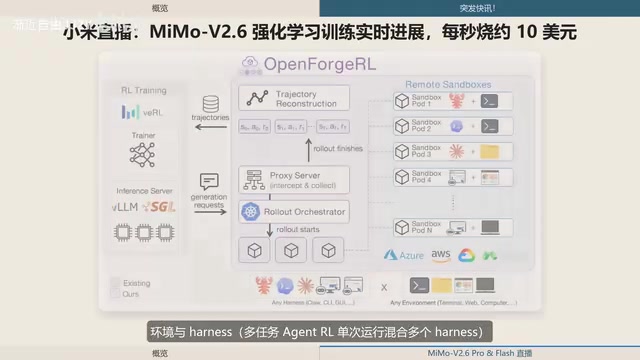
Xiaomi live-streams MiMo V2.6 RL training, burning ¥8.55M in 1.5 days at roughly $10 per second.
Xiaomi's MiMo team is publicly live-streaming the reinforcement learning training of MiMo V2.6 Pro and Flash, having spent roughly ¥8.55M (~$1.28M) in just one and a half days — about $10 per second. Training scales across three dimensions: large-batch rollout sampling, multi-task agent IO architecture, and fine-grained credit assignment with test cases and rubrics. On DeepSWE V1.1, Pro scores 63.72 and Flash scores 60.77, trailing DeepSeek V4.1 Flash's 74.1. Xiaomi plans to open-source training details in the coming weeks.
Xiaomi's large model team has found a uniquely attention-grabbing way to show the world what training a frontier AI model actually costs — by live-streaming the reinforcement learning (RL) training process in real time. According to a late-night post from Luo Fuli, head of the MiMo large model team, the MiMo V2.6 series is currently in the RL training phase, and the team has chosen not only to share training details publicly but to display the entire burn rate live for anyone to watch.
Live-Streaming Training: Putting the Burn Rate on Full Display
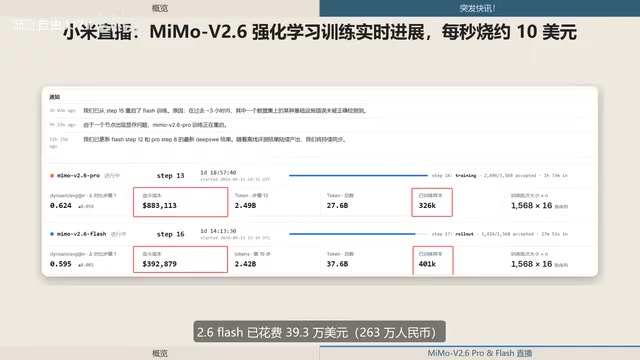
The most eye-catching aspect of this live stream is its cost transparency. As of 1:45 PM when the video was recorded, MiMo V2.6 had already trained on 727,000 samples — with MiMo 2.6 Pro having spent $883,000 (approximately ¥5.92M) and MiMo 2.6 Flash having spent $393,000 (approximately ¥2.63M), totaling roughly ¥8.55M combined.
The stream had been running for about a day and a half, which works out to an average spend of roughly ¥60 per second — approaching the $10-per-second mark. This approach of showing a live-scrolling training bill gives the public an intuitive sense of just how capital-intensive frontier model training really is. It's no longer an abstract figure buried in a financial report; it's a cost counter ticking up every single second.
For the industry, this level of transparency is itself a signal. Training costs for large models have historically been treated as closely guarded commercial secrets. Xiaomi's decision to go public is both a display of confidence and a very public endorsement of its scale of compute investment.
The Technical Path: Scaling Compute Across Three Dimensions
According to Luo Fuli, MiMo V2.6's RL training scales compute along three distinct dimensions — and understanding these is key to appreciating the technical substance behind this run.
First: scaling training volume. Each training step processes approximately 2B tokens, using 1,568 prompts with 16 rollouts per prompt. This large-batch sampling approach is a well-established method in current RL training for improving sample efficiency and training stability.
Second: scaling environments and harnesses. The team uses a multi-task agent IO architecture that mixes multiple harnesses within a single run. This means the model isn't trained in a single-task environment, but is simultaneously exposed to multiple task types and tool-calling scenarios — more closely mirroring the demands of real-world agentic applications.
Third: scaling scoring and credit assignment. Training incorporates agentic intra-group credit assignment, test cases, and rubric-based rewards in combination. This multi-pronged approach aims to more accurately evaluate the value of each action the model takes across complex multi-step tasks, providing more effective reward signals as a result. The team openly admits they are still investigating how far RL can actually be scaled — a fundamentally open research question at the frontier.
The role of RL in large model training: Unlike the pretraining phase, which uses supervised learning on massive text corpora, the RL phase is fundamentally about teaching the model how to do better rather than how to imitate existing answers. The model generates multiple candidate responses (rollouts) for the same prompt, which are then scored by a reward model or rule-based function. A policy gradient algorithm (such as PPO or GRPO) then updates the model parameters to reinforce high-scoring behaviors and suppress low-scoring ones. This phase demands far more compute than standard fine-tuning: each training step requires running inference (to generate rollouts) and backpropagation (to update weights) simultaneously, effectively stacking inference costs on top of training costs. The configuration MiMo's team has made public — 2B tokens per step, 16 rollouts — is a textbook example of the large-batch RL paradigm the industry has converged on to balance sample diversity with training stability.
The credit assignment challenge: In multi-step agentic tasks, a model may need to execute dozens of sequential actions to complete a goal (e.g., writing code, calling tools, verifying results). Traditional reward schemes assign a single final score only upon task completion, giving the model no signal about which specific steps were correct or incorrect. This is the classic "credit assignment problem under sparse rewards." MiMo's approach of "agentic intra-group credit assignment" combined with test case and rubric rewards is designed to provide finer-grained evaluation signals at each intermediate step — for example, how many unit tests passed, whether the output format meets specifications — helping the model learn complex reasoning chains more efficiently rather than relying on stumbling upon a fully correct trajectory by chance. This is one of the most central and hardest-to-solve engineering challenges in current agentic RL research.
Upcoming Open-Source Release and Model Launch
Beyond the live stream, Xiaomi has promised to gradually open-source the training details over the coming weeks. The MiMo V2.6 series models — including both Pro and Flash variants — are also set to launch soon.
The value of open-sourcing training details lies in the fact that the engineering implementation of RL training is often far harder to reproduce than model weights alone. Practical knowledge around harness design, credit assignment strategies, and reward function construction would be a meaningful contribution to the broader open-source community. If Xiaomi delivers on this commitment, it will add genuinely useful content to the public knowledge base for RL training in China.
Benchmark Results: Competitive but Still Catching Up
Based on publicly available benchmark results, MiMo V2.6 scores 63.72 (Pro) and 60.77 (Flash) on the DeepSWE V1.1 evaluation. After checking the latest data on the DeepSWE official leaderboard, the reviewer noted that MiMo 2.6 Pro's score is now roughly on par with a competing Flash-tier model from another vendor.
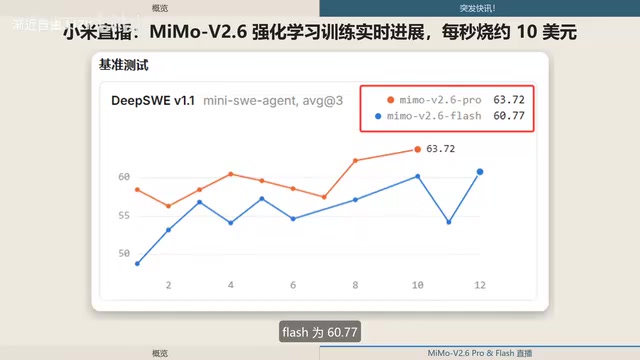
For reference, DeepSeek V4.1 Flash reported a DeepSWE V1.1 score of 74.1 at launch. This means MiMo V2.6 still has a meaningful gap to close on this agentic coding benchmark and remains in catch-up mode. That said, the model is still mid-training, so the final scores have room to improve — which is precisely what makes the live stream compelling: viewers can watch the numbers move in real time as training progresses.
It's worth noting that no single benchmark can fully characterize a model's capabilities. DeepSWE skews heavily toward coding and agentic tasks, and real-world performance warrants evaluation across additional dimensions.
About the DeepSWE benchmark: DeepSWE is a benchmark specifically designed to evaluate the capabilities of Software Engineering Agents. The core task requires a model to autonomously locate bugs within real code repositories, apply fixes, and verify correctness through test cases. Unlike traditional coding problems, DeepSWE demands a complete set of agentic capabilities: multi-turn tool calling, file reading and writing, code execution, and self-correction. It is therefore widely regarded as an industry reference point for measuring agentic coding ability. Scores are typically expressed as a resolve rate — the percentage of problems the model successfully solves. Because the task difficulty closely mirrors real-world development scenarios, high performance on DeepSWE is generally considered strong evidence of practical engineering utility.
Closing Thoughts
Xiaomi's live-streamed MiMo V2.6 training is fundamentally an experiment in turning the AI R&D process into a product and a piece of content. It satisfies the public's curiosity about what frontier AI training actually looks like, while using a very real and very public bill to tell the industry exactly how expensive a ticket to the top tier really is. For technical practitioners, the real value will emerge over the coming weeks as training details are gradually open-sourced. Those interested can follow the live stream and watch to see how far this $10-per-second experiment can push the boundaries of RL.
Related articles
Andrew Ng on Agentic AI: Cutting Through the Hype to Find Real Value in Agent Development
Andrew Ng's Agentic AI course intro: separating hype from real value, exploring agent workflows in customer service, research, law, and healthcare, and why evals and error analysis define expert-level agent development.
The Netflix Microservices Myth: An Architecture Migration Misunderstood by an Entire Industry
The real story behind Netflix's cloud migration and microservices transformation — and why the entire industry copied the solution while missing the actual problem.

Java 27 Deep Dive: How Default Changes Are Quietly Reshaping Production Environments
Java 27 has just 9 JEPs but changes key defaults: compact object headers on by default, G1 as unconditional default GC, Flight Recorder redaction, and built-in post-quantum TLS 1.3.