Xiaomi MiMo V2.6 Pro Tops Open-Source Rankings: A Deep Dive into Its Value-for-Money Edge

Xiaomi MiMo V2.6 Pro tops the open-source leaderboard with flagship intelligence at a fraction of the cost.
Xiaomi MiMo V2.6 Pro scores 46 points on Artificial Analysis's overall leaderboard (7th overall, 1st open-source), with the entire open-source top five dominated by Chinese models. Its standout advantage is cost: just $0.0026 per task — about 1/38th of the Claude flagship. It also delivers 104.9 tokens/second (fastest among Pro flagships) and a 1M-token context window. These gains stem from its sparse MoE architecture: 472B total parameters with only 31B activated per inference, compressing compute without sacrificing capability.
Xiaomi's new MiMo model (referred to as "Memo" in the video) has sparked considerable discussion since its release. According to an analysis by Bilibili creator AI小童, Xiaomi founder Lei Jun claimed on Weibo that MiMo has become the top-ranked open-source model. Is this marketing hype, or is there real data to back it up? Using multiple leaderboards from the third-party evaluation platform Artificial Analysis, we can take a relatively objective look at MiMo V2.6 Pro's actual performance.
Overall Leaderboard: Breaking Into the Top Tier on Debut
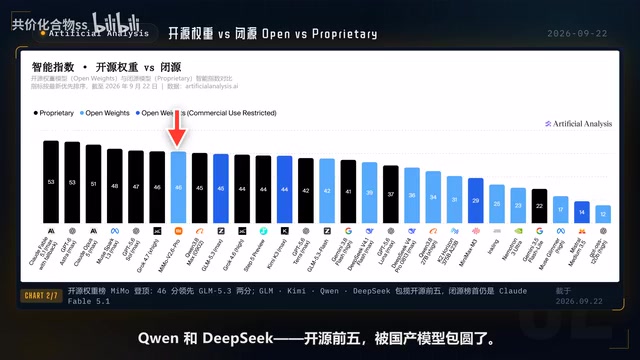
On Artificial Analysis's overall intelligence leaderboard, MiMo V2.6 Pro scored 46 points, tying with Grok 4.7 for sixth and seventh place. To appreciate what this score means, you need to look at the broader picture: GLM 5.3 and Kimi K3, ranked eighth and ninth, both sit at 44 points, while the top-ranked Claude flagship series scores just 55.
In other words, MiMo's first appearance in the top ten places it right at the tail end of the first tier — a very strong starting position. For a newly released model to directly benchmark against leading flagships in overall capability suggests that Xiaomi's investment in model training isn't exploratory — it's a serious bid for the top.
Open-Source Weights Leaderboard: Domestic Models Sweep the Board
Once closed-source models are removed, the story gets even more interesting. MiMo V2.6 Pro jumps straight to the top of the open-source weights leaderboard with 46 points, beating second-place GLM 5.3 by a full 2 points. Kimi K3, Qwen (QN), and DeepSeekAd follow close behind.
Notably, the entire top five on the open-source leaderboard is occupied by Chinese models. This reflects a broader rise of domestic large language models in the open-source ecosystem — not just isolated breakthroughs, but a collective competitive advantage. MiMo claiming the top spot in such a competitive field carries more weight than the raw score alone.
Cost Advantage: Flagship Performance at Fraction of the Price
If the rankings are about prestige, then cost per task is where MiMo really earns its keep.
According to the video data, MiMo V2.6 Pro completes a single task for just $0.0026. To put that in perspective: the Claude flagship costs 38 times more, Gemini 3.5 Ultra is over 4 times more expensive, GPT-6 costs more than 7 times as much, and even the relatively affordable GPT-5.6 runs 20–30% higher.
This becomes even clearer on a scatter plot of intelligence index vs. cost: MiMo's data point sits on the far left of the horizontal axis (among the cheapest options) while remaining firmly in the top ten on the vertical axis. With competitors charging tens of times more per task at the same performance tier, calling MiMo the "price-performance king" isn't much of an exaggeration. For enterprises and developers running large-scale API calls, this cost gap compounds significantly in production deployments.
The "cost per task" metric is typically calculated by evaluation platforms based on average input/output token counts from a standardized test set, combined with API pricing — reflecting per-call costs under typical workloads rather than peak consumption in extreme scenarios. For enterprise users, this metric often matters more than rankings: at one million daily API calls, the difference between $0.0026 and $0.10 translates into a monthly bill that's dozens of times higher. Keep in mind that API pricing can change at any time, and different providers have varying policies on rate limits, concurrency, and SLA guarantees — all of which should factor into real deployment decisions.
Speed and Context: The Fastest Model in the Flagship Tier
MiMo also delivers an impressive performance on inference speed.
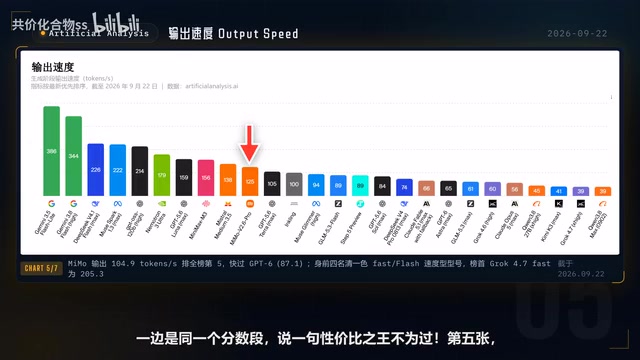
At 104.9 tokens per second, MiMo ranks fifth on the full leaderboard — faster than GPT-6's 87 tokens per second. The four models ahead of it are all purpose-built speed-optimized variants (Fast, Flash, etc.). Among models positioned as "Pro flagship" offerings, MiMo is the fastest — delivering both capability and responsiveness without sacrificing quality for speed.
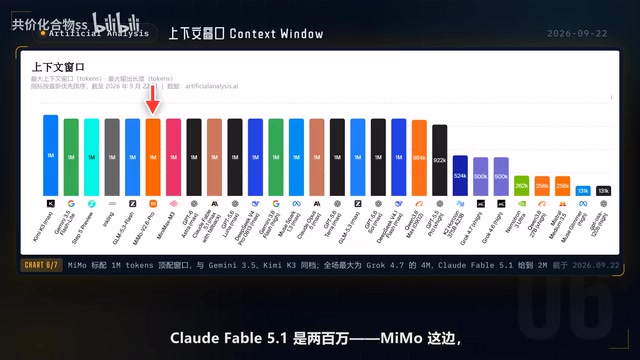
On context window size, MiMo offers a top-tier 1 million tokens, on par with Gemini 3.5 and Kimi K3. The largest on the market is Grok 4.7 at 4 million tokens, while the Claude flagship series offers 2 million. While not the absolute largest, 1 million tokens is more than sufficient for the vast majority of long-text processing scenarios — MiMo has no obvious weakness on this dimension.
Architecture: MoE Puts Compute Where It Counts
Looking at model architecture, MiMo V2.6 Pro has 472 billion total parameters but activates only 31 billion per inference — a textbook sparse MoE (Mixture of Experts) design.
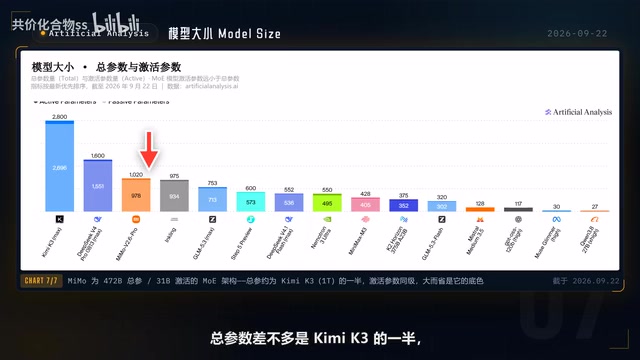
By comparison, its total parameter count is roughly half that of Kimi K3, yet its activated parameters are in the same ballpark. This explains the cost and speed advantages described earlier: through a "large but sparse" design, MiMo retains the knowledge capacity of a large model while keeping actual per-inference computation extremely low. Scaling up total parameters while controlling activated ones is exactly the kind of engineering discipline that gets the most out of every dollar spent.
MoE (Mixture of Experts) architecture works by splitting a model into multiple "expert" sub-networks. During each inference, a lightweight "gating network" dynamically selects a small subset of experts to participate in computation, rather than activating all parameters. This stands in sharp contrast to traditional dense models, which engage all parameters on every forward pass. The key advantage: a model can accumulate far more total knowledge than any single inference requires (large total parameters), while actual compute costs depend only on the activated subset (small active parameters) — achieving order-of-magnitude compression in both speed and cost. This architecture isn't unique to Xiaomi; OpenAI's GPT-4, Google's Gemini series, and DeepSeek-V3 all use similar designs. MiMo achieving comparable scores to flagship-tier models with just 31 billion activated parameters suggests its expert routing and training strategies have been thoroughly optimized — not simply inflated by raw parameter count.
Conclusion: Lei Jun Wasn't Overstating It
Taken together, MiMo V2.6 Pro ranks seventh overall and first among open-source models, costs just $0.0026 per task, and doesn't lag on speed. Cross-referencing multiple Artificial Analysis metrics, Lei Jun's claim of "open-source number one" holds up in terms of comprehensive leaderboard standing.
Of course, these evaluation results come from a single third-party platform. Real-world usability, generalization across tasks, and stability in specific business scenarios still need to be validated through broader user testing and long-term deployment. But based on the numbers alone, MiMo's performance is more than enough to earn it a spot on any developer's shortlist. Would you consider giving this model a try?
Related articles

Amphibious Transforming Drone: Beyond 100x Power Savings, What Are the Real Needs?
Is the amphibious transforming drone just a gimmick? Starting from the 100x power difference of the M4 Morphobot, explore real application scenarios and thesis topic ideas, analyzing boundary conditions where pure drones and pure ground robots both fail.

Warhound Raises $200 Million: Genetically Engineered "War Dogs" Paired with Anduril Gear
Warhound raises $200M, backed by Ben Lamm and Palmer Luckey, to genetically engineer dogs for military and law enforcement use and equip them with Anduril gear. This article analyzes its technology direction, funding logic, and ethical controversy.

Claude API Comes to Google Cloud: IAM Integration and SDK Access Guide
Anthropic hosts the full Claude API on Google Cloud with IAM-controlled permissions and unified billing. This guide covers the Vertex AI and Anthropic-hosted entry points, IAM role configuration, and SDK access.