Xiaozhi AI Embedded Practical Project: Open-Source C++ ESP32 Project Becomes a New Learning Favorite

Bilibili creator includes open-source Xiaozhi AI ESP32 project in C++ training camp, analyzing architecture and learning value.
This article introduces how a Bilibili creator incorporates the open-source "Xiaozhi AI" project as Project Five in their training camp. Based on the MIT license, Xiaozhi AI deploys large models onto ESP32 for voice dialogue, covering key technologies like C++ engineering, FreeRTOS, network communication, AI integration, and hardware abstraction. The creator praises its architecture, believing it helps students boost resumes, aids embedded beginners in mastering a complete project, and lets industrial software developers expand technical boundaries. The camp includes over ten chapters of notes emphasizing architectural thinking over code details, and notes that those with a foundation can self-study while beginners should follow systematic courses.
In the wave of integrating open-source hardware with AI, an ESP32 project called "Xiaozhi AI" is quietly becoming a new favorite among C++ embedded development learners. In a recent video, a Bilibili creator detailed the newly added "Project Five" of their training camp—an embedded ESP32 practical tutorial based on the open-source Xiaozhi AI project—and shared the project architecture, learning value, and target audience. This article, based on the video content, outlines the technical highlights and learning path of the project.
Project Background: From Open-Source Community to Teaching Case
Xiaozhi AI is an open-source project under the MIT license, allowing anyone to use, modify, and even commercialize it for free. The project is highly popular on GitHub, and its core idea is to deploy large model capabilities onto a microcontroller (ESP32) to enable voice dialogue and function extensions. In the video, the creator mentioned that after personally soldering the board and debugging the code, they were deeply impressed by its excellent engineering design, and both the code volume and architecture design have teaching value, so they included it as an extended project in the training camp.
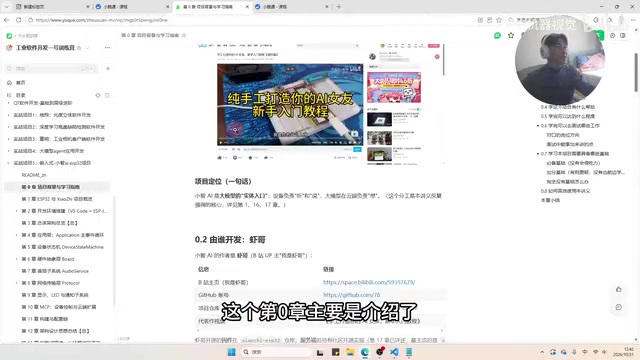
"This project is an open-source project under the MIT license, and anyone can use, modify, and even commercialize it for free." — the creator emphasized in the video.
According to the creator, Xiaozhi AI became popular in 2024, and although it is not the latest hot topic now, its engineering practice value remains outstanding. For students, having an open-source project with "real technical popularity" on their resume better reflects technical vision and engineering ability compared to overused library management systems.
Technical Architecture: Hardware Abstraction and AI Integration
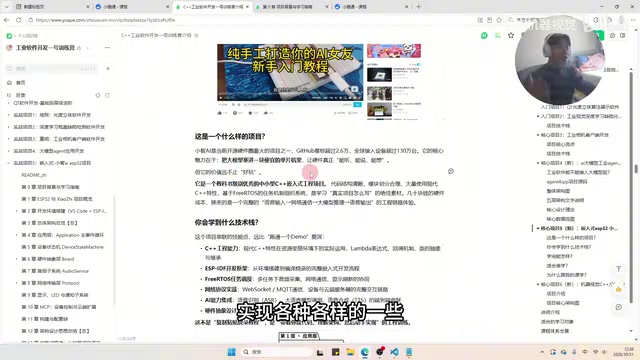
The architecture design of the Xiaozhi AI project was repeatedly praised by the creator. From a technical stack perspective, learning this project covers multiple key areas:
- C++ engineering skills: The project code structure is clear and contains extensive C++ practice, suitable for improving engineering thinking.
- ESP32 development framework: As an embedded software development project, learners can master ESP32 hardware interfaces and development processes.
- FreeRTOS: The project uses a real-time operating system. Although the creator admitted not having delved deeply into it, it is an important skill in embedded development.
- Network communication: Involves device networking and data transmission.
- AI capability integration: Large model dialogue and end-to-end voice processing, reflecting the combination of AI and embedded systems.
- Hardware abstraction design: The creator particularly pointed out that hardware abstraction is a "very core architectural design idea" of the project, helping to understand software-hardware decoupling.
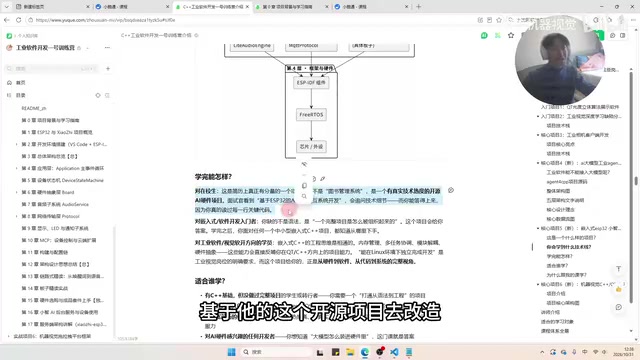
Although the architecture diagram shown by the creator is not fully captured in the screenshot, their description indicates that the project adopts a layered design for easy porting and function expansion. This design approach is also instructive for industrial software developers.
ESP32 and FreeRTOS
ESP32 is a low-cost, low-power system-on-chip launched by Espressif Systems, integrating Wi-Fi and Bluetooth functions, with a clock speed of up to 240MHz and rich peripheral interfaces, making it a popular platform for IoT and embedded AI projects. FreeRTOS is a lightweight real-time operating system kernel, typically integrated on ESP32 via the ESP-IDF framework. It provides mechanisms such as task scheduling, semaphores, and queues, enabling developers to organize concurrent operations like audio acquisition, network communication, and AI inference in a multitasking manner. The Xiaozhi AI project precisely utilizes FreeRTOS's task management capabilities to split voice processing and large model interaction into independent tasks, ensuring real-time performance and stability. Understanding basic FreeRTOS concepts (such as task priorities and interrupt handling) is a prerequisite for comprehending the project's concurrency logic.
Hardware Abstraction Layer (HAL)
The hardware abstraction layer is a software design pattern that inserts an interface layer between the operating system or application and specific hardware, encapsulating hardware register operations, timing control, and other details, and providing a unified API upward. In the Xiaozhi AI project, hardware abstraction decouples the driver code for peripherals such as audio codecs, microphones, speakers, and displays from the business logic. The advantage is that when changing to different models of ESP32 development boards or peripherals, only the HAL layer implementation needs to be modified, while the upper-layer voice dialogue and network transmission code remain almost unchanged. For learners, understanding the layered thinking of HAL helps master portable and maintainable embedded software architecture, which is why the creator called it a "very core architectural design idea."
Learning Value: From Resume Boost to Engineering Thinking
For learners from different backgrounds, the value of the Xiaozhi AI project varies.
Students: A Hardcore Project on the Resume
The creator pointed out that the project is "not as overused as a library management system," but rather an enterprise-level open-source project with real technical popularity. Many companies may develop secondary applications based on it, so mentioning this project in interviews can demonstrate attention to the open-source ecosystem and hands-on ability.
Embedded/Software Beginners: A Complete Small-to-Medium Project
For beginners, Xiaozhi AI provides a complete embedded C++ project template. The creator believes that in today's era of increasing AI-assisted programming, learners do not need to delve into the syntax details of every line of code, but should focus more on macro architecture design and engineering proficiency. Through this project, one can systematically improve architectural design thinking and code modification capabilities.
Industrial Software Developers: Expanding Technical Boundaries
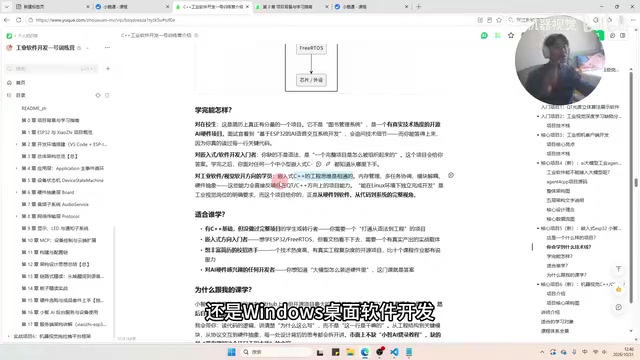
The training camp mainly targets C++ Qt industrial software development, but the creator emphasized that C++ engineering thinking is universal. Although Xiaozhi AI runs on an ESP32 board while industrial software runs on Windows computers, "essentially they are both C++ code," and the learning process is "very smooth, with no obstacles at all." This cross-domain practice helps broaden technical horizons.
Course Design: Combining Lecture Notes and Hands-On Practice
The creator wrote over ten chapters of lecture notes for the project, covering modules such as environment setup, overall architecture overview, hardware layer abstraction, audio subsystem, and network transport layer. For difficult issues, appendix articles were generated for specialized explanations. In addition, the large model MCP functionality and tool module invocation design and implementation involved in the project were already introduced in the training camp's preceding project (Project Four: Large Model Agent Application Development), forming a closed knowledge loop.
The lecture notes not only explain code logic but also focus on conveying design thinking. The creator admitted: "Code is dead; our course will guide you through the code logic, explaining clearly why it is written this way, rather than telling you what this line does like AI." This deep analysis from engineering structure to key modules is something self-study cannot replace.
MCP (Model Context Protocol)
MCP is an open protocol aimed at standardizing the interaction between large language models and external tools/data sources. It allows the model to dynamically call tools (such as querying weather, controlling devices, accessing databases) during conversations, thereby expanding the model's capability boundaries. In the Xiaozhi AI project, MCP functionality is used to enable the voice assistant on ESP32 to call predefined tool modules, implementing practical functions such as device control and information query. The training camp's preceding project "Large Model Agent Application Development" has already introduced the basic concepts of Agents and tool invocation, so the MCP implementation in Project Five is the embedded landing of this knowledge. Understanding MCP helps grasp the design patterns for function expansion in "large model + hardware" scenarios.
Target Audience and Learning Advice
The creator clearly stated that the project code is open source and AI tools are powerful, so learners with a foundation can completely use AI-assisted self-study. But for beginners, even with AI, they may encounter many problems, and systematic courses and guidance can significantly lower the learning threshold.
For training camp students, this project is updated as free extended content, aimed at enriching resumes and expanding capabilities. The creator also reminded that no project is perfect, and Xiaozhi AI is "treated as an additional extension," with the focus still on solid mastery of the training camp's preceding projects and foundational content.
Conclusion
The Xiaozhi AI embedded ESP32 project provides a practical platform for C++ learners to connect AI and hardware. Its excellent architecture design, active open-source community, and real industrial application potential make it a worthwhile learning target. Whether for resume enhancement or understanding software-hardware co-design, this project offers a rare entry point. As the creator said, in the AI era, we should pursue grand architectural design ideas and engineering capabilities rather than being confined to syntax details—this may be the most profound inspiration the Xiaozhi AI project brings to learners.
One-line Summary
A Bilibili creator includes the open-source Xiaozhi AI ESP32 project in a C++ training camp, analyzing its architecture and learning value.
Paragraph Summary
This article introduces how a Bilibili creator incorporates the open-source project "Xiaozhi AI" as Project Five in their training camp. Xiaozhi AI, under the MIT license, deploys large models onto ESP32 microcontrollers for voice dialogue, covering key technologies such as C++ engineering, FreeRTOS, network communication, AI integration, and hardware abstraction. The creator praises its excellent architecture design and believes the project can help students enrich resumes, assist embedded beginners in mastering a complete project, and enable industrial software developers to expand technical boundaries. The training camp provides over ten chapters of lecture notes, focusing on architectural thinking rather than code details, and notes that those with a foundation can self-study while beginners are advised to follow systematic courses.
Related articles

DSH + Ollama Local LLM Deployment in Practice: Free Chat with Da Fei Yu
Bilibili creator tests DSH + Ollama local LLM deployment end to end: Ollama install, Xunlei-accelerated downloads, ModelScope GGUF model import, DSH custom API address setup, and a comparison of Qwen 3.5 4B, 8B, Gemma, and other models on 8GB VRAM, with advice on choosing local deployment vs. API calls.

Tested: A $899 Mac Mini vs. a $200/Month AI Subscription
Real-world test of whether an M4 Mac mini can replace a $200 AI subscription: 16GB can't fit large models, and both speed and quality fall short—but privacy, no caps, and near-zero running costs make it an ideal host for an always-on agent. Includes buying advice per configuration and money-saving strategies.

RSTGameTranslation: Real-Time OCR Localization + Offline Translation with Local LLMs
RSTGameTranslation is an open-source real-time Windows game translation tool: OCR for English, Japanese, and Korean with Chinese overlays in place, plus Ollama or LM Studio local LLM offline translation and Whisper speech transcription for games, manga, and visual novels.