YC S22 Startup Coris Is Hiring a Backend Engineer

YC S22 company Coris is hiring a backend engineer—ideal for developers seeking rapid growth.
Using YC S22 company Coris's Hacker News backend engineer posting as a starting point, the article analyzes early-stage startup tech roles and how to evaluate them. Early-stage backend engineers take on duties far beyond the job description—API design, database architecture, deployment, and ops—offering fast growth but high intensity and uncertainty. Suitable candidates decide independently, have database and API performance experience, and solve problems pragmatically under constraints. The article advises checking product direction, team size, and backend team composition, plus HN comments and YC's directory, before applying.
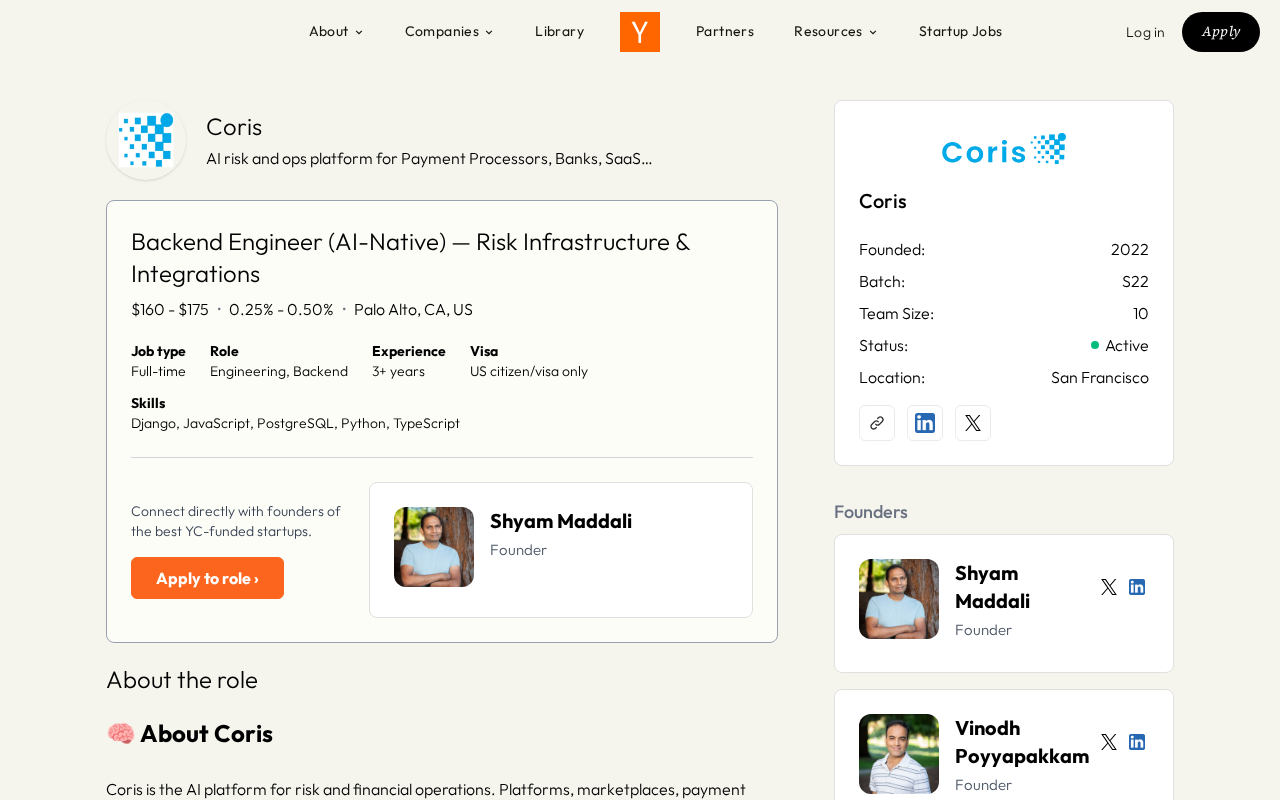
A Startup Job Posting Worth Paying Attention To
On the Hacker News hiring board, YC S22 company Coris posted a job opening for a backend engineer. For developers watching technical roles at early-stage startups, postings like this often reveal more about the current startup ecosystem's technical priorities and talent needs than big-tech listings do.
Coris is a member of Y Combinator's Summer 2022 batch. YC's backing means it has cleared initial product validation and has some funding base and growth pressure. For job seekers, that means both opportunity and the uncertainty that comes with early-stage companies.
Y Combinator (YC) is one of the world's best-known startup accelerators. Each year it selects early-stage startups in two batches (Winter/Summer), providing seed funding, three months of intensive mentorship, and a Demo Day to present to investors. Selected companies are commonly called "YC companies." S22 refers to the Summer 2022 batch. YC's backing carries strong signal value in Silicon Valley and the global venture community: it means the company has at least passed YC partners' evaluation of its product and team, received standard investment terms (historically $125K for 7% equity, later adjusted to a standardized agreement), and can tap into a vast alumni network. For job seekers, a YC background reduces the risk of "is this company a scam," but it does not equal commercial success—most YC companies never reach later-stage funding, so understanding exactly what this signal means matters.
Why a Backend Role at an Early-Stage Company Deserves Serious Consideration
The role of a backend engineer at an early-stage startup is fundamentally different from at a big tech company. Backend roles at large companies usually focus on a specific subsystem, with clear boundaries but limited visibility. At Coris's stage, a backend engineer will likely juggle API design, database architecture, deployment pipelines, and occasionally touch infrastructure and operations.
This "full-stack backend" mode of working significantly accelerates technical growth. You get to experience the complete cycle of building a system from scratch in a short time, rather than doing incremental optimization on a mature system. The trade-off is usually higher work intensity, with less polished processes and documentation than at a big company.
Another trait of YC companies is an extremely fast iteration pace. Companies from the S22 batch have been operating for some time now; their product direction may have shifted, and their tech stack may have been refactored. Joining at this stage means you're not facing a blank slate, but a system that has been market-tested yet still carries substantial technical debt to repay.
What Kind of Candidate Fits This Opportunity
Judging from the job title, Coris is explicitly looking for a backend engineer, not a full-stack or frontend one. This suggests the team has specific backend requirements—perhaps a clear gap in system performance, data processing, or service reliability that needs filling.
Candidates suited to this kind of role typically share a few traits: they can make technical decisions independently without detailed requirement docs, have hands-on experience with database design and API performance, and are willing to solve problems pragmatically in resource-constrained environments. If you're used to mature infrastructure and clear upstream/downstream division of labor at a big company, you may feel uncomfortable at first.
Conversely, if you're feeling stagnated at a big company and want an environment where you can rapidly accumulate system design experience, a backend role at a YC company is worth applying to.
Technical debt at startups usually refers to compromise decisions made for speed during rapid iteration—hardcoded business logic, lack of test coverage, single-point databases, manual deployment processes, and so on. These decisions are rational in a product's early days: validate market demand at minimum cost rather than pre-building architecture you may never need. But once a company reaches the stage past S22, its user and feature scale exceed early assumptions, and technical debt surfaces as performance bottlenecks, frequent outages, and slowing development velocity. A backend engineer joining at this point has an important job: gradually paying down that debt without disrupting business iteration. This differs from maintaining a mature system at a big company or designing from scratch on a greenfield project—it requires the ability to identify priorities, control refactoring risk, and understand business tempo all at once.
How to Evaluate This Kind of Job Opportunity
When you see a job posting, the important thing isn't to apply immediately, but to make a few judgments first. What is Coris's product direction, how big is the current team, how many people are on the backend team—these determine your actual working conditions after joining. If the backend team is only one or two people, you'll likely take on responsibilities far beyond the job description.
Also worth watching is the HN comment section. Under Hacker News job postings, current or former employees often reveal what a company is really like, and others directly question its tech choices or business model. This information is often more valuable than the posting itself.
For a YC-backed company like Coris, you can also check its funding stage, founder backgrounds, and product summary through YC's official directory. Putting that information alongside the job requirements helps you judge whether this is a growth hire or a backfill hire—the risks and opportunities are entirely different.
Summary
Coris's backend engineer opening reflects the ongoing demand for technical talent at early-stage YC companies. Such roles suit engineers who want rapid growth, can accept uncertainty, and are willing to make technical decisions in resource-constrained environments. Before applying, it's worth figuring out the team size, product stage, and actual composition of the backend team, then deciding whether it's worth your time.
One-line Summary
YC S22 company Coris is hiring a backend engineer—ideal for developers seeking rapid growth.
Paragraph Summary
The article uses YC S22 company Coris's backend engineer job posting on Hacker News as a starting point to analyze the characteristics and evaluation methods of technical roles at early-stage startups. The author notes that backend engineers at early-stage companies take on responsibilities far beyond the job description, covering API design, database architecture, deployment, and operations. Growth is fast but intense and uncertain. Suitable candidates should be able to decide independently, have database and API performance experience, and solve problems pragmatically under resource constraints. The article advises job seekers to first understand the product direction, team size, and actual backend team composition, and to check HN comments and YC's official directory for funding and founder information to judge whether the hire is for growth or backfill.
Related articles

CSS Anchor Positioning: A New UI Positioning Approach Without JavaScript
A deep dive into CSS Anchor Positioning: from anchor-name and position-anchor to the anchor() function, position-area shorthand, position-try-fallbacks, anchor-size, and upcoming anchor queries.

New AI Chart Interaction: Continuous Follow-up Questions and Visualization in Conversation
Explore a new AI interaction method for continuously generating charts in conversation. Use the /visualize command to ask follow-up questions and visualize answers in the same chat window, improving data analysis efficiency.

Cursor Merges Into X Subscription: Paid Plans Share Unified Usage Pool, Grok Model Coding Usage Doubled
Cursor joins The X Subscription with a unified usage pool and doubled Grok coding quota. Third-party models shift to API pricing. Existing users can keep or migrate plans.