YC Startup Bets $1M, Offers Bounty for AI to Crack Five Major Materials Science Challenges

YC startup Displaced Materials offers a $1M bounty for solutions to five open materials science problems.
Displaced Materials, a YC startup founded months ago, has announced a $200,000 bounty for each of five unsolved materials science problems, totaling $1 million. The company uses AI to accelerate chip materials discovery; the bounty serves as both research funding and a low-cost way to access global talent and ideas. The article examines the long R&D cycles and high trial-and-error costs in materials science, AI's value in property prediction and candidate screening, and how bounties can build data and brand awareness. It notes that evaluation criteria, experimental validation, and IP ownership details remain undisclosed.
A YC startup called Displaced Materials is challenging the global materials science community with real money on the table. The company, founded just months ago and using AI to discover chip materials, has announced a $200,000 bounty for each of five unsolved materials science problems, for a total prize pool of $1 million.
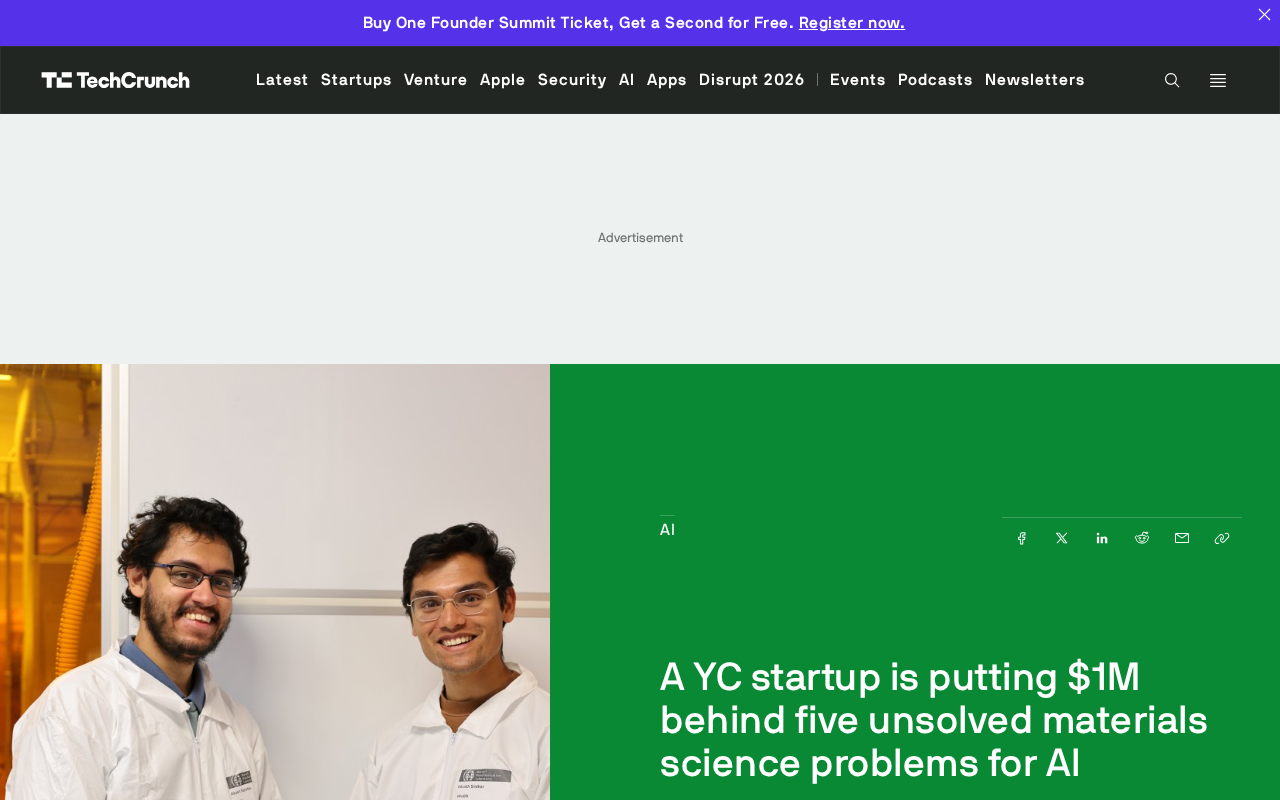
A Million-Dollar Bounty: Five Problems, $200K Each
According to the original report, Displaced Materials has quickly emerged within the YC ecosystem, with its core business being the use of artificial intelligence to accelerate the discovery of chip materials. The five problems in this bounty are all long-standing open challenges in materials science. The specific topics were not disclosed in the source material, but what is clear is that each solution carries a $200,000 prize, totaling $1 million across the five problems.
The cleverness of this move lies in the fact that it serves both as research funding and as a screening mechanism for talent and ideas. For an early-stage startup, building a large research team directly is costly, whereas the bounty model can attract global intellectual resources at a relatively low fixed cost while accumulating data and case studies for its own technology platform.
YC (Y Combinator) is one of the world's most renowned startup accelerators, known for seed-stage investment and an intensive three-month program, having incubated companies such as Airbnb, Stripe, and Dropbox. YC-backed startups typically carry a distinct technology-driven, rapid-growth orientation, and the brand endorsement alone can bring attention and fundraising convenience to early-stage companies. As a YC-backed company, Displaced Materials daring to publicly offer a million-dollar bounty just months after founding is not unrelated to the YC ecosystem's culture of encouraging high-risk, high-leverage strategies.
Why Materials Science? Where AI Fits In
Materials science has long faced a fundamental contradiction: going from concept to commercial material often requires a research and development cycle of more than a decade and enormous experimental costs. Traditional methods rely on trial and error and expert intuition, with a vast search space and low efficiency.
AI is changing this landscape. Machine learning models can predict material properties, screen candidate compounds, and optimize synthesis pathways, thereby substantially compressing the time required in the early discovery phase. Displaced Materials' choice of chip materials as its entry point reflects the semiconductor industry's urgent demand for new materials—as process nodes advance, traditional material systems are approaching physical limits, making the search for alternatives an industry imperative.
The five open problems most likely cover key areas ranging from materials discovery and performance prediction to synthesis feasibility. The bounty approach also allows the company to access ideas not yet publicly disclosed in academia and industry.
Materials informatics is an interdisciplinary field that has emerged in recent years, with the core idea of combining machine learning, high-throughput computing, and materials databases to replace traditional trial-and-error experiments. Typical tools include databases based on density functional theory (DFT), such as the Materials Project, and generative models used for inverse design of new materials with target properties. In the chip materials domain, AI has been used to screen high-k gate dielectrics, low-resistance interconnect metals, and thermal management materials. However, the field remains constrained by scarce experimental data and poor model transferability, which is why high-quality data has become a focal point of competition.
The Dual Logic of the Bounty Model
From a business perspective, this $1 million investment is not pure charity. First, the bounty can produce high-quality solutions, allowing the company to validate the effectiveness of its own AI platform and even directly obtain commercially viable material solutions. Second, the bounty campaign itself is brand marketing—for a startup just months old, building visibility in the materials science community is worth no less than paid advertising.
The deeper logic lies in data. One of the core bottlenecks in AI-driven materials discovery is the scarcity of high-quality data. By soliciting solutions through bounties, the company can accumulate real-world materials problems and corresponding solutions, which can feed back into model training and form a competitive moat.
This model has precedents in AI, but public bounties specifically for materials science remain rare. Displaced Materials' attempt may inspire more AI startups to use bounties to tackle fundamental scientific challenges.
Bounty-style research is not new. The X Prize Foundation, the Netflix recommendation algorithm competition, and DARPA's Grand Challenge have all employed similar mechanisms, using prize money in place of traditional funding to attract dispersed intellectual resources. Compared with research grants, the advantage of bounties is that they pay for results, do not presuppose research paths, and can aggregate solutions across institutions. But their limitations are also obvious: evaluation criteria are difficult to standardize, short-term competitions may encourage overfitted solutions, and intellectual property ownership often needs to be clearly agreed upon in advance. Public bounties in the AI materials discovery field have been relatively rare, partly because experimental validation is costly and time-consuming, making it difficult to close the loop within a bounty framework.
A Signal to the Materials Science Community
For materials science researchers, this is a signal worth paying attention to. A $200,000 prize per problem is an attractive amount in basic science, especially for young researchers and interdisciplinary teams. The bounty does not restrict institutional background, so in theory anyone with a viable solution can participate, lowering the barrier to entry.
However, the challenges are equally obvious. Open problems remain unsolved for so long often because they require interdisciplinary knowledge and extensive experimental validation, and theoretical solutions alone may struggle to win. How Displaced Materials will evaluate submissions, whether experimental validation is required, and how intellectual property ownership will be defined—these details will determine the actual effectiveness of the bounty. The source material does not provide this information, and it is worth following up on.
Regardless of the outcome, the fact that a startup just months old is willing to bet a million dollars on fundamental science problems sends a clear message: the role of AI in materials science is shifting from an auxiliary tool to a problem definer.
One-line Summary
YC startup Displaced Materials offers a $1 million bounty for solutions to five open materials science problems.
Paragraph Summary
Displaced Materials, a YC startup founded just months ago, has announced a $200,000 bounty for each of five unsolved materials science problems, for a total prize pool of $1 million. The company's core business is using AI to accelerate chip materials discovery. This bounty serves both as research funding and as a low-cost mechanism for accessing global intellectual resources and screening talent. The article analyzes the pain points of long R&D cycles and high trial-and-error costs in materials science, as well as the value of AI in predicting material properties and screening candidates, noting that the bounty can also help the company accumulate high-quality data, feed model training, and build brand awareness. It also cautions that details such as evaluation criteria, experimental validation requirements, and intellectual property ownership have not been disclosed and will affect the bounty's actual impact.
Related articles
 Tech Frontiers
Stylome Bot Slammed as Useless Junk: Why Do AI Detection Tools Keep Failing?
Reddit users test the Stylome AI detection bot: Gemini-rewritten text judged human-written, consistently low confidence. An analysis of AI text detection's technical dilemmas, privacy concerns, and credibility crisis in community governance.
 Tech Frontiers
When AI Becomes a Productivity Divide: Clarity or "AI Psychosis"?
A civil engineer's deep use of agentic AI boosted efficiency but bred contempt for peers who refuse to learn. Is this clarity or AI psychosis? An analysis of the cognitive and psychological challenges behind the AI productivity divide.
 Tech Frontiers
Opus 5.5 Benchmark Scores Climb, Community Says Its "Weights Are Blessed"
Reddit community discusses Opus 5.5's rising scores on the Benchmaxxing Bench, with users describing its performance as "weights are blessed." This article interprets the community reaction and cautions against conflating benchmark scores with real capability.