Yelp Launches AI Phone Assistant: Checks Wait Times for You and Remembers Your Taste

Yelp embeds an AI agent that can call restaurants for wait times and launches memory-based personalized recommendations.
Yelp has embedded a series of new AI features into its app. The most notable is an AI voice agent that can call restaurants on the user's behalf to ask about wait times, plus a personalized recommendation system that remembers user preferences. This marks Yelp's extension from a local information aggregation platform toward "agentic execution": wait times are highly dynamic and difficult to collect in a structured way, so real-time AI inquiries can fill data blind spots. The article notes that agentic AI is becoming a new competitive battleground for consumer applications. Combining Yelp's UGC with personal preferences can improve recommendation hit rates, but personalized memory raises privacy considerations. The feature's actual effectiveness depends on merchants' willingness to answer, speech recognition accuracy, and real-time information. Coverage and launch regions are not yet clear, and will determine whether it is a practical tool or a demo feature.
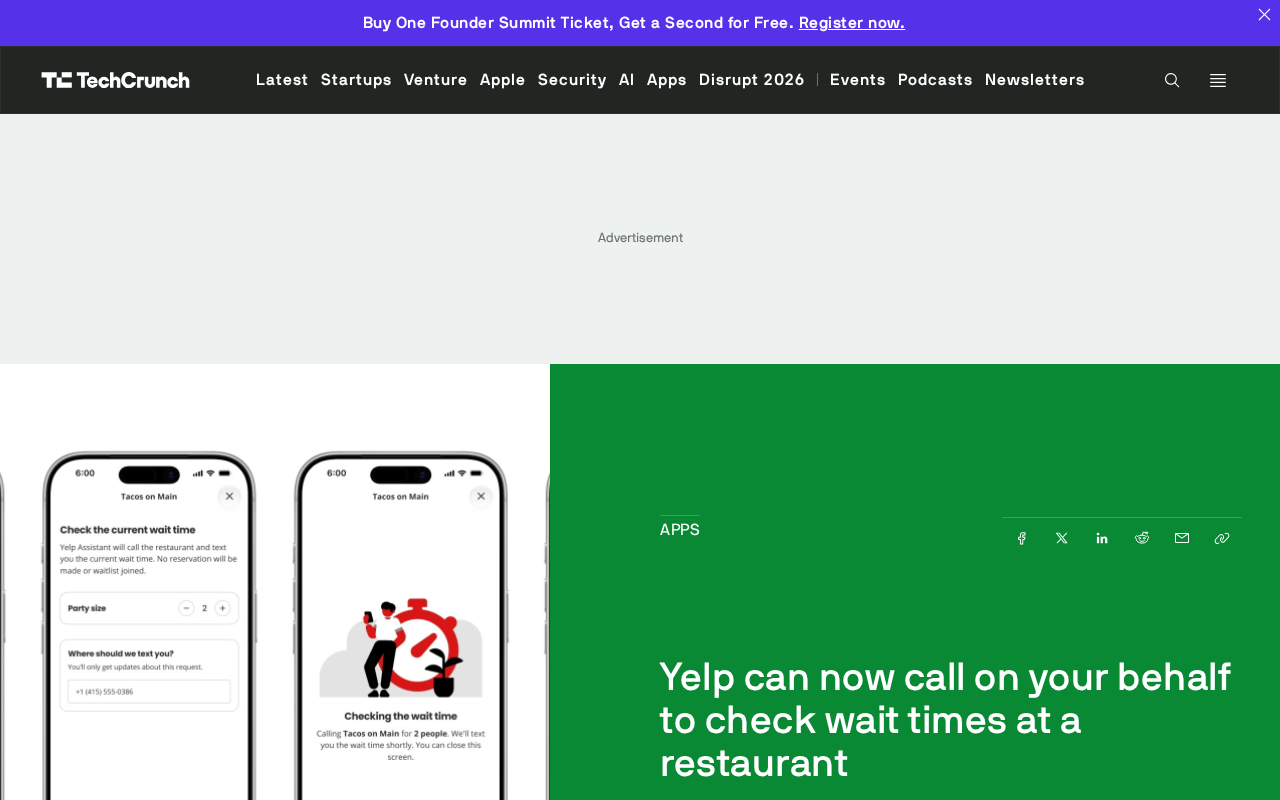
Yelp is turning AI from "recommendations in a search box" into "an assistant that can make phone calls for you." According to the latest news, Yelp has embedded a series of new AI features into its app, the most notable of which is that AI can call restaurants on the user's behalf to ask about wait times. The new features also include a personalized recommendation system that remembers user preferences.
From Information Platform to "Agentic Execution": Yelp's AI Shift
Yelp's traditional role has been an aggregator of local life information—users search, browse reviews, make decisions on their own, and then manually call or visit the store. This update changes the last link in that chain: an AI agent directly takes on the action of "calling to confirm wait times."
This may seem like a small feature, but it actually touches on a deep pain point for local service platforms. Restaurant wait times are highly dynamic data that is difficult to collect in a structured way. They depend on on-site table turnover rates, reservation conditions, and cash flow, and can hardly be accurately reflected through a static database. Yelp chose to use an AI voice agent to "ask in real time," essentially using agent capabilities to fill the blind spots in data sampling.
What is noteworthy is that this means Yelp's AI is no longer just generating text or ranking results, but beginning to interact with the real world on behalf of users. This kind of "agentic AI" is becoming a new competitive battleground for consumer applications.
Agentic AI refers to AI systems with autonomous planning, tool invocation, and interaction with external environments to complete multi-step tasks, distinct from passive models that only generate text or rank results. Its core capabilities include task decomposition, function calling (such as phone-call APIs), state memory, and exception handling. In consumer scenarios, agentic AI upgrades applications from "telling users how to do something" to "doing it for users." A typical tech stack involves large language models as the reasoning engine, speech synthesis and recognition modules, and an orchestration layer for external service interfaces. Yelp's AI phone assistant is exactly the implementation of this paradigm: the model needs to understand user intent, initiate a call, parse the merchant's reply, and feed back the result. The reliability of any single link directly affects whether the task loop can be closed.
Personalized Recommendations: AI Remembers Your Preferences
In addition to the phone assistant, Yelp has also introduced a recommendation system with memory capabilities. Unlike traditional collaborative filtering or location-based recommendations, the new system records user preferences and continuously calls on them in subsequent interactions—like a local life consultant who knows your taste.
From a product logic perspective, this complements the review data Yelp has accumulated over the long term: the platform has both massive amounts of user-generated content (UGC) and individual-level preference signals, and combining the two can improve recommendation hit rates. However, personalized memory also brings privacy considerations—the storage boundaries for user preference data and whether it can be exported or deleted will be unavoidable issues when such features are implemented.
Collaborative filtering is a classic recommendation system method, divided into user-based and item-based types: the former finds groups of users with similar tastes and recommends items they like to the target user; the latter recommends based on co-occurrence relationships between items. It does not rely on content features, but suffers from cold-start and sparsity problems. Yelp's newly introduced memory-based recommendation is a combination of content-based personalization and session memory: the system explicitly stores user preference signals (such as cuisine, price range, and occasion) and continuously calls on them in subsequent interactions, similar to maintaining a dynamic profile for each user. The two are complementary—collaborative filtering mines collective wisdom, while the memory mechanism captures individual long-term preferences, jointly improving recommendation hit rates, but also placing higher demands on the storage and privacy boundaries of preference data.
The AI Arms Race in the Local Life Sector
Yelp's move is not an isolated event. Local life and travel platforms have intensively launched AI capabilities in recent years: from itinerary planning assistants to review summaries, and now to voice agents, AI is moving from "assisting decisions" to "executing on behalf."
For Yelp, this direction is reasonable. Its core assets are local merchant relationships and review content, and AI agents can precisely activate both ends: on one end, saving users communication costs; on the other, bringing more precise foot traffic to merchants. But the challenges are equally obvious—the actual usability of AI phone calls depends on merchants' willingness to answer, the accuracy of speech recognition, and the real-time nature of wait-time information. If any of these links fails, the user experience will suffer.
It is currently unclear which merchants and regions the feature covers. These details will directly determine whether it is a practical tool or a demo feature.
UGC (User-Generated Content) is a core asset of local life platforms such as Yelp, referring to reviews, ratings, photos, and posts contributed spontaneously by users. The value of UGC lies in its scale effect and authenticity: massive reviews form a collective signal of merchant reputation and are also the corpus foundation for recommendation algorithms and AI summaries. However, UGC suffers from uneven quality, declining timeliness, and the risk of fake reviews. Platforms usually improve usability through weighted ratings, anti-fraud models, and review summaries (AI extracting key points from long reviews). By combining UGC with personal preference memory, Yelp is essentially layering individual signals on top of collective signals, making recommendations both socially proofed and aligned with personal taste. This is also its data moat that distinguishes it from purely algorithmic platforms.
Editorial View
Yelp's AI phone assistant points to a broader trend: the competitive focus of consumer AI is shifting from "generating content" to "completing tasks." For information aggregation platforms, whoever can seamlessly embed AI agents into real-world service workflows is more likely to occupy the "entry point" position in users' minds. As for whether Yelp can use this feature to reactivate user engagement, it will depend on the breadth of coverage and quality of execution going forward.
One-line Summary
Yelp embeds an AI agent that can call restaurants on users' behalf to check wait times, and launches memory-based personalized recommendations.
Paragraph Summary
Yelp has embedded a series of new AI features into its app. The most notable is an AI voice agent that can call restaurants on the user's behalf to ask about wait times, along with a personalized recommendation system that remembers user preferences. This marks Yelp's extension from a local information aggregation platform toward "agentic execution": wait times are highly dynamic data that is difficult to collect in a structured way, and real-time AI inquiries can fill data blind spots. The article notes that agentic AI is becoming a new competitive battleground for consumer applications. Combining Yelp's UGC with personal preferences can improve recommendation hit rates, but personalized memory raises privacy considerations. The actual effectiveness of the feature depends on merchants' willingness to answer, speech recognition accuracy, and information real-time availability. Coverage and launch regions are not yet clear, and will determine whether it is a practical tool or a demo feature.
Related articles
uGAP: An AI Platform Unifying 100+ African Geospatial Datasets
uGAP is an African geospatial AI platform by a University of Cape Town team, unifying 120+ African datasets with a Python SDK for discovery, processing, and model training, already used in cyclone flood mapping.

Cursor Can Now Control Your Computer: AI Agents Can Drive Desktop Apps for Testing
Cursor adds desktop control: AI agents can drive desktop apps like the iOS Simulator to test their own features. We analyze the impact on dev workflows, possible technical approaches, and reliability concerns.

Vibecoding a Custom Inference Engine: High Hopes, Harsh Reality
A Reddit developer shares the real experience of vibecoding a custom inference engine: running GGUF Q4 models in the browser with WebGL2 and GLSL, only to fall into tokenizer debugging hell. This article analyzes the engineering challenges of browser-side LLM inference and why cloning llama.cpp is the more rational choice.