Yogurt: A Free, Open-Source AI Meeting Notes Tool With No Bot Joining Required

Yogurt is a free, open-source, local-first AI meeting notes tool that records in the background without a bot and generates summaries.
Yogurt is an AI meeting notes tool that debuted on Product Hunt, positioned as a free, open-source alternative to Granola. Its standout feature is that it doesn't join meetings as a bot—instead it records Zoom, Google Meet, and Teams in the background, shows real-time transcripts during meetings, and automatically generates summaries and action items afterward. All data stays local, no account is required, and it supports Mac, Windows, and Linux, emphasizing privacy and open source. It also offers cross-meeting natural-language Q&A, full audio playback, automatic recording stop, and MCP integration that plugs notes into Claude or ChatGPT workflows. The article also notes the trade-offs: local processing has device performance requirements, and the project's updates and long-term maintenance still need to be observed. It's best suited to technical users who value privacy, cost, and the willingness to tinker.
Say Goodbye to Bot Attendees: Yogurt Redefines AI Meeting Notes
If you've used Granola, you probably liked its "quietly record, summarize afterward" experience. But Granola isn't open source, and its data isn't entirely local. Now a tool called Yogurt has debuted on Product Hunt, positioning itself around being free, private, and open source, and explicitly taking aim at Granola.
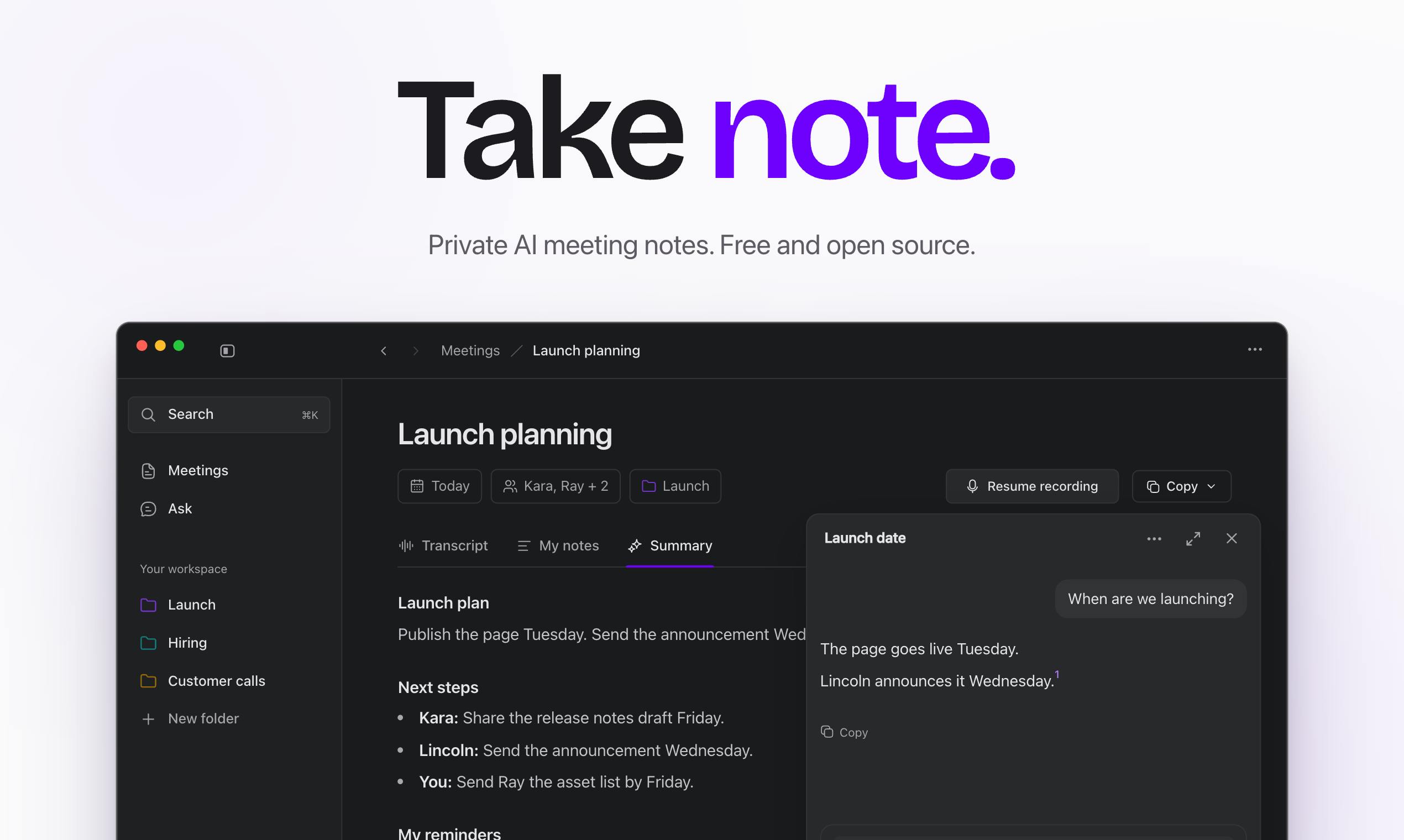
Yogurt's most appealing feature is this: it doesn't join your meetings as a bot. Many AI meeting note tools (such as Otter.ai and Fireflies) send a robot into the meeting, which often feels intrusive to participants. Yogurt instead records Zoom, Google Meet, and Teams in the background, displays the transcript in real time, and automatically generates a summary and next steps when the meeting ends. The whole process doesn't disturb the meeting and doesn't depend on a cloud account.
According to its Product Hunt page, Yogurt supports Mac, Windows, and Linux, requires no account registration, and keeps all data on your local computer. For privacy-conscious users, this is a key selling point.
Core Features: More Than Transcription—A Meeting Knowledge Base
Yogurt's feature list is quite practical:
- Real-time transcription: Displays the transcript during the meeting for quick scanning.
- Post-meeting summaries: Automatically generates meeting summaries and action items.
- Cross-meeting Q&A: Ask questions about all meetings, a specific folder, or a single meeting—even during a meeting.
- Full audio playback: Replay meeting recordings anytime.
- MCP integration: Share notes with Claude or ChatGPT via MCP (Model Context Protocol).
- Automatic recording stop: Recording stops automatically when the meeting ends, avoiding unnecessary audio capture.
Combined, these features make Yogurt feel more like a local meeting knowledge base than just a recording tool. Cross-meeting Q&A is especially noteworthy—it means you can search information from past meetings in natural language, such as "What pricing plan did we discuss with the client last time?"
MCP (Model Context Protocol) is an open protocol proposed by Anthropic in late 2024, designed to standardize how AI assistants connect to external data sources and tools. It's often compared to a "USB-C port for AI applications": developers only need to implement a server once according to the protocol, and MCP-compatible clients like Claude and ChatGPT can read files, call tools, or access databases in a unified way. In the meeting-notes context, MCP lets Yogurt expose local notes as context that AI can retrieve, so users can have large models answer questions or generate documents based on past meeting content without manually copying and pasting—this is the key mechanism that sets it apart from pure transcription tools.
Open Source and Privacy: The Local-First Trade-off
Yogurt emphasizes that "everything stays on your computer" and is open source. This brings clear privacy advantages: meeting content isn't uploaded to third-party servers, and no account is required. For sensitive industries such as corporate legal, healthcare, and finance, this may be more appealing than the features themselves.
However, local processing also means certain device performance requirements. Although the official hardware requirements aren't published, real-time transcription and summary generation typically require some computing resources. In addition, the sustainability of open-source projects is also a factor users need to consider—update frequency, community activity, and long-term maintenance all affect the actual experience.
Local-first is a concept in software architecture that has gained traction in recent years, emphasizing that data is stored primarily on the user's device rather than being cloud-centric. It typically combines local databases, offline availability, end-to-end sync, and conflict resolution so users can fully use core features without an internet connection. For meeting-notes tools, local-first means transcription, summarization, and retrieval all happen on the machine, with the cloud handling only optional sync or model calls. This architecture offers advantages in privacy and latency, but the cost is the need to adapt to audio capture permissions across different operating systems, bear the compute overhead of model inference, and meet higher requirements for data backup and migration.
How It Differs From Granola: A Free, Open-Source Alternative
On Product Hunt, Yogurt is explicitly positioned as "a free, open-source alternative to Granola." Granola is a popular AI meeting notes app, but it's closed source and paid. Yogurt offers a choice for users who want a similar experience but don't want to pay or care about open-source privacy.
The core difference between the two is that Granola leans more toward a polished commercial product, while Yogurt takes the open-source community route. Yogurt's MCP integration is a highlight, allowing users to plug meeting notes directly into Claude or ChatGPT workflows, opening up more possibilities for AI-assisted work.
Who Is It For?
Yogurt suits the following people:
- Those who frequently use Zoom, Google Meet, or Teams for meetings and need automatic recording and summaries;
- Those who are privacy-sensitive and don't want meeting content uploaded to the cloud;
- Developers or technical users who like open-source tools and are willing to tinker and give feedback;
- Users who want to integrate meeting notes into AI tools like Claude and ChatGPT.
If you only have occasional meetings or need highly stable commercial support, a mature paid product may be a better fit. But if you want free, local, and open source, Yogurt is worth a try.
Currently, Yogurt has 75 votes on Product Hunt, ranking 19th. Discussion isn't high yet, but the direction is clear. As remote collaboration and demand for AI meeting notes grow, local-first open-source tools like this may attract more attention.
This article is based on information from the Product Hunt product page; feature details are subject to official releases.
Background
Bot attendance vs. background recording are the two main technical approaches for AI meeting note tools. The bot approach joins the room through a meeting platform's bot API or a virtual participant; its advantages are simple integration and cross-platform consistency, while its drawbacks are that other participants can see it, and some enterprise meetings restrict or prohibit bots from joining. Background recording relies on OS-level audio capture (such as macOS screen recording and audio permissions, or Windows loopback audio) to directly capture audio played on the device and from the microphone, so it's completely transparent to participants and doesn't depend on meeting platform authorization. However, this approach is closely tied to the device, OS version, and how the meeting software is implemented, making compatibility maintenance more costly—one reason Yogurt needs to support all three major desktop systems.
One-line Summary
Yogurt is a free, open-source, local-first AI meeting notes tool that records in the background without a bot and generates summaries.
Related articles

Prompt Engineering for Beginners: From Writing Prompts to Engineering Thinking
Starting from the essence and four functions of prompts, this article systematically explains the six-step process, four success criteria, learning value, and practical limitations of prompt engineering to help you build a complete understanding.

Anthropic Launches Nasdaq IPO: AI Giant's Listing and Risk Disclosures
Anthropic officially launches its Nasdaq IPO under ticker ANT, with market valuation expected to potentially exceed SpaceX's record. The prospectus devotes nearly 100 pages to AI risks, while first-half revenue grew over 14x but net losses widened sharply, reigniting the AI bubble debate.

Rust cURL Clone Uses 4,832 unsafe Blocks—Is the Memory Safety Myth Broken?
A Rust cURL clone uses 4,832 unsafe keywords, challenging Rust's memory safety narrative. We analyze what unsafe really means, compare Fil-C, and examine rewrite motives.