YOLO26n-Depth Edge Deployment Test: The Optimization Challenge of Only 3-4 FPS on RK3576

YOLO26n-Depth achieves only 3-4 FPS on RK3576, revealing key optimization challenges for edge depth estimation.
A developer deployed YOLO26n-Depth on the RK3576 edge platform and measured only 3-4 FPS with an unoptimized Python pipeline. This article analyzes the performance bottlenecks—including NPU operator fallback, Python overhead, and the computational cost of combined detection and depth estimation—compares performance across Jetson, RK3588, and Raspberry Pi platforms, and provides actionable optimization strategies including INT8 quantization, C++ zero-copy deployment, and multi-threaded pipelines.
Introduction: When Depth Estimation Meets Edge Devices
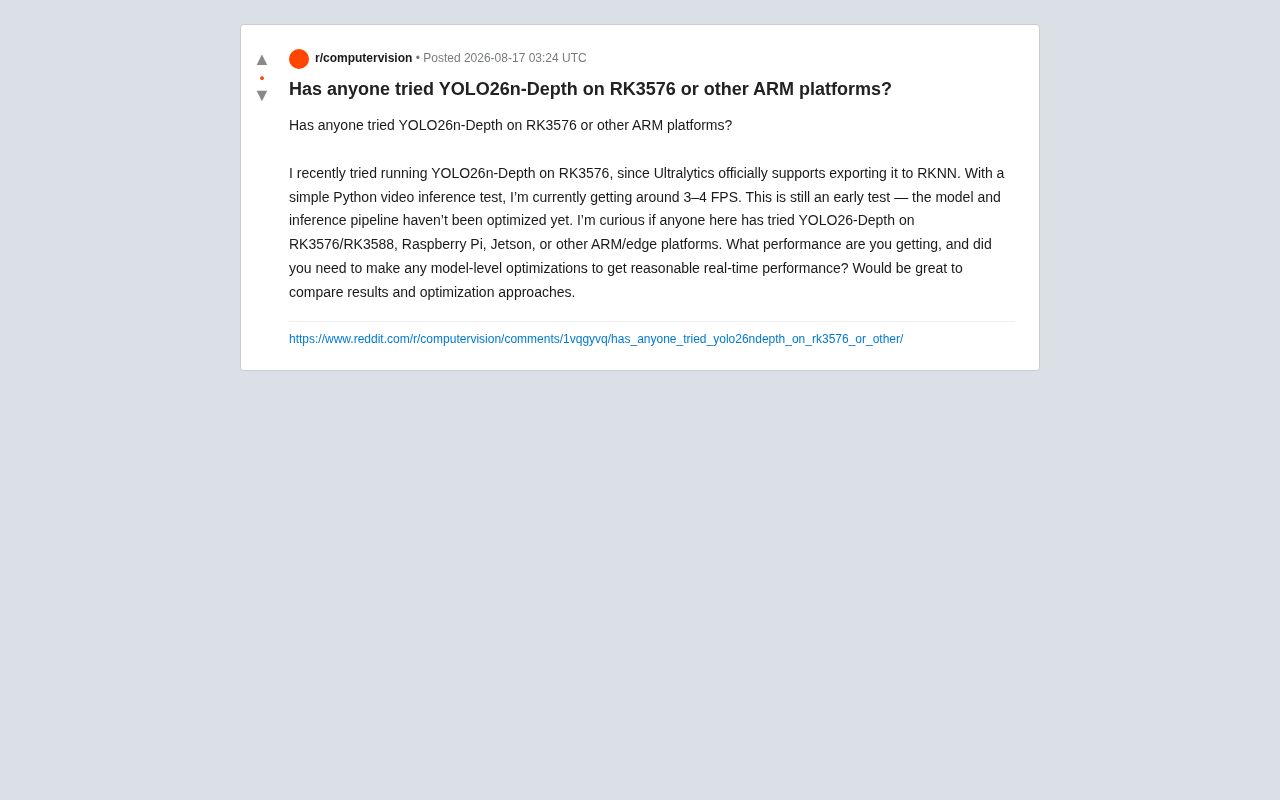
Recently, a developer shared preliminary test results of deploying the YOLO26n-Depth model on the RK3576 platform on Reddit, drawing attention from the edge computing and computer vision communities. The test results showed that without optimization, simple Python video inference could only achieve 3–4 FPS. While this number seems low, it reflects the common performance bottlenecks that edge devices face when running multi-task vision models.
As Ultralytics officially begins supporting YOLO26n-Depth export to RKNN format (the dedicated inference format for Rockchip NPUs), more and more developers are attempting to deploy these compound models—which combine object detection and depth estimation—on ARM platforms. RKNN (Rockchip Neural Network) is Rockchip's proprietary model format and inference framework designed for its NPU. Developers use the RKNN-Toolkit2 toolchain to convert models from general formats like PyTorch and ONNX to RKNN format, with quantization and graph optimization performed during conversion. The NPU is essentially a dedicated matrix computation accelerator with hardware-level optimizations for common deep learning operators like convolution and matrix multiplication, delivering far higher performance per watt than general-purpose CPUs/GPUs. However, NPU operator coverage is limited—when encountering unsupported operations, execution "falls back" to the CPU, causing frequent data transfers between heterogeneous compute units that severely drag down inference speed. This article will explore the current performance landscape and optimization paths for edge-based depth estimation models through this real-world test case.
What Is YOLO26n-Depth?
Evolution from Detection to Depth Perception
The YOLO series has long been the benchmark in real-time object detection, and YOLO26n-Depth adds Monocular Depth Estimation capability on top of traditional detection. This means the model can not only identify object locations and categories in an image but also infer the relative depth information of each pixel or object.
Monocular depth estimation is an extremely challenging task in computer vision, aiming to infer 3D depth information of a scene from a single 2D image. Unlike stereo vision that relies on disparity principles or LiDAR that relies on time-of-flight, monocular depth estimation is fundamentally an ill-posed problem—a single 2D image can theoretically correspond to infinitely many 3D scenes. Deep learning breakthroughs have made this task feasible: models learn visual patterns such as perspective relationships, occlusion cues, texture gradients, and semantic priors through large-scale training to infer depth. In recent years, progress has been rapid, from DPT (Dense Prediction Transformer) to the Depth Anything series. Fusing depth estimation with object detection into a single model is a recent research trend that reduces overall computation and system complexity by sharing a feature extraction backbone while completing both tasks.
For applications like robot navigation, autonomous driving assistance, and drone obstacle avoidance, this integrated "detection + depth" capability is extremely attractive—it avoids the hardware cost of deploying additional depth sensors (such as stereo cameras, ToF, or LiDAR) and achieves spatial awareness with just a single RGB camera.
The Computational Cost of Compound Models
However, there's no free lunch. The addition of the depth estimation branch significantly increases the model's computational burden. Compared to pure detection YOLO26n, the Depth version requires more feature upsampling and dense prediction operations, which place higher demands on memory bandwidth and NPU operator support. This is one of the fundamental reasons for its lower frame rate on edge devices.
RK3576 Platform Test: What Does 3-4 FPS Mean?
Hardware Specifications and Theoretical Compute
The RK3576 is a mid-range AIoT processor from Rockchip with a built-in NPU offering approximately 6 TOPS of compute power. TOPS (Tera Operations Per Second) is the standard metric for measuring NPU theoretical peak performance—6 TOPS means the NPU can execute approximately 6 trillion INT8 fixed-point operations per second. However, there's a huge gap between theoretical compute and actual inference performance—factors affecting real utilization include memory bandwidth bottlenecks (time the NPU spends waiting for data), operator scheduling efficiency, model-hardware architecture compatibility, and data transfer overhead. Industry experience shows that most models achieve only 30%-60% of theoretical peak utilization on NPUs, so simply comparing TOPS numbers cannot accurately predict actual inference frame rates across different platforms.
Compared to the flagship RK3588 (similar ~6 TOPS NPU but stronger CPU/GPU), the RK3576 is more budget-friendly for cost-sensitive embedded projects.
On such hardware, pure YOLO detection models can typically run at 30+ FPS. Yet YOLO26n-Depth achieves only 3–4 FPS—a performance drop of nearly an order of magnitude—clearly revealing the heavy overhead of the depth estimation task.
Common Bottlenecks in Unoptimized Pipelines
The original poster explicitly noted that "the model and inference pipeline are not optimized." Based on common edge deployment experience, the low frame rates in such early tests often don't come entirely from the model itself but are distributed across multiple stages:
- Python layer overhead: Using Python to directly call inference introduces substantial interpreter overhead and data copy costs. Switching to C/C++ deployment typically yields significant improvements.
- Unaccelerated pre/post-processing: If image preprocessing (resize, normalization) and post-processing (depth map decoding, NMS) run serially on the CPU, they become serious bottlenecks.
- NPU operator fallback: Some depth estimation operators may not be natively supported by the RKNN NPU, causing fallback to CPU execution and slowing overall speed.
Cross-Platform Performance Comparison: Community Reference Points
Horizontal Comparison of Major ARM Edge Platforms
The poster called on the community to share real-world data from platforms like RK3588, Raspberry Pi, and Jetson, reflecting edge AI developers' strong demand for cross-platform comparisons. Looking at each platform's positioning:
- NVIDIA Jetson Series: With mature TensorRT acceleration and powerful GPU compute, this is typically the best-performing platform for depth estimation models. The Orin series can easily achieve real-time inference. TensorRT improves inference speed by 2-5x through layer fusion (merging multiple consecutive operations into a single kernel), precision calibration (automatically selecting optimal FP16/INT8 mixed-precision strategies), kernel auto-tuning, and dynamic tensor memory management. Jetson's core advantage lies in its GPU architecture being consistent with desktop/server GPUs, allowing models developed with CUDA in academia to migrate almost seamlessly. In comparison, NPU platforms like RKNN still lag in operator compatibility and toolchain maturity, but their power and cost advantages make them more competitive in large-scale deployment scenarios.
- RK3588: NPU compute is close to RK3576, but a stronger CPU helps accelerate pre/post-processing, potentially yielding slightly higher frame rates.
- Raspberry Pi: Lacking a dedicated NPU (unless externally connected to accelerators like Coral TPU or Hailo), running such compound models would be very challenging.
Optimization Path Recommendations
To push YOLO26n-Depth toward usable real-time performance on RK3576, consider the following approaches:
- INT8 Quantization: Quantizing the model from FP16/FP32 to INT8 is a standard optimization for RKNN deployment and can significantly boost NPU throughput. INT8 quantization compresses model weights and activations from 32-bit floating point to 8-bit integers, delivering three benefits: ~4x model size reduction, dramatically lower memory bandwidth requirements, and the NPU being able to process more operations in the same clock cycle. The quantization process requires a calibration dataset to profile the numerical distribution of activations at each layer and determine optimal scaling factors. Notably, depth estimation tasks are more sensitive to precision due to their regression nature, potentially requiring mixed-precision strategies—keeping sensitive layers at FP16 while using INT8 for others.
- C++ Deployment + Zero-Copy: Abandon Python, adopt the RKNN C API with RGA hardware for image scaling, and reduce CPU-NPU data transfers. The core concept of Zero-Copy is sharing the same physical memory region between CPU and NPU, avoiding redundant data copying between different hardware units. RGA (Raster Graphic Acceleration Unit) is a 2D graphics acceleration engine built into Rockchip SoCs that can perform image scaling, cropping, color space conversion, and other operations in hardware, offloading these tasks from the CPU. Combining Zero-Copy and RGA enables building an efficient inference pipeline where data barely passes through the CPU.
- Operator Inspection and Replacement: Analyze the exported RKNN model logs to identify operators falling back to CPU and find alternative implementations.
- Reducing Input Resolution: Appropriately lowering inference resolution within acceptable accuracy limits can improve frame rates nearly linearly.
- Multi-threaded Pipeline: Place capture, inference, and post-processing in different threads running in parallel to hide some latency.
Conclusion: Edge Depth Estimation Is Still a Work in Progress
This real-world test case from Reddit, while just an early attempt, genuinely reflects the current predicament of running compound vision models on edge devices: the richer the functionality, the greater the computational pressure. The initial result of 3–4 FPS should not be seen as the endpoint but as the starting point for optimization.
As Ultralytics' official support for RKNN export continues to mature and the community accumulates more experience in quantization and deployment optimization, there's good reason to believe that these integrated "detection + depth" models will gradually become practical on mid-range edge platforms. For developers exploring this path, cross-platform data sharing and optimization experience exchange are key to accelerating this progress.
Related articles

Gaussian Process Bandit Optimization: Exploration Strategies and Inference Regret Guarantees
Cumulative regret guarantees in Bayesian optimization fail to reflect final recommendation quality. This article examines a new study that provides inference regret guarantees for Gaussian process bandit optimization through exploration query strategies and fill distance analysis, validated on hyperparameter optimization and control tasks.
The Most Detailed Codex Guide on Bilibili: From Installation to Real-World Practice
The most detailed Codex guide on Bilibili: from app store installation to daily work mode configuration, with a real coffee shop project demonstrating file organization, data extraction, dashboard creation, and other practical tasks. Learn to use Plan Mode and desktop pets to leverage Codex efficiently.

Appearance Compensation in Volume Rendering: Why RGB Accuracy Cannot Guarantee Density Correctness
Volume rendering research reveals that volumetric data perfectly reproducing external RGB views may still contain density errors: appearance compensation can double central density and keep external rays unchanged even when L2 error exceeds 14.52%. Density recovery depends on appearance capacity, spatial resolution, and measurement design.