You Don't Have to Start from Scratch with n8n: Learn Automation Through Templates

n8n beginners should start with templates — observe, deconstruct, then adapt to build automation skills.
This article tackles the common struggle n8n beginners face when confronted with a blank workflow canvas. Instead of starting with theory, it proposes a template-driven learning method: find a ready-made workflow, follow three steps — observe the overall logic, understand each node's role, then adapt it to your own needs. The approach works by giving the brain a concrete anchor point, reducing cognitive load and enabling gradual skill-building with a clear reference in hand. The method applies equally to other visual automation and low-code platforms.
The Blank Canvas Problem for n8n Beginners
For anyone new to n8n, opening the app and staring at a blank workflow canvas is a familiar experience — the immediate reaction is often "Where do I even begin?" That feeling of not knowing where to start is one of the most common first hurdles in learning automation.

One YouTube creator points out that instead of endlessly second-guessing yourself in front of a blank canvas, there's a far more effective learning path: start with ready-made templates. The core idea is that automation is fundamentally about connecting individual nodes in a logical sequence — and for beginners, it's much easier to study a "house that's already been built" than to start by laying the foundation yourself.
n8n is an open-source workflow automation tool that uses a visual node editor, allowing users to build automated processes by dragging and connecting "nodes" — no deep programming background required. Each node represents a single unit of action, such as sending an email, reading a spreadsheet, calling an API, or triggering a webhook. n8n supports connections to hundreds of third-party services (like Google Sheets, Slack, GitHub, and more) and can be self-hosted, making it especially popular in privacy-conscious environments. Precisely because of its flexibility, the blank canvas you encounter when first opening it can feel overwhelming — there's so much you could do that it's hard to know what to do first.
Why Learning from Templates Is More Effective
The traditional learning approach tends to start with theory: understand what each node does, learn about trigger types, grasp how data flows — and then try to build something. The problem is that theory without a concrete context rarely sticks.

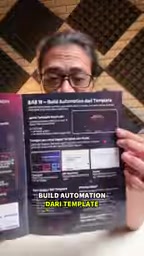
The creator references a book called Mahir n8n dalam 8 jam (Master n8n in 8 Hours), which specifically covers the method of "building automation from templates." The value of a template lies in the fact that it gives you a fully structured reference to work from — you can directly see what a real, functional automation workflow looks like, how its nodes are connected, and how data passes between them.
This approach of "reverse-engineering an existing product" is far more efficient than trying to build something from scratch with no reference point.
A Three-Step Path: From Imitation to Independent Building
The learning path the creator outlines breaks down into three clear stages:
Step 1: Observe an Existing Automation Example
Find a pre-built template and resist the urge to modify it right away. Instead, take time to observe how it works as a whole — understand what problem it solves, and which services and nodes it uses.

Step 2: Understand Each Component
Once you have a sense of the big picture, break it down piece by piece — what role each node plays, why they're arranged in that particular order, which ones are triggers, and which handle data processing logic. This step is the key to moving from "I can see it" to "I understand it."
Step 3: Adapt It to Your Own Needs
Once you understand the template's structure, that's when the real value kicks in — modifying and extending the existing foundation to fit your actual use case. At this point, you have a clear reference to work from, which makes changes feel far more manageable and reduces the risk of getting stuck.
What This Means for Automation Learners
This methodology isn't exclusive to n8n — it applies to any visual automation tool or low-code platform. Template-driven learning works because it reduces cognitive load for beginners: it gives the brain a concrete "anchor point" first, and then gradually builds understanding of the more abstract concepts on top of that.
For anyone who wants to get into automation but keeps putting it off, the answer isn't to stare down a blank canvas until inspiration strikes. Instead, actively seek out ready-made workflow templates from the community and treat them as study material to dissect. n8n itself has a rich template library, which makes "learning from templates" a well-supported starting point.
One note worth mentioning: the content here originates from a YouTube short with a book-promotional angle. The core concept — template-driven learning — is broadly applicable and genuinely useful, but readers should evaluate the book itself independently.
"Cognitive Load" is a central concept in educational psychology, referring to the amount of mental effort placed on working memory when a learner processes new information. When learning material is too abstract and lacks concrete reference points, working memory can easily become overloaded, causing learning efficiency to drop or learners to give up entirely. This is precisely why template-driven learning works: a ready-made workflow provides a tangible, perceivable example that lets the brain switch from "generating from nothing" to "recognizing and analyzing" — dramatically lowering the initial barrier to entry. This mirrors the strategy of "read example code before writing code" in programming, and "copy the masters" in design training — the underlying cognitive mechanism is the same.
Related articles

Amphibious Transforming Drone: Beyond 100x Power Savings, What Are the Real Needs?
Is the amphibious transforming drone just a gimmick? Starting from the 100x power difference of the M4 Morphobot, explore real application scenarios and thesis topic ideas, analyzing boundary conditions where pure drones and pure ground robots both fail.

Warhound Raises $200 Million: Genetically Engineered "War Dogs" Paired with Anduril Gear
Warhound raises $200M, backed by Ben Lamm and Palmer Luckey, to genetically engineer dogs for military and law enforcement use and equip them with Anduril gear. This article analyzes its technology direction, funding logic, and ethical controversy.

Claude API Comes to Google Cloud: IAM Integration and SDK Access Guide
Anthropic hosts the full Claude API on Google Cloud with IAM-controlled permissions and unified billing. This guide covers the Vertex AI and Anthropic-hosted entry points, IAM role configuration, and SDK access.