You Get the Algorithm but Get Stuck on the Math? Unpacking the Learning Gap in Machine Learning
Understanding an algorithm's purpose and its underlying math can happen independently; the gap is common but bridgeable.
Starting from a Reddit learner's question, the article points out a common gap in ML learning between the "purpose layer" and the "math layer": you can intuitively say what an algorithm does but get stuck on why the formulas are designed that way. The sticking point is usually not computational ability but the lack of a mapping between mathematical operations and algorithmic purposes—for example, not knowing that the dot product corresponds to a similarity measure. Being able to use ML libraries can mask this gap, creating black-box proficiency. The article suggests working backward from specific algorithms to the math, building geometric intuition, and accepting the path of using first and understanding why later, emphasizing that the gap is a normal stage in learning, not a deficiency.
Many people learning machine learning encounter a peculiar sense of split: you can explain in one sentence what an algorithm does—find similarities, make predictions, reduce error—but the moment you open the formulas, vectors, matrices, dot products, and projections rush at you, and the math from school reappears in a new context. Suddenly you're not sure whether you actually understand it.
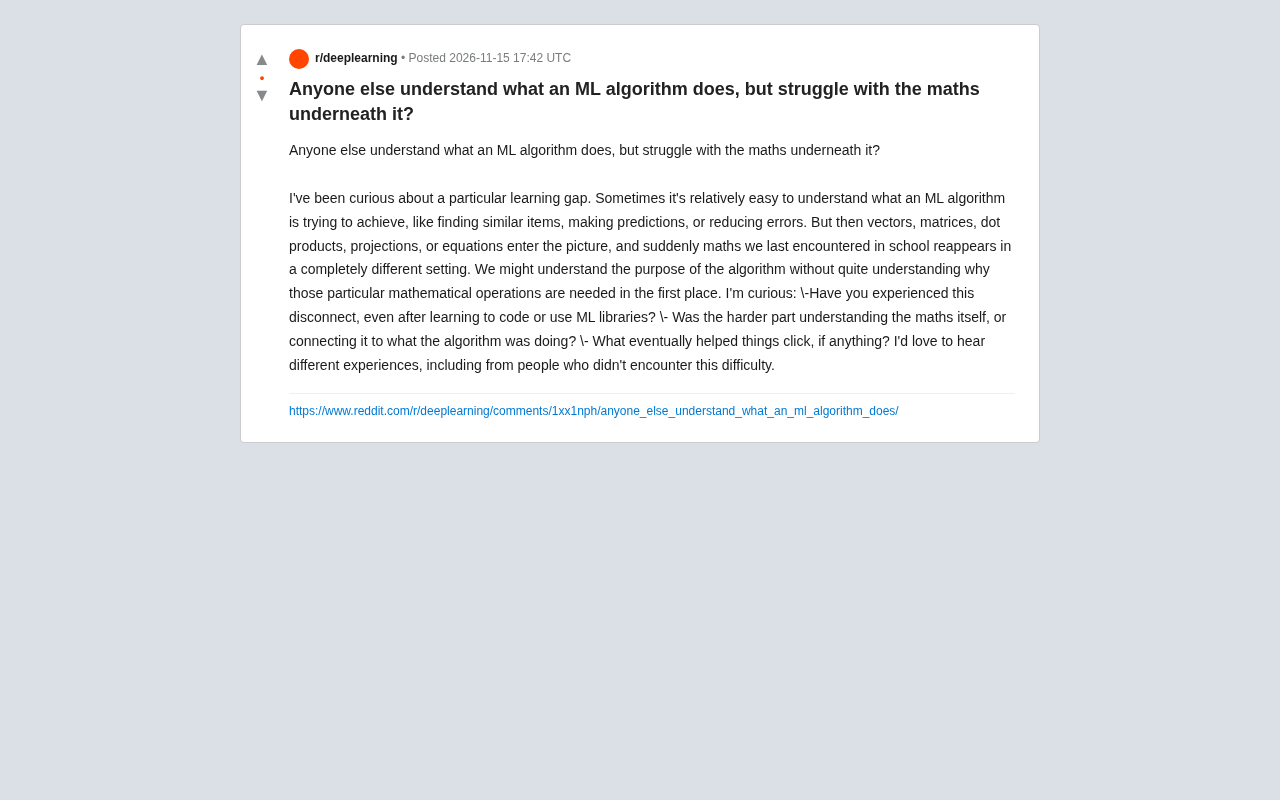
This is not an isolated phenomenon. A question from a learner on Reddit struck a chord with many: understanding the purpose of an algorithm and understanding the math behind it are two things that can happen independently.
The Gap Between Purpose and Math
The questioner described it accurately: what an algorithm wants to do is often intuitively easy to grasp, but why it specifically needs these mathematical operations is often poorly explained. For example, you know a recommendation system is finding similar items, but why the dot product rather than something else? You know the model is reducing error, but what role do projections and matrix factorization play here?
The key to this gap is that math classes teach operations, while machine learning requires explanation. The same matrix multiplication is a calculation exercise in the classroom, but in a model it might be "projecting data into a new feature space." Without this layer of translation, formulas are just symbols.
The questioner further broke this down into three sub-questions, each hitting the mark: even if you can already write code and use libraries, do you still feel this disconnect? Is what's blocking you the math itself, or the connection between the math and the algorithm's purpose? And what ultimately made everything click?
Sticking Point One: The Math Itself, or the Connection?
From the direction of the discussion, most people's difficulty is not in their ability to compute calculus or linear algebra. What really blocks people is "why this step"—why the loss function should be designed this way, why gradient descent should move in this direction, why features should be normalized.
This actually points to a common teaching blind spot: textbooks tend to teach tools first and purposes later, while human understanding often needs purpose first before revisiting the tools. When you don't know that the dot product measures similarity in direction, it's just a sum of products; once you know it corresponds to the core of cosine similarity, the same operation takes on meaning.
So "not understanding the math" is often a false premise. A more accurate description is "lacking the mapping between the math and the algorithm."
Dot product and cosine similarity are key examples for understanding "similarity of vector directions." The dot product is defined as the sum of the products of corresponding components of two vectors, and its geometric meaning is (\mathbf{a}\cdot\mathbf{b}=|\mathbf{a}||\mathbf{b}|\cos\theta), where (\theta) is the angle between the two vectors. When vector lengths are fixed, the larger the dot product, the smaller the angle, and the closer the directions. Cosine similarity further normalizes this to (\cos\theta=\frac{\mathbf{a}\cdot\mathbf{b}}{|\mathbf{a}||\mathbf{b}|}), retaining only direction information and ignoring length. In recommendation systems, the dot product or cosine similarity between user vectors and item vectors measures precisely how close their "interest directions" are; in high-dimensional space, this operation is equivalent to comparing the angle between two embedding vectors. Once you understand this geometric meaning, the dot product is no longer an abstract sum of products but a direct computational tool for "similarity."
The connection between loss functions and gradient descent is also often where the gap lies. The loss function turns "how bad the model is" into a scalar, and gradient descent uses the gradient of this scalar to update parameters. The gradient points in the direction of steepest increase of the loss function, so updating parameters along the negative gradient direction reduces the loss. The key is not memorizing the update formula (\theta \leftarrow \theta - \eta \nabla L(\theta)), but understanding: the design of the loss function determines how "badness" is measured, and the gradient translates this measure into the direction and magnitude of parameter adjustment. If the loss function is poorly chosen, gradient descent may fail to converge to the desired solution. The math at this step exists to turn the purpose of "reducing error" into an executable numerical optimization process.
Sticking Point Two: Using Libraries Can Actually Mask Understanding
The question specifically mentions "even if you've learned to write code or use machine learning libraries." This is precisely why the gap is easy to overlook: calling a library produces results, masking the blank spots in internal mechanisms. You can train a classifier with a few lines of code but can't explain why it converges.
This "black-box proficiency" is sufficient in engineering practice, but when the model performs abnormally, requires tuning, or needs interpretation of results, the gap in understanding becomes exposed. Between being able to use tools and understanding principles lies a layer of cognition that must be actively filled in.
"Black-box proficiency" refers to being able to call interfaces to complete training and prediction without knowing the mathematical meaning of each internal step. This phenomenon is especially common in deep learning frameworks: a few lines of code can define a network, compile, and fit, but how backpropagation computes gradients, how optimizers update weights, and how regularization terms affect the loss are all encapsulated under high-level APIs. Black-box proficiency is highly efficient in standard workflows, but when you need custom losses, debug non-convergence, explain model decisions, or run ablation experiments, the gap in understanding becomes a real obstacle. The remedy is not to abandon using libraries but to actively open the black box at key points—for example, manually implementing a small gradient descent, printing intermediate tensors, or comparing the update trajectories of different optimizers.
What Ultimately Makes Understanding Click
Although the question is open-ended, from the commonalities of this kind of learning difficulty, breakthroughs often happen in a few directions.
Work backward from specific algorithms to the math, rather than forward from math to algorithms. Pick an algorithm you're familiar with and ask, step by step, "what problem is the math at this step solving?" This is more effective than systematically relearning linear algebra.
Replace symbol memorization with geometric intuition. Vectors, projections, and dot products all have clear geometric pictures. Build the image first, then return to the formulas, and understanding will be much more solid.
Accept the path of "use it first, understand why later." A gap is not failure but a normal stage in the learning process. Many people, after repeated use, suddenly connect purpose and math at some moment.
A Gap Is the Norm, Not a Defect
Back to the original question: is it normal to understand what an algorithm does but get stuck on the math? From this discussion, it's a fairly common experience among machine learning learners. The purpose layer and the math layer are two different languages, and a bridge of translation is needed.
Recognizing that the gap exists is itself the first step toward closing it. Rather than doubting your math ability, see it as a concrete, decomposable learning task: not relearning math, but building the connection between math and algorithms.
Related articles

Gemini 4 Hydrogen vs Sonnet Comparison Test: Uses Only 1% of Weekly Quota, Performance on Par
Hands-on test: Gemini 4 Hydrogen vs Sonnet on the same CRUD task—Hydrogen used only 1% weekly quota with comparable performance and better UI details, while Anthropic's model used 7%. Developer says daily tasks don't require expensive models.

Gemini 4 Neon Released: Beats Opus 5.5 on Multiple Benchmarks, Google Returns to the Top Tier
Google DeepMind releases Gemini 4 Neon: 61 on the Artificial Analysis intelligence index (3rd) and 1st on the coding index, beating Opus 5.5 on multiple benchmarks. $3/$15 per million tokens; available in the Gemini API and AI Studio.
Gemini 4 Neon Review: Benchmark Scores Rival Carbon, API Cost-Performance Analysis
Full review of Google Gemini 4 Neon: benchmark scores rival Carbon, API priced at 2x Hydrogen, yet Antigravity quota consumption is only 1x (vs Carbon's 3x). Real tests show it replaces 90% of Carbon use cases. Includes channel restrictions, ban risks, and combination strategy analysis.