YouTube Launches AI-Powered Custom Feeds: Describe What You Want, Let the Algorithm Build It

YouTube tests Gemini-powered custom feeds that let users describe what they want to watch in plain language.
YouTube is testing a "custom feeds" feature that lets users describe the type of content they want in natural language, with Google's Gemini model interpreting that intent and generating a personalized video stream. This breaks from the platform's traditional black-box recommendation logic and shifts meaningful algorithmic control back to users. It represents a new paradigm combining intent-driven retrieval with conventional behavioral collaborative filtering, lowers the barrier to shaping one's own recommendations, and signals a genuine platform effort to address filter bubbles and improve algorithmic transparency. Whether it succeeds depends on matching accuracy, content availability, and compatibility with YouTube's monetization model.
YouTube Lets Users Define Their Own Recommendation Algorithm
YouTube is testing a new feature called "custom feeds" that lets users describe in their own words the type of videos they want to watch, then uses Google's Gemini model to build a personalized content stream accordingly. For the first time, this shifts some control over the recommendation logic — long dominated by the platform's black-box algorithm — back to users themselves.
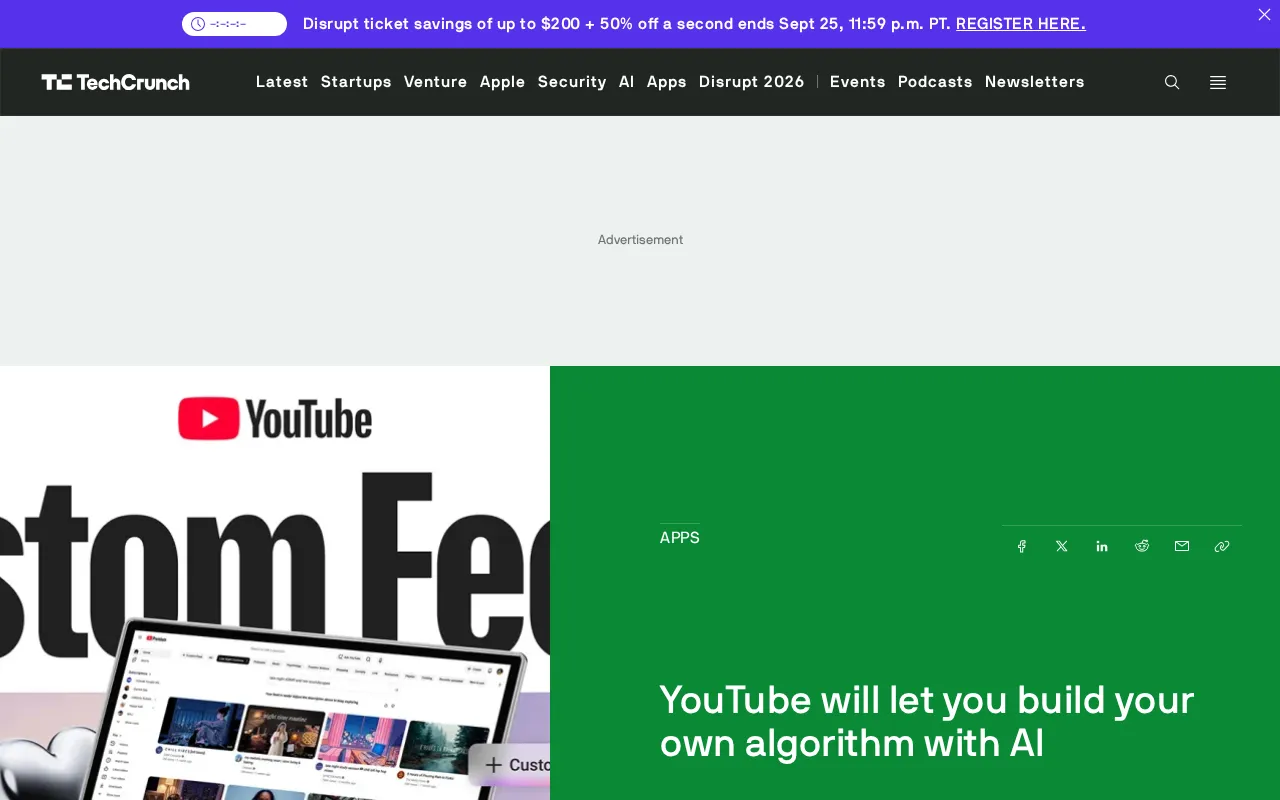
For users accustomed to passively receiving recommendations, this represents a meaningful shift in approach. YouTube's algorithm has traditionally inferred your interests automatically based on watch history, time spent, likes, and other behavioral signals. Now, users can tell the platform directly: "I want hands-on tutorials about home gardening" or "Show me behind-the-scenes content from indie game developers" — and the system will organize content around that natural language description.
What Role Does Gemini Play?
At the heart of this feature is Gemini's natural language understanding capability. User-entered descriptions tend to be vague and conversational, and Gemini needs to parse these expressions into actionable content filtering criteria, then match results from YouTube's vast video library that align with the user's intent.
This reflects a new application paradigm for generative AI within recommendation systems. Traditional recommendations rely on collaborative filtering and behavioral modeling — essentially "guessing what you might like." Natural language retrieval powered by large language models is closer to "you tell me what you want, I'll find it for you." The two approaches aren't mutually exclusive; they're more likely to complement each other. Custom feeds give users an active channel to express intent, addressing the filter bubble problem that pure behavioral recommendation tends to create.
Collaborative Filtering is the foundational technology behind traditional recommendation systems. Its logic is: "What users with similar behavior to yours enjoy, you might enjoy too." This approach is heavily dependent on historical data and tends to reinforce existing preferences — creating the so-called "filter bubble," where users are trapped in an echo chamber of their past interests and struggle to discover new areas. Behavior-based recommendation also suffers from the cold-start problem: for new users or new videos, the system lacks sufficient data to make accurate recommendations. The natural language intent parsing that Gemini represents bypasses this path dependency entirely, building content filtering logic directly from what users explicitly express. In principle, this decouples recommendations from historical behavior, giving users a shortcut to break out of their established interest circles.
Why This Matters
In recent years, discussions around recommendation algorithm transparency and user control have intensified. Users frequently complain about being "held hostage by the algorithm" — unable to escape content they're not interested in, or struggling to explore new areas of interest. YouTube's experiment is, in part, a response to these criticisms.
Letting users define their feeds with natural language effectively lowers the barrier to "taming the algorithm." Previously, changing recommendation outcomes required indirect, slow, and unpredictable methods — repeatedly clicking "Not interested," clearing watch history, and so on. Now, a single sentence can redefine an entire content channel, dramatically improving both the sense of control and immediacy.
From a broader perspective, this also reflects the trend of major content platforms deeply embedding large language models into core product experiences. Search, recommendation, and content organization — the central pillars of any platform — are being progressively reshaped by AI.
Algorithm transparency has attracted growing regulatory attention in recent years. The EU's Digital Services Act (DSA), which came into force in 2023, explicitly requires large platforms to offer users at least one recommendation option "not based on profiling" and grants users the right to be informed about and to intervene in algorithmic recommendation parameters. Google, YouTube's parent company, is directly subject to this regulation as a very large platform operator. Seen in this context, the custom feeds feature is not just a product innovation — it may also be a strategic move by the platform to proactively enhance user control in response to compliance pressure. Similar regulatory trends are gaining momentum in the US and other markets, providing external momentum for the industry's broader evolution toward algorithmic transparency.
Potential Value and Open Questions
If this feature successfully rolls out, the most immediate beneficiaries will be users with clear, niche interests. They can create multiple custom feeds for different topics, bringing more structure to their content consumption rather than being swept along by a single main recommendation stream.
That said, several questions remain. First is matching accuracy — can Gemini truly understand the intent behind vague user descriptions and avoid irrelevant results? Second is the breadth of content supply, as niche requests may face a shortage of available videos to recommend. Third is how this feature will align with YouTube's existing advertising and monetization logic, since user-driven feeds could disrupt the platform's established traffic distribution patterns.
Given the limited public information available at this stage, the specific launch timeline, coverage scope, and real-world effectiveness all await further disclosure from YouTube. But one thing is clear: the direction of "using AI to build your own algorithm" represents an important exploration by content platforms seeking a new balance between personalization and user sovereignty.
Related articles

5 Practical Ways Real Estate Agents Can Use AI to Boost Efficiency (2026 Edition)
How can real estate agents use AI to boost efficiency? Based on a YouTube walkthrough, this breaks down five methods — ChatGPT for listing descriptions, Canva for marketing materials, forms for open house leads, Zapier for automated follow-up, and seller meeting prep — and flags risk boundaries like fair housing laws, photo authenticity, and price verification.

Grok Bot vs ChatGPT Agent: Which AI Agent Is More Powerful?
How does Grok Bot differ from ChatGPT Agent? This comparison examines how they work: Grok Bot has a cloud computer and runs persistently inside tools to execute multi-step tasks automatically; ChatGPT Agent operates web pages in a browser and is more mature at general tasks. Includes selection advice.

Walmart Agent Gateway: AI Shops for You Automatically—Why Is Amazon Going the Opposite Way?
Walmart's Agent Gateway lets ChatGPT, Gemini and other AI assistants access its product catalog to search, compare and add to cart, with spending limits and per-purchase approval. Amazon blocks external AI agents—two retail giants, opposite paths. Currently US-only, India may follow.