YouTube Launches Conversational Video Editing Tool: Edit Videos with Natural Language

YouTube introduces AI-powered conversational video editing so creators can edit with natural language commands.
YouTube has brought AI into the core of video creation with a new conversational editing feature, allowing creators to describe their edits in natural language while AI interprets and executes the changes — no timelines or complex menus required. The tool is especially useful for smaller creators with limited skills or resources, and keeping editing inside the platform reduces friction from switching between apps. Full feature details are yet to be disclosed, but the move reflects a broader industry race to embed AI into creator tools and AI's growing role in professional post-production workflows.
YouTube Makes Video Editing as Easy as Chatting
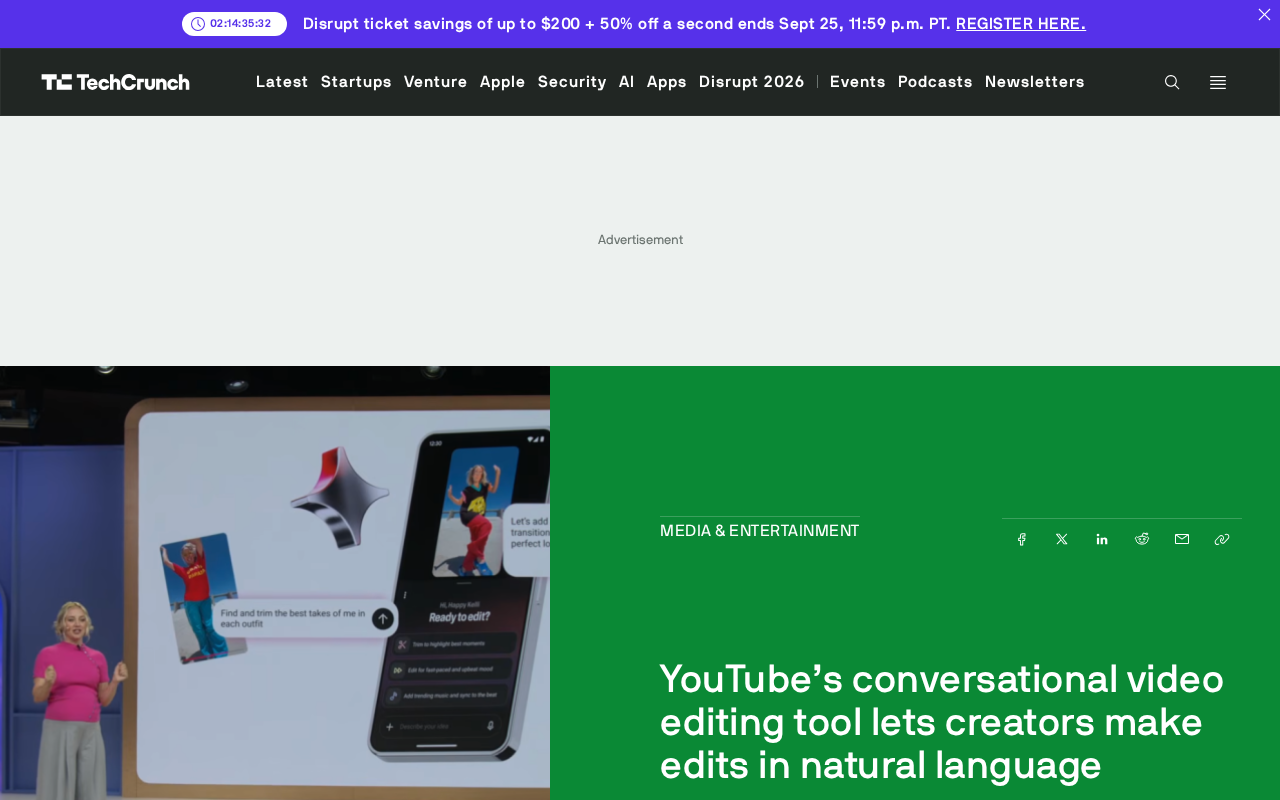
YouTube is pushing AI into the heart of the creator workflow. The platform has introduced a conversational video editing feature that lets creators edit videos through a natural language chat interface — no more relying on traditional timeline scrubbing and layered menu navigation.
In other words, creators can describe the changes they want just like talking to an assistant — for example, "remove the silence at the beginning" or "add background music to this section" — and the AI interprets the intent and executes the corresponding edits.
From Timeline to Chat: A Shift in Editing Paradigms
Traditional video editing is far from beginner-friendly. Cutting, transitions, color grading, and audio are typically scattered across complex interfaces with a steep learning curve. The conversational editing approach abstracts these technical operations into natural language instructions, letting creators focus on what effect they want rather than how to operate the software.
This interaction model follows the same thread as generative AI's recent breakthroughs in text and image domains. When AI can understand vague, conversational expressions and translate them into concrete actions, the barrier to creation drops significantly. For YouTube creators whose primary focus is content output rather than professional editing, this direction toward reduced operational complexity has clear, practical value.
From a technical standpoint, conversational video editing typically relies on large language models (LLMs) to parse user instructions and map them to a chain of underlying editing operations. These systems must simultaneously handle semantic understanding (e.g., what exactly counts as "the silence at the beginning") and temporal localization (finding the corresponding segment on the video timeline) — a far more complex challenge than AI editing for pure text or static images. Similar explorations already exist in the industry, such as Adobe's AI-assisted editing features and Runway's video generation tools. However, deeply integrating natural language instructions with full timeline editing remains a technically demanding frontier. With access to Google DeepMind's model capabilities, YouTube is well-positioned to pursue this path.
What This Means for Creators
The most immediate impact is efficiency. Tasks that previously required repeated operations in editing software could theoretically be completed through a brief conversation, shortening the cycle from filming to publishing.
For small and mid-sized creators and solo content producers without a professional team, tools like this are especially appealing — they help bridge the gap in skills and resources. Having editing tools built directly into the platform ecosystem also means creators no longer need to switch between multiple third-party applications, streamlining their workflow.
It's worth noting that publicly available details remain limited. The specific capability boundaries, supported edit types, output quality, and availability are all still pending further disclosure from YouTube. Whether conversational editing can truly replace precise manual editing — or whether it will serve more as an assistive tool — remains an open question worth watching.
Platform Competition and the AI Creator Tools Megatrend
YouTube's move can also be understood within a broader industry context. Major content platforms are racing to embed AI capabilities into their creator tools in order to strengthen creator loyalty. Lowering the barrier to creation and improving output efficiency is, at its core, a strategy to expand a platform's content supply and overall activity.
Whoever can offer a smoother, smarter creative experience is better positioned to retain creators. Conversational editing is a direct product of this competitive logic — it reflects AI's gradual penetration from "content generation" into "editing and post-production," a domain far closer to professional workflows.
On the competitive front, TikTok's CapCut has long deeply integrated AI editing features and built up a massive creator user base, while Meta continues to add AI-assisted capabilities to its Reels creation tools. YouTube's launch of conversational editing is a direct response to this competitive landscape. Notably, building editing tools natively into the platform also carries strategic value at the data level — creators completing their edits within the platform means more behavioral data stays within YouTube's ecosystem, helping to further optimize recommendation algorithms and ad targeting capabilities. The business logic extends well beyond simply improving the user experience.
Related articles

Gaussian Process Bandit Optimization: Exploration Strategies and Inference Regret Guarantees
Cumulative regret guarantees in Bayesian optimization fail to reflect final recommendation quality. This article examines a new study that provides inference regret guarantees for Gaussian process bandit optimization through exploration query strategies and fill distance analysis, validated on hyperparameter optimization and control tasks.

The Most Detailed Codex Guide on Bilibili: From Installation to Real-World Practice
The most detailed Codex guide on Bilibili: from app store installation to daily work mode configuration, with a real coffee shop project demonstrating file organization, data extraction, dashboard creation, and other practical tasks. Learn to use Plan Mode and desktop pets to leverage Codex efficiently.

Appearance Compensation in Volume Rendering: Why RGB Accuracy Cannot Guarantee Density Correctness
Volume rendering research reveals that volumetric data perfectly reproducing external RGB views may still contain density errors: appearance compensation can double central density and keep external rays unchanged even when L2 error exceeds 14.52%. Density recovery depends on appearance capacity, spatial resolution, and measurement design.