YouTube Music Launches AI Content Labels: Transparency Over Blanket Bans
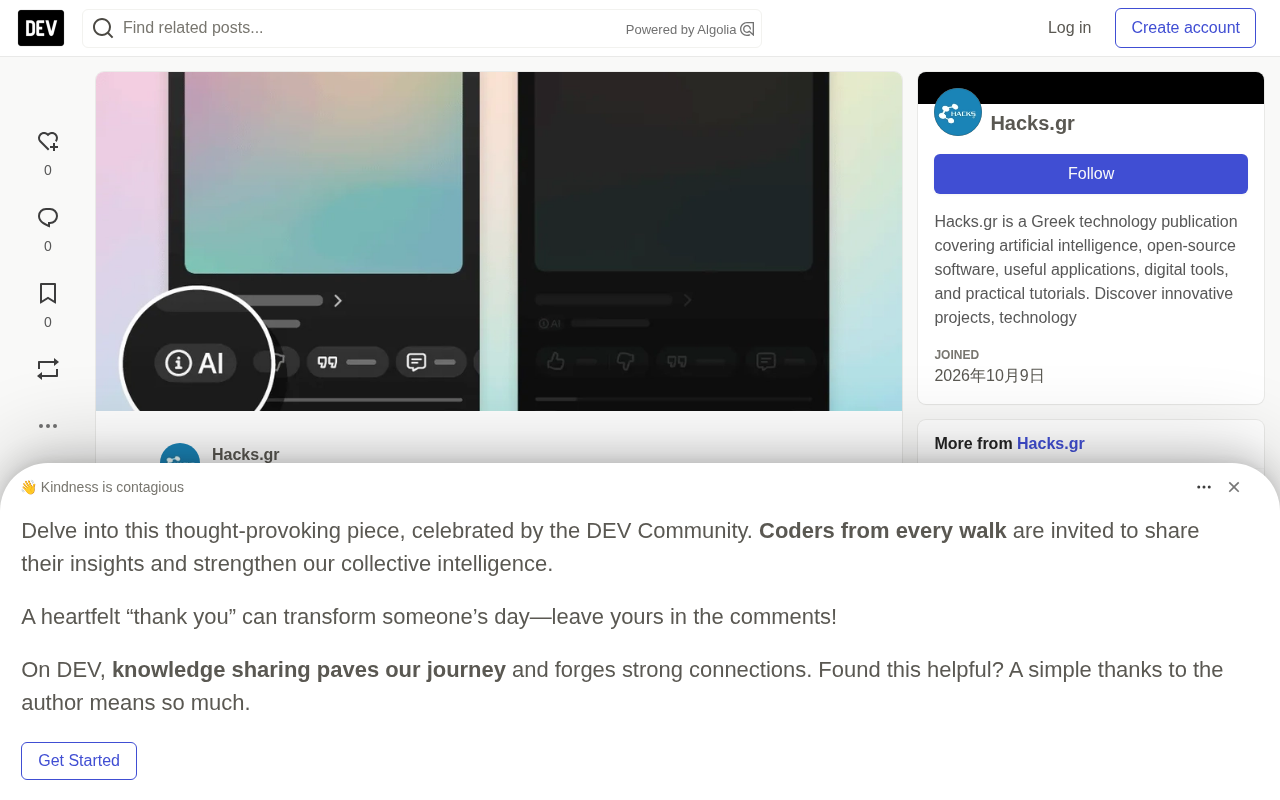
YouTube Music launches three-tier AI content labels, addressing AI music with transparency rather than restrictions.
YouTube Music has introduced three-tier AI content labels on playback pages, categorizing tracks as fully AI-generated, partially AI-created, and no AI used, while explicitly excluding traditional audio processing like Auto-Tune from 'AI-created' status. The platform uses a dual-track mechanism combining partner self-reporting with proprietary detection tools. Unlike Deezer and TIDAL, which exclude AI music from recommendations, YouTube focuses on transparency without restricting monetization, while also testing its own AI creation tool Dream Track. The article notes challenges in detection accuracy, mislabeling, and cross-platform standard unification, but sees it as an actionable starting point.
YouTube Music is introducing a new AI content labeling system on its playback pages, distinguishing between tracks that are fully AI-generated, partially AI-assisted, and completely free of AI involvement. This move offers a concrete example of how the streaming industry might handle AI music: rather than imposing blanket restrictions, it uses transparency to let listeners decide for themselves.
How the Three-Tier Labels Classify AI Involvement
According to YouTube's official documentation, partners must choose among three categories to describe their content's level of AI involvement:
- Fully AI-generated: The entire song is program-generated, with no real-time participation from a human creator.
- Partially AI-generated: The artist combines AI with their own creative elements to form a hybrid work.
- No AI used: The track is not based on such technology. Even if it went through simple voice correction processing like Auto-Tune, it falls into this category.
The cleverness of this classification lies in excluding traditional audio processing tools like Auto-Tune from the "AI-created" designation, avoiding the mislabeling of nearly all modern pop music as AI-generated.
Auto-Tune is a pitch correction software released in 1997, originally designed to fix subtle pitch deviations in vocal recordings. It achieves pitch correction by detecting the frequency of incoming audio in real time and adjusting it to the nearest target pitch. When parameters are set to extremes, Auto-Tune produces a robotic "electro" effect—a side effect that was later heavily used in hip-hop, pop, and electronic music as a deliberate artistic expression. Classifying Auto-Tune under "no AI used" reflects that regulators' definition of "AI-created" is not based on any algorithmic assistance, but focuses on whether generative AI substantially participated in producing the musical content. Clarifying this distinction is crucial to understanding the entire labeling system: it prevents virtually all mainstream music from the past two decades that has used pitch correction from being labeled as AI-generated.
Detection Mechanism: Partner Self-Reporting + Platform's Proprietary Tools
YouTube does not rely entirely on uploaders' honesty. The platform requires partners to proactively select a disclosure category while also deploying its own detection tools and collaborating with companies in the field to identify AI content.
This "self-reporting + detection" dual-track mechanism means that even if creators fail to label accurately, YouTube has the capability to identify AI-generated content through technical means. However, the platform has not yet disclosed the specific accuracy rates of its detection tools or its process for handling misclassifications.
According to Hacks.gr, YouTube identifies AI content through both its proprietary detection tools and industry partnerships.
Divergence from Deezer and TIDAL's Approach
YouTube's approach stands in sharp contrast to some competitors. Deezer and TIDAL have adopted stricter rules—excluding AI-generated music from recommendation systems and potentially stripping creators of related rights.
YouTube has chosen a different path: focusing on transparency without restricting these songs' monetization capabilities. The platform is also experimenting with its own AI music creation tool, "Dream Track," allowing creators to generate music with AI. This "label and participate" strategy makes YouTube both referee and player in the AI music ecosystem.
Other major platforms like Apple Music and Spotify have also announced or implemented similar labeling policies.
Deezer is a France-based streaming platform known for being among the first to publicly disclose the proportion of AI-generated music in its catalog; TIDAL is co-owned by artists including Jay-Z and has long positioned itself around high-fidelity audio and creator rights protection. Both platforms' stricter stance on AI music reflects differences in their positioning and user bases. Deezer and TIDAL excluding AI-generated content from recommendation algorithms means such music is harder for listeners to discover, effectively weakening its reach; "losing related rights" for creators could involve restrictions at the royalty distribution or platform agreement level. In contrast, YouTube, leveraging its massive user base and advertising monetization system, prefers informational labeling over traffic penalties for AI content—directly tied to its commercial interest in simultaneously operating the AI creation tool Dream Track.
What It Means for Creators and Listeners
For listeners, labels on playback pages provide clear informational cues, letting them know whether the content they're listening to involves AI generation. This is far more direct than asking after the fact or relying on media reports.
For creators using AI tools, YouTube's policy preserves monetization channels while requiring honest disclosure. This balanced approach may become an industry standard—responding to public demands for AI content transparency while avoiding stifling innovation through excessive restrictions.
The partially AI-created category covers the most common human-machine collaboration scenarios. As more and more musicians use AI as an assistive tool rather than a replacement, this category may become the most frequently used option in the labeling system.
Limitations and Challenges of the Labeling System
The labeling system still faces several unresolved questions. Whether detection tools can accurately distinguish between "partial AI involvement" and "fully AI-generated" currently lacks public data support. Additionally, the mechanism of partners self-selecting categories, without effective verification, could lead to mislabeling or missed labels.
Inconsistent labeling standards across platforms could also impose additional compliance burdens on musicians distributing across multiple platforms. If Apple Music, Spotify, and YouTube each adopt different classification logic, creators will need to report separately for each platform.
The direction of AI music labeling systems depends on the maturity of detection technology and the speed of industry standard coordination. YouTube's step, at least, provides an actionable starting point for discussion.
Cross-platform compliance burden is not a new issue in music distribution. Previously, different streaming platforms had varying requirements for explicit lyrics, regional copyright, and metadata formats, and musicians typically relied on distributors or digital rights management tools to unify adaptation. But AI labeling involves substantive judgment about the creative process, which is difficult to automate through simple metadata mapping. If platforms define the threshold for "partial AI involvement" inconsistently, the same song could be labeled "partial AI" on one platform and "no AI used" on another. For independent musicians and small labels, researching and adapting to each platform's rules individually will bring significant time and compliance costs, potentially further widening the resource gap between them and major record companies.
One-line Summary
YouTube Music launches three-tier AI content labels, addressing AI music with transparency rather than restrictions.
Paragraph Summary
YouTube Music has introduced three-tier AI content labels on its playback pages, categorizing tracks as fully AI-generated, partially AI-created, and no AI used, while explicitly excluding traditional audio processing like Auto-Tune from "AI-created" status. The platform uses a dual-track mechanism combining partner self-reporting with proprietary detection tools to identify AI content. Unlike Deezer and TIDAL, which exclude AI music from recommendation systems, YouTube focuses on transparency without restricting AI music's monetization capabilities, while also experimenting with its own AI creation tool Dream Track. The article notes that the labeling system still faces challenges in detection accuracy, mislabeling handling, and cross-platform standard unification, but it provides an actionable starting point for the industry to address AI music.
Related articles

New in Notion 3.8: Your ChatGPT Subscription Now Works Directly in Notion Agent
Notion 3.8 lets Business/Enterprise workspaces connect ChatGPT Plus, Pro, or Go subscriptions to power Notion Agent, replacing Notion credits. Eligibility, setup, MCP risks, and team implications explained.

ChatGPT Agent Mode Quick Start: A Multi-Step Task Automation Tutorial
How to use ChatGPT Agent mode? This guide breaks down the enabling steps: open the Tools dropdown from the Composer, select Agent Mode, and clearly describe multi-step goals, plus browser interaction in the VM, data analysis, file generation, and real-time interrupt controls.

Premiere Pro Meets AI Assistants: Automation Agent Brings Editing Automation
Automation Agent connects ChatGPT and Claude Code to Adobe Premiere Pro, enabling speech-based rough cutting, face pixelation, and more, with built-in FFmpeg and Python local tools and a one-time purchase, no subscription.