YouTube Overhauling Comments and Membership: More Fan Engagement, Better Creator Monetization

YouTube upgrades comments with GIFs and voice, adds personalized moderation and paid fan communities.
YouTube is rolling out a coordinated upgrade around community interaction and creator monetization. New GIF replies and voice-powered TV comments boost engagement and unlock the long-neglected big-screen audience. Personalized moderation tools give creators finer-grained control over community quality. On the monetization side, paid members-only communities productize fan loyalty, shifting creators from ad dependence toward stable subscription income — while taking direct aim at third-party platforms like Patreon and Discord.
YouTube is rolling out a significant upgrade to its community interaction and creator monetization systems. The core philosophy behind this update is straightforward: make the comments section more enjoyable while giving creators more channels to turn fan enthusiasm into revenue. From GIF replies to paid members-only communities, YouTube is searching for a new balance between entertainment and commercialization.
Comments Are No Longer Just Text: GIFs and Voice Enter the Picture
For a long time, YouTube's comment section was stuck in plain-text mode — feeling somewhat dull compared to other social platforms. This update introduces GIF replies, letting users express emotions and reactions through animated images, bringing the experience closer to the interaction model on platforms like Twitter (X) and Instagram. GIFs tend to spark lighter-weight engagement more effectively than text and are better at energizing the overall atmosphere in the comments.
Perhaps even more noteworthy is the voice-powered commenting on TV. As more users watch YouTube on their living room TVs, traditional keyboard input is a frustrating experience on big screens. By enabling voice comments, YouTube is trying to unlock TV — long a dead zone for interaction — and shift passive viewing into active participation. This design reflects YouTube's growing focus on the living room as a rapidly expanding share of viewing time.
YouTube on TV has grown rapidly in recent years. According to YouTube's own data, more than 150 million people watch YouTube on a TV screen every month, making it one of the fastest-growing viewing surfaces in terms of watch time. Yet the big-screen environment is inherently hostile to text input: navigating an on-screen keyboard with a remote is painfully slow, and almost no one keeps a Bluetooth keyboard handy. This input barrier has long kept TV viewers in a purely passive consumption state, making them hard to convert into active community participants. Voice commenting directly addresses this pain point — using the built-in microphone on a smart TV or set-top box to convert speech to text, it bypasses the physical input bottleneck entirely.
Personalized Moderation: Giving Creators Back Control
A more active comments section often comes with governance headaches — spam, harassment, and off-topic noise all erode community quality. YouTube is now rolling out personalized moderation tools, giving creators more flexibility to manage comment content according to their channel's tone and community standards.
There's a clear product rationale here. The comments section is both where creators connect with fans and where negativity can accumulate. Putting more granular control in creators' hands means different types of channels can maintain their own community culture. For niche creators serving a specific audience, customizable moderation meaningfully reduces the operational burden and helps retain core fan communities.
Paid Members-Only Communities: Deepening the Fan Economy
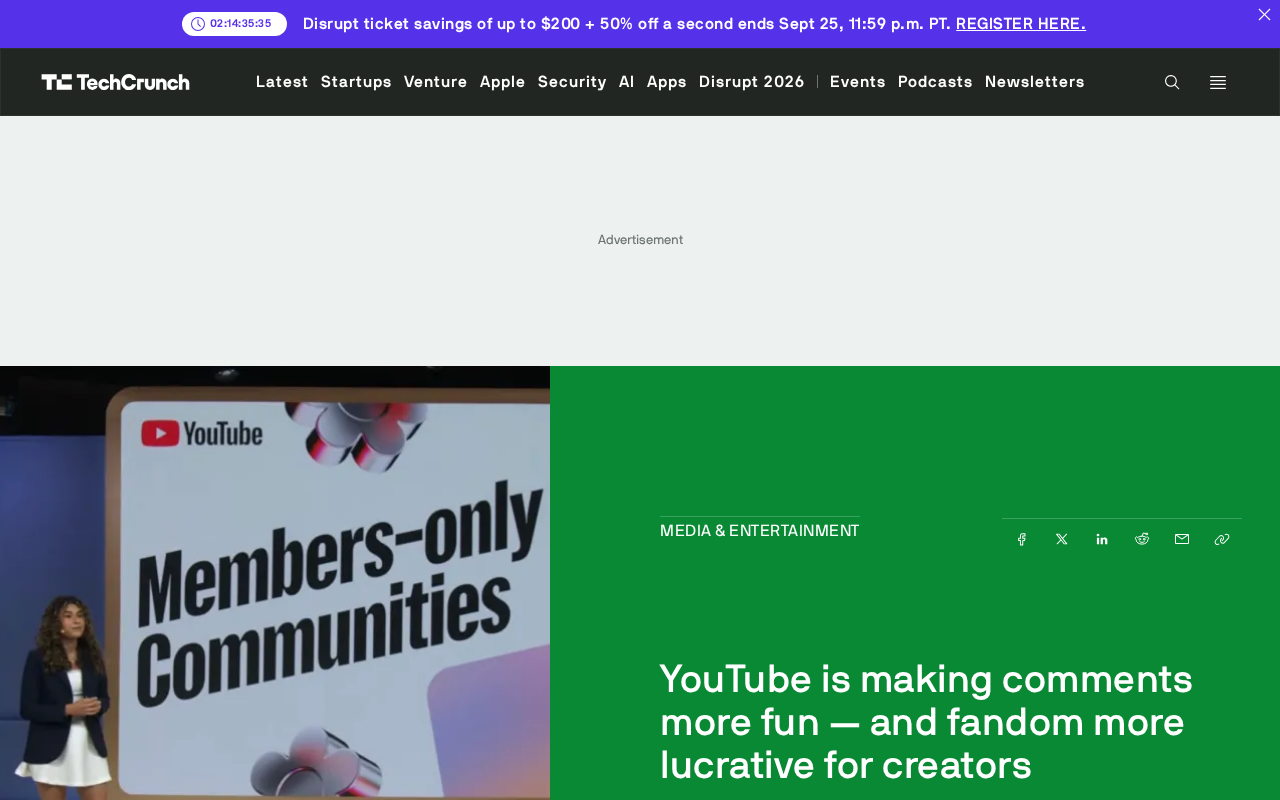
On the monetization front, the most significant move is paid members-only communities. This isn't simply an extension of the existing channel membership feature — it's a direct productization of fan belonging. Paying members gain access to exclusive spaces with interaction experiences that set them apart from general viewers.
This model echoes a broader trend across the content industry: moving away from a single revenue structure dependent on ad revenue sharing, toward a more diverse, core-fan-driven "fan economy." When a small segment of highly loyal fans is willing to pay for exclusive content and community identity, creators gain more stable income — and become less exposed to the volatility of platform ad policies. For YouTube, this both strengthens creator retention and reclaims value from competing third-party platforms like Patreon and Discord paid communities.
Patreon and Discord are currently the most mature third-party paid community tools in the creator ecosystem. Patreon is a subscription-based creator support platform where fans pay monthly to unlock exclusive content or interaction perks, with the platform taking roughly 8–12% in fees. Discord, which originated in gaming communities, has in recent years become a mainstream tool for creators to run private communities, supporting tiered paid access to server channels. YouTube's existing "channel memberships" feature already overlapped partially with Patreon's logic, but lacked the sense of an independent community space. The new paid members-only communities are designed to keep fans engaged on YouTube even outside of active video watching — reducing creators' reliance on external tools to build private communities, and thereby lowering the platform's risk of user churn.
More Ways for Fans to Support Creators
Beyond the features above, YouTube has also signaled that more new ways for fans to support their favorite creators are on the way. While the specifics haven't been fully disclosed, the overall direction points toward a more complete creator revenue ecosystem — from tips and memberships to exclusive communities. YouTube wants every ounce of fan enthusiasm to translate into a sustainable support channel.
From a platform strategy perspective, these updates aren't isolated feature additions — they're a coordinated package built around "community" and "monetization." Interactive features (GIF replies, voice comments) expand the scale of participation; moderation tools protect community quality; and paid communities and support features convert that participation into revenue. The three elements are tightly interlocked, collectively reinforcing YouTube's position as the primary arena for creators.
What This Means for Creators and Viewers
For creators, this batch of updates provides richer community management tools and clearer monetization paths — particularly benefiting mid-tier creators who have already built loyal fan bases. Paid communities allow them to earn stable income without being entirely dependent on view counts and ad revenue.
For everyday viewers, comments will feel more lively and the barrier to participating from a TV is lower. But the introduction of paid communities also means that some quality interactions and content may end up behind a paywall, making the divide between free and paid experiences increasingly pronounced. This is an unavoidable trade-off in any content platform's commercialization journey.
Overall, YouTube is evolving toward something more social and more commercial. Whether it can hold the line between "more engaging interaction" and "over-commercialization" will be the real test once these new features go live.
Related articles

OpenAI Codex CLI Practical Guide: The Open-Source AI Coding Agent in Your Terminal
OpenAI Codex CLI is an open-source AI coding agent that runs in your terminal. This guide covers its 2025 launch, 2026 desktop app, ChatGPT merger, and a three-step setup and workflow.

AI for Beginners Course Review: ChatGPT, Gemini, and AI Agents in Practice
A hands-on review of a complete beginner AI course covering ChatGPT, Gemini, Notebook LM, Manus, and DeepSeq, with 18,000-record dataset analysis, AI agent website building, and LLM principles and limits.

How Do AI Agents Autonomously Complete Complex Tasks? The ReAct Framework Explained
What's the core difference between an AI Agent and a chatbot? Using competitive research as an example, this article breaks down the ReAct framework's three-step loop of reasoning, acting, and observing, explaining how Agents autonomously decompose tasks, call tools, spot data gaps, and dynamically adjust plans to ultimately deliver complete results.