Z.AI's Looped Architecture Lets a 750B Model Rival 2T: A Deep Dive into GLM-5.4

Z.AI's loop transformer gives a 750B model near-2T performance, but flagship benchmarks and openness are questionable.
Z.AI's GLM-5.4 takes a different path from parameter stacking: its first loop transformer design runs a 26-layer prelude, then repeats layers 27–54 twice with shared weights, stretching 78 unique layers into 106 effective ones. Per-token dampgates and a sparse KV cache with a 128-token sliding window control activations and inference cost, yielding near-2T-class reasoning with 750B parameters. It ships with four interactive coding demos—a FreeCAD six-axis robotic arm, the fully playable 3D game BrickWild, a GLSL birdwatching scene, and a self-narrated music video—with native vision in the flagship. But there are clear information gaps: no official 750B flagship leaderboard, a blog chart that's actually a 30B test table, and an independent Kingbench 4 score of 33.2/60, ranking seventh. There are currently no open weights and no third-party API; access is only via a roughly $18/month coding plan, and Z.AI admits the looped architecture can get stuck in excessively long thinking loops on hard prompts.
While most AI labs are still stacking parameters and racing toward trillion-scale models, Z.AI has taken a very different path. According to a breakdown of GLM-5.4 by a YouTube tech channel, the company used a "looped layer" design to push a 750-billion-parameter model to reasoning performance close to the 2-trillion-parameter class—and generated a fully playable 3D game on the spot.
Four Real Coding Demos: From a Robotic Arm to a 3D Game
Before discussing benchmarks, let's look at what GLM-5.4 actually delivered. Z.AI released four general-purpose coding demos at once:
- A six-axis robotic arm built in FreeCAD
- A complete, playable 3D brick-world game called BrickWild, including movement, maps, and a physics system
- An interactive 3D birdwatching scene built purely with math and GLSL shaders
- A self-narrated music video
Unlike the text-only GLM-5.3, the flagship version of GLM-5.4 ships with native vision capabilities built in. What makes this set of demos notable is that they aren't just demo clips—they're complete, interactive artifacts. BrickWild in particular packs the game loop, collision detection, and level logic into the model's output.
Looped Transformer: How 78 Layers Become 106
How does GLM-5.4 achieve 2-trillion-parameter-class reasoning with 750 billion parameters? The answer lies in the architecture diagram Z.AI published. This is the company's first loop transformer design.
Tokens first enter a 26-layer prelude, after which layers 27 through 54 are executed twice with shared weights. This stretches 78 unique layers into 106 effective layers. To prevent activations from exploding, Z.AI added per-token dampgates and reused a "one-shot sparse KV cache"—retaining only a 128-token sliding window during the second pass.
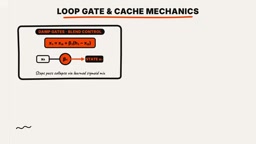
On speed: up to 200 tokens per second during off-peak hours, and 70–80 tokens/second under peak load, with support for million-token contexts. In other words, the looped design gives the model a deeper computational path under the same weights, while the caching strategy keeps inference costs in check.
Loop Transformer is a class of architectures that performs multiple forward computations over some layers at inference time, with roots in work such as the Universal Transformer. Its core idea is to reuse the same set of weights repeatedly, deepening the effective computation graph without increasing parameter count—essentially trading "time for depth." This is a different parameter-efficiency route from Mixture-of-Experts' "more parameters but only activate a subset." The key challenges of looped designs are training stability and inference cost control: repeated execution amplifies activations with each pass, requiring gating or normalization to suppress; and each additional loop means another round of KV cache reads and writes, so sliding windows or sparse caching are often used to limit memory and latency overhead.
KV cache (Key-Value Cache) is the mechanism in autoregressive generation that caches the attention keys and values of historical tokens to avoid recomputation, and it is the main source of memory usage in long-context inference. A "one-shot sparse KV cache" means that during the second pass of the loop, not all historical keys and values are retained—only a fixed-size sliding window (128 tokens here), so that subsequent layers attend only to the most recent local context. This significantly reduces memory and bandwidth demands, but the cost is that the model's visibility into long-range information is truncated during the looped stage; on long-document tasks, it may "remember the beginning and forget the middle," which needs to be compensated for in the inter-layer design.
Benchmark Fog: A 30B Test Table and Third-Party Baselines
Now for the part that most warrants caution. According to the YouTube channel's analysis, Z.AI quietly released GLM-5 earlier this year under the codename "Pony Alpha," and this time GLM-5.4 went straight onto the coding plan without publishing any leaderboard data for the 750-billion flagship—and Artificial Analysis has no score for it yet.
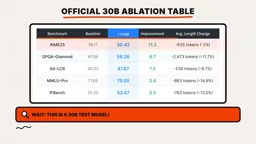
Looking closely at the charts on the Z.AI blog, it's actually a small 30-billion-parameter test table showing gains on AIME25 and GPQA Diamond, along with a 10% to 14% reduction in output tokens. On the other hand, according to the independent Kingbench 4 test cited by the channel, the real GLM-5.4 scores 33.2/60, or 55.3%, ranking seventh overall—beating Kimmy K, 3.1 Pro, Quinn 4 Max, and even GPT-6.1 Sol.
There's a clear information gap here: no official flagship benchmark, yet third-party rankings are already out. This "board first, ticket later" release cadence makes evaluation difficult.
The AIME25 and GPQA Diamond mentioned in the article are two frequently cited high-difficulty evaluation sets. AIME25 draws from the 2025 American Invitational Mathematics Examination, mainly testing multi-step mathematical reasoning; answers are unique and easy to auto-grade, but it is sensitive to prompt format, and scores fluctuate considerably across different sampling counts. GPQA Diamond is the hardest tier of the "Google-Proof Q&A" dataset, with questions written by domain experts and adversarially validated, covering graduate-level knowledge in physics, chemistry, biology, and more; it tests a model's specialized knowledge and robustness to distraction. Both lean toward single-turn, closed-book Q&A and don't fully correspond to long-horizon capabilities like coding and agentic tasks, so scores on these two alone are hard to use for inferring a model's overall engineering ability.
Barriers and Flaws: No Open Weights, No Standalone API
Before considering a purchase, there are a few practical constraints. According to the channel, GLM-5.4 currently has no open weights and no third-party API endpoints—both are locked behind a security-hardening process. Users can only access it through Z.AI's own coding plan, starting at about $18 per month.

Existing subscribers received a 50% quota increase. But Z.AI also admits that the looped architecture can get stuck in overly long "marathon thinking loops" on hard prompts—a structural side effect of the looped design, where the model can trap itself in repeated iterations.
Open weights means the parameter files of a trained model are published in downloadable form, allowing others to deploy locally, fine-tune, or redistribute—typically seen with the Llama and Qwen series; the opposite is the closed-source model that offers only a cloud API. Whether weights are open directly affects three things: data compliance and the feasibility of private deployment, controllability of inference costs (amortizable against one's own compute), and whether the community can reproduce and audit model behavior. For new designs like looped architectures, the absence of weights also means external researchers cannot verify the actual implementation details of inter-layer reuse, gating, and caching strategies, and third-party benchmark scores are harder to independently verify.
Conclusion: The Architectural Creativity Deserves Credit, But Don't Subscribe Blindly
GLM-5.4 is undeniably one of the most creative architecture releases this November. It proves that you don't need 3 trillion weights to beat Kimmy K, 3.1 Pro, and Quinn 4 Max on coding tasks. The loop transformer approach offers a new direction for parameter efficiency: trade shared weights for depth, and caching strategies for throughput.
But if you're considering a monthly subscription, it's worth waiting until independent Artificial Analysis scores and open weights land before deciding. There's still a way to go between architectural innovation and product maturity.
Would you trust a looped-architecture 750B model over Gemini Neon?
Related articles

Trained Entirely on Ascend NPU! Phai-A1-35B Code Model Hands-On Test
Phai-A1-35B-1M is a 35B expert model based on Qwen 3.6, targeting code and Agents, with its entire fine-tuning and reinforcement learning training done on Huawei Ascend NPUs. This article covers its MoE architecture, 1M context, official benchmark scores, and deployment, plus license caveats for the base model.

RK3588S Benchmarks Local LLMs: 35B MoE vs. NPU Acceleration — Which Is Faster?
RK3588S benchmarked with local LLMs: 4B dense, 35B MoE, and NPU-accelerated models compared. Pure CPU hits 5.8 tokens/s generation; NPU reaches 26 tokens/s prefill — revealing edge device selection strategies.

GLM 5.4 Recurrent Transformer Explained: How 750B Parameters Surpasses DeepSeek?
Zhipu AI releases GLM 5.4, the first recurrent Transformer flagship with 750B parameters claiming 2-3T-model intelligence. Analysis of its tech, DeepSeek comparison, and lack of third-party tests.