Zalcro: The Planning Tool That Saves AI Coding from the Death Loop

Zalcro plans architecture before AI coding, using structured build plans to cut context loss and rework.
Zalcro is a planning tool positioned in the "pre-build" stage of AI coding, targeting the "fix one thing, break another" death loop developers hit with Cursor, Claude Code, and similar tools. Before prompting, it helps map out app architecture and generates a build-ready plan that breaks vague requirements into modules, data flows, and implementation order, reducing context loss in long conversations. It supports Lovable, Replit, Cursor, and Claude Code via pasted step-by-step prompts or an MCP connection. The article frames this as a reflection on vibe coding: architectural decisions still need a human to think them through.
Why AI Coding Needs a "Plan First" Tool
Most people who write code with AI have been through this scenario: you open Cursor or Claude Code, confidently type in a prompt, and the AI quickly generates a pile of code that throws errors when you run it. So you add more prompts, the AI fixes a few spots, and something else breaks. After a few rounds, the context keeps growing, the AI starts forgetting the original requirements, and the project spirals into a "death loop" that gets messier with every change.
Zalcro, launched on Product Hunt, targets exactly this pain point. Its positioning is clear: map out the architecture before you start prompting. The official description nails it: "Jumping straight into prompting usually leads to the AI losing context and breaking your app."
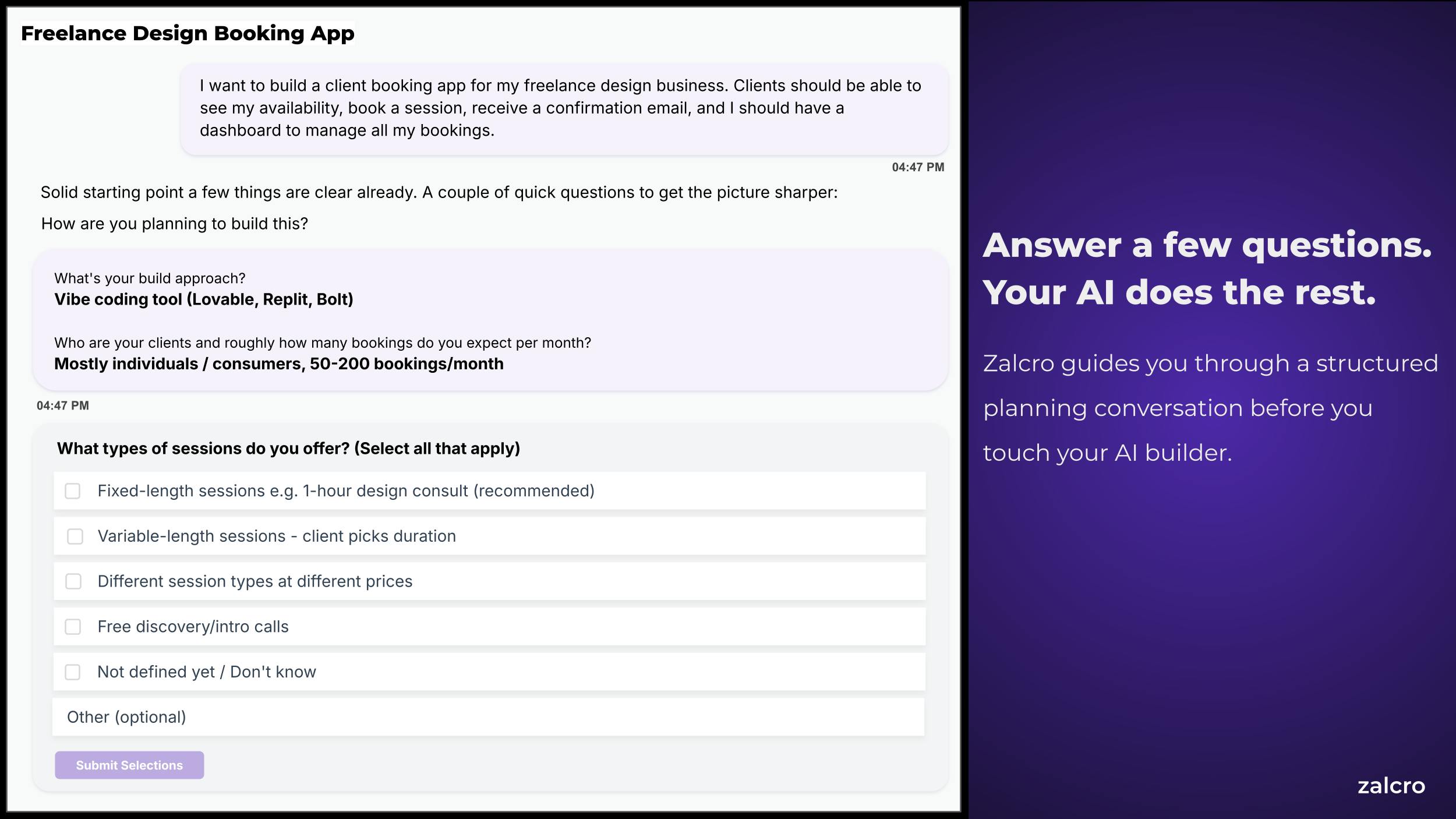
Zalcro's Core Idea: Generate an Executable Build Plan First
Zalcro's approach isn't complicated, but it hits on a part of the AI-assisted development workflow that has long been overlooked. Users first work through their app's architecture with Zalcro, and the tool generates a "build-ready plan"—one that's specific enough for the AI to follow directly.
The value of this plan: the AI no longer receives a vague "build me a budgeting app," but rather broken-down modules, data flows, and an implementation order. With clear requirement boundaries, the odds of the AI losing context in a long conversation drop naturally.
Judging by its positioning, Zalcro places itself in the "pre-build" stage—before any code is written. That's a smart spot to choose: it doesn't compete with build tools like Cursor or Lovable, but becomes their upstream.
Seamless Integration with Mainstream AI Coding Tools
Zalcro is adapted for major AI build tools. The official materials mention support for Lovable, Replit, Cursor, and Claude Code. There are two ways to use it:
- Direct paste: Zalcro generates step-by-step prompts that users copy and paste into whichever tool they're using;
- MCP connection: via Model Context Protocol, so planning output flows straight into the development environment.
MCP support is a detail worth noting. As an open protocol championed by Anthropic, MCP is becoming the standard interface for exchanging context between AI tools. By supporting MCP, Zalcro's planning output can flow more smoothly into development environments like Claude Code that support the protocol, reducing the friction of manual copying.
Model Context Protocol (MCP) is an open protocol introduced by Anthropic in late 2024, designed to establish a standardized way of exchanging context between AI applications and external data sources and tools. Think of it as the "USB-C port" of the AI world: in the past, every AI tool had to write custom adapter code for every data source, whereas MCP provides a unified client-server architecture that lets models read files, call tools, and retrieve structured context on demand. For planning tools like Zalcro, MCP support means the build plans it generates don't require manual copy-paste—they can be read directly by development environments like Claude Code that support MCP, chaining "planning" and "execution" into an automated pipeline. As MCP is adopted by tools like Cursor and Replit, it is becoming the de facto context standard in the AI coding ecosystem.
Filling a Process Gap in the "Vibe Coding" Boom
Zalcro's tagline uses the term "vibe coders," pointing to a popular development style today: describe your intent in natural language, let the AI generate code, and iterate by feel. This lowers the barrier to programming, but it also amplifies "prompt dependency"—many people hand the planning step over to the AI as well, and the result is racing full speed in the wrong direction.
Zalcro represents a kind of reflection: AI can help you write code, but architectural decisions still need to be thought through by a human first. The tool's job is to structure and make executable that thinking—not to replace it.
Judging by the Product Hunt numbers, Zalcro received 20 upvotes and ranked 18th, so the buzz isn't especially high. This suggests the "pre-build planning" concept still needs market education—many developers haven't yet realized that the problem isn't that AI models aren't strong enough, but that the input they provide isn't structured enough.
The Room for Growth in the Planning Tool Category
Zalcro isn't alone. Tools for planning, context management, and specification (spec) around AI coding are multiplying, reflecting an industry consensus: the bottleneck in AI coding is shifting from "generating code" to "managing intent." When model capabilities are strong enough, the key variable determining output quality becomes the clarity of the input and the stability of the context.
Zalcro was developed by David Odukoya and is currently positioned as an independent product. Whether it can hold its ground against build tools like Cursor that keep strengthening their own planning capabilities will depend on whether it can do "planning" more deeply and professionally than general-purpose tools.
Vibe coding is a term coined by former Tesla AI lead Andrej Karpathy in early 2025 to describe a way of programming where you're "fully immersed in the vibes": the developer describes what they want in natural language, accepts all the code the AI generates, no longer reviews it line by line, and instead iterates based on runtime results and intuition. This dramatically lowers the barrier to prototyping, letting non-professional developers quickly build apps. But its weakness is obvious too—when a project grows from a single-file script into a multi-module system, "going by feel" can't replace a clear design of data flows, dependencies, and edge cases, and errors accumulate as context grows. Zalcro's emphasis on "planning first" is essentially a correction to vibe coding: keeping its advantages of low barriers and fast iteration while pulling architectural decisions back into human hands.
Spec-driven development is a practice that recently emerged in the AI coding community, advocating that before letting AI write code, you produce a structured specification document—including feature boundaries, data models, interface contracts, and acceptance criteria. What distinguishes it from traditional requirements documents is that the spec is written for AI to execute rather than for humans to read, so it emphasizes operability, step-by-step structure, and machine parseability. Tools like GitHub's Spec Kit and Amazon's Kiro have productized this idea. Zalcro's "build-ready plan" is a concrete form of this approach: translating vague natural language intent into step-by-step instructions the AI can follow directly. This also explains why planning tools are emerging in clusters—when code generation itself is no longer the bottleneck, how to pass human intent to the model losslessly becomes the key factor determining output quality.
Who It's For
If you're building projects with Lovable, Replit, Cursor, or Claude Code and have run into the following, Zalcro is worth a try:
- As soon as the project gets a bit bigger, the AI frequently breaks one thing while fixing another;
- The AI repeatedly forgets earlier requirements in long conversations;
- You have to re-explain the project structure every time you start a new conversation.
For developers who only write small scripts and single-file tools, Zalcro's planning step may feel cumbersome; but for multi-module apps that need continuous iteration, the payoff of planning before prompting is much more obvious.
Efficiency gains in AI coding never depend solely on how fast the model runs, but also on what route you set it on. What Zalcro tries to do is draw the route before the starting gun fires.
One-line Summary
Zalcro plans the architecture before AI coding, using structured build plans to reduce context loss and rework.
Paragraph Summary
Zalcro is a planning tool positioned in the "pre-build" stage of AI coding, targeting the "fix one thing, break another" death loop developers commonly hit when using tools like Cursor and Claude Code. Its core approach: before entering a prompt, it helps users map out the app architecture and generates a build plan specific enough for the AI to execute directly, breaking vague requirements into modules, data flows, and an implementation order—reducing the odds of context loss in long conversations. Zalcro supports Lovable, Replit, Cursor, and Claude Code, and can be used either by pasting step-by-step prompts or by connecting directly to the development environment via the MCP protocol. The article sees this as a reflection on "vibe coding"—architectural decisions still need to be thought through by a human first, not handed to the AI. The product's modest traction on Product Hunt suggests the "pre-build planning" concept still needs market education.
Related articles

Chain of Thought Isn't Just for AI: How Humans Can Use CoT to Improve Thinking Quality
Chain of Thought isn't just a prompt trick for large models. Starting from a Hacker News discussion, this article analyzes why CoT works for human thinking too, breaks down actionable ways to transfer it, and highlights the key differences between human CoT and machine CoT.
Cloudflare Teams Up with OpenAI: Closi…
Cloudflare Teams Up with OpenAI: Closing the Loop from Vulnerability Discovery to Defense with AI
Cloudflare uses OpenAI Daybreak to investigate security vulnerabilities and generate reviewable remediation plans, while developers use Codex to boost coding efficiency and quality.

Orca Multi-Agent Orchestration in Practice: A Guide to Parallel Collaboration with Claude and Codex
Orca is Stable AI's free open-source agent workbench supporting 34 agents like Claude Code and Codex in parallel. Learn its Git worktree isolation, multi-model orchestration, and mobile management.