Zed Editor Proto Extension Updated to v0.3.4: Version Bump Explained

Zed's Proto extension releases v0.3.4, a routine maintenance bump with no user-facing changes.
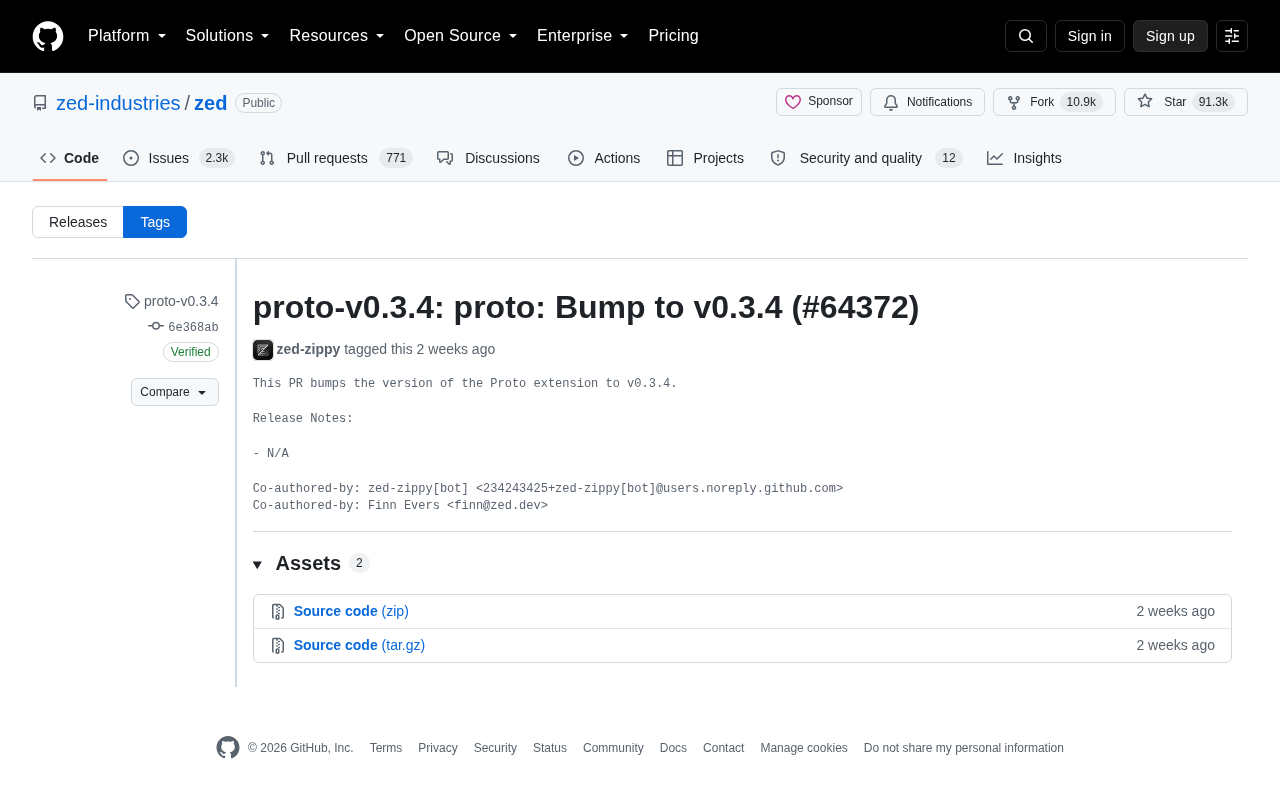
The Proto extension for the Zed editor has been updated to v0.3.4 (PR #64372), a maintenance version bump triggered by the automated bot zed-zippy[bot], with Release Notes marked as N/A — meaning no user-facing feature changes. The Proto extension provides Protocol Buffers (.proto file) syntax highlighting and formatting support within the Zed ecosystem, versioned independently from the main editor. Such releases typically reflect dependency syncs or build adjustments and are automatically synced via Zed's extension management with no action required from end users.
The Proto extension for the Zed editor has been updated to v0.3.4. This is a routine version bump triggered by Zed's project maintenance workflow. This article breaks down the change based on the official commit information.
What's in This Update
According to the release notes from the official Zed repository (zed-industries/zed), this commit (PR #64372) bumps the Proto extension version to v0.3.4. The Release Notes field is marked as "N/A," meaning this update does not include detailed feature changes or bug fixes.
The version bump was tagged by the automated bot zed-zippy[bot] and co-signed by developer Finn Evers. The commit carries a verified GitHub GPG signature (key ID: B5690EEEBB952194), confirming the authenticity of the release source.
What Are Zed and the Proto Extension?
Zed is a high-performance code editor that has gained significant attention in recent years. Built by the team behind the former Atom editor, Zed focuses on native performance, low latency, and collaborative coding. It has accumulated over 90,000 stars and nearly 11,000 forks on GitHub, making it one of the most popular projects in the open-source editor space.
The Proto extension is a language extension within the Zed ecosystem that provides support for Protocol Buffers (protobuf). Protocol Buffers is a language-agnostic, platform-agnostic structured data serialization format developed by Google, widely used in microservice communication and gRPC interface definitions. This extension gives developers writing .proto files basic language support such as syntax highlighting and formatting.
Why Independent Extension Versioning Matters
Zed uses an architecture that separates extensions from the main application. Language extensions like Proto maintain their own independent version numbers, which means they can iterate and update without waiting for a new release of the main editor. A version increment like v0.3.4 typically corresponds to dependency syncs, build configuration adjustments, or minor updates to underlying grammar libraries.
Protocol Buffers uses .proto files to define data structures and service interfaces, then generates target-language code via the protoc compiler. Compared to JSON or XML, protobuf uses binary encoding, resulting in smaller payload sizes and faster serialization/deserialization — making it widely adopted in performance-sensitive distributed systems. The gRPC framework uses protobuf as its default Interface Definition Language (IDL), making it a de facto standard in cloud-native and microservice ecosystems. For developers, having syntax highlighting and formatting support when writing .proto files significantly reduces syntax errors and improves coding efficiency.
This decoupled architecture between extensions and the main application is increasingly common in modern editors. VS Code's Marketplace and Neovim's plugin ecosystem follow similar philosophies. Zed's extension system uses WebAssembly (WASM) as a sandboxed runtime environment — extensions are distributed as WASM modules, ensuring cross-platform consistency while preventing untrusted native code from running directly on users' machines. Independent version increments also allow extension maintainers to quickly respond to upstream grammar library updates (such as tree-sitter grammars) without affecting the stability of the main application, keeping syntax parsing accurate.
Understanding "N/A" Release Notes
In open-source continuous integration workflows, operations like version bumps are often generated by automated tools and don't necessarily come with user-facing feature changes. Release Notes marked as N/A are fairly common and typically indicate:
- The update is a maintenance release that doesn't require user attention to specific changes
- The actual changes may be at the dependency or internal build level and don't affect the end-user experience
- More substantial feature updates may follow in subsequent releases
For most users, these kinds of updates are automatically synced through Zed's extension management mechanism and require no manual action.
Summary
The proto-v0.3.4 release is a routine maintenance version bump in the Zed editor ecosystem. While it doesn't come with explicit feature change notes, it reflects Zed's active iteration cadence and well-structured automated release process. Developers interested in protobuf tooling or the Zed editor can keep an eye out for further extension updates down the line.
Related articles

Gaussian Process Bandit Optimization: Exploration Strategies and Inference Regret Guarantees
Cumulative regret guarantees in Bayesian optimization fail to reflect final recommendation quality. This article examines a new study that provides inference regret guarantees for Gaussian process bandit optimization through exploration query strategies and fill distance analysis, validated on hyperparameter optimization and control tasks.

The Most Detailed Codex Guide on Bilibili: From Installation to Real-World Practice
The most detailed Codex guide on Bilibili: from app store installation to daily work mode configuration, with a real coffee shop project demonstrating file organization, data extraction, dashboard creation, and other practical tasks. Learn to use Plan Mode and desktop pets to leverage Codex efficiently.

Appearance Compensation in Volume Rendering: Why RGB Accuracy Cannot Guarantee Density Correctness
Volume rendering research reveals that volumetric data perfectly reproducing external RGB views may still contain density errors: appearance compensation can double central density and keep external rays unchanged even when L2 error exceeds 14.52%. Density recovery depends on appearance capacity, spatial resolution, and measurement design.