Zed Editor Releases v1.25.0-pre Preview: New Developments in Code Collaboration Tools

Zed releases v1.25.0-pre preview for targeted testing, entering the final stage before stable release.
High-performance code editor Zed released v1.25.0-pre on GitHub, verified with GPG key ID B5690EEEBB952194 and marked for team member @SomeoneToIgnore, indicating a small-scale targeted test rather than a public beta. This signals that Zed 1.25 stable has entered its final pre-release phase. Built by the original Atom team in Rust, Zed is known for low latency and native collaboration. The preview suits developers and eager testers, but not production use; regular users should wait for the official 1.25 stable release.
Zed Releases v1.25.0-pre Preview
High-performance code editor Zed recently released the v1.25.0-pre preview version on GitHub, tagged by core contributor zed-zippy and explicitly marked as a v1.25.x preview for team member @SomeoneToIgnore. This indicates that Zed's 1.25 stable release has entered its final pre-release testing phase.
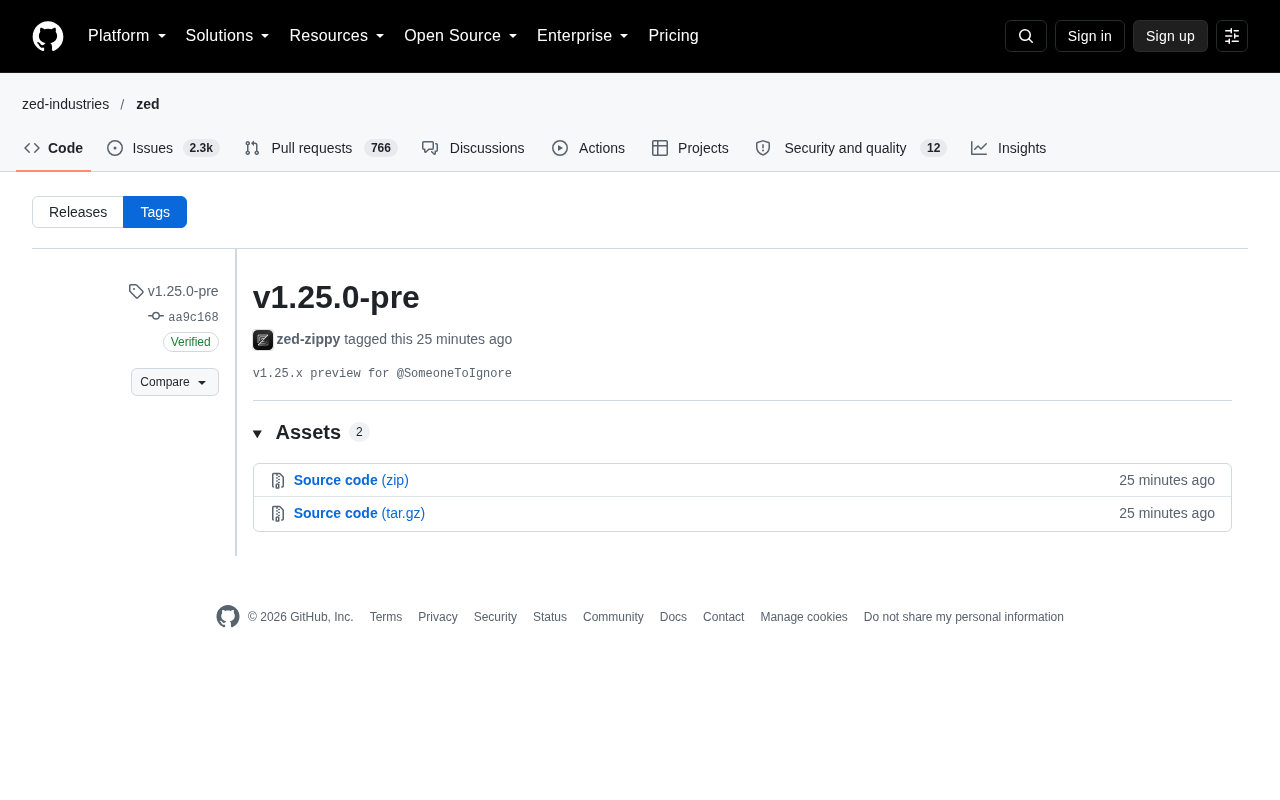
Signature Verification and Release Process
This commit (aa9c168) has been verified by GitHub's signature verification, with GPG key ID B5690EEEBB952194. The Verified badge indicates that the code source is trustworthy, which is particularly important for an editor that prioritizes security and local-first operation. From the release process perspective, the Zed team has adopted a strategy of first delivering previews to designated members and then gradually expanding the testing scope. This approach is similar to the release cadence of VS Code Insiders and Neovim nightly, but Zed tends toward smaller-scale targeted distribution.
GPG (GNU Privacy Guard) is an encryption tool based on the OpenPGP standard, widely used in open-source projects to verify the authenticity and integrity of commits and release artifacts. Developers use their private keys to generate digital signatures for commit content, and anyone can use the corresponding public key to verify whether the signature matches. The GPG key ID B5690EEEBB952194 mentioned in this article is the short identifier for this public key, which GitHub uses to display the Verified badge next to the commit.
For an editor that emphasizes local-first operation and privacy security, signature verification is not mere formality: it prevents man-in-the-middle tampering with source code, forgery of publisher identity, and also gives downstream packagers and users confidence that the downloaded binaries were indeed built by the official team. As a tool that needs to access the local file system and even execute AI network requests, supply chain security is especially critical for Zed, making the Verified badge practically meaningful.
The Development Cadence Behind the Preview
Zed was built by the original team behind the Atom editor, written in Rust, and is known for extremely low input latency and native collaboration capabilities. From the 1.0 official release to the current 1.25.x series, the team has maintained a fairly tight iteration frequency.
Why Choose a Pre-release Version
The -pre suffix indicates that this version is still in the pre-release stage and may contain unfixed regression issues. For regular users, the stable version remains the first choice; for developers who want to experience new features early or help verify specific fixes, preview versions provide an earlier feedback window. This preview is explicitly directed at @SomeoneToIgnore, indicating that it is targeted verification for a specific need rather than a public test for all users.
In the Semantic Versioning (SemVer) system, suffixes such as -pre, -alpha, -beta, and -rc are collectively called pre-release identifiers, and their sorting priority is lower than the corresponding official version. That is, 1.25.0-pre would be ranked before 1.25.0 in version comparison, and package managers typically do not treat such versions as default upgrade targets.
The benefit of this naming convention is that pre-release versions can share the same version number backbone with stable versions, making it easier to track the code state of the "future stable version," while clearly informing users of its instability through the suffix. Software repositories, CI pipelines, and dependency resolution tools can all automatically recognize the suffix and handle it accordingly—for example, skipping pre-release versions—thereby preventing regular users from accidentally upgrading to an unstable build.
A Reflection of the Open-Source Collaboration Model
Tags on GitHub, commit signatures, and the note "v1.25.x preview for @SomeoneToIgnore" together outline the transparent and efficient collaboration approach of the Zed team. Compared to closed development, this public preview process allows the community to track project progress and also accumulates test data for subsequent stable releases.
In GitHub workflows, a tag is a named reference to a specific commit, typically used to mark release points, such as v1.25.0-pre. Since a tag points to a fixed commit hash, it is more stable than a branch and makes it easy for others to precisely locate a particular version's build artifacts for reproduction or auditing.
Tags can also trigger CI/CD pipelines to automatically complete steps such as building, packaging, and generating release notes. By writing "v1.25.x preview for @SomeoneToIgnore" in the tag annotation, the Zed team embeds the release intent directly into the version metadata, so community members can understand the purpose and scope of the build without additional communication. This "tag as documentation" practice is also common in the release practices of projects like Rust and Neovim.
Recommendations for Users
If you are currently using Zed, it is advisable to continue following the official release of the 1.25 stable version. Preview versions are suitable for developers and enthusiastic testers, but not for production environments. Considering Zed's recent continuous investment in AI-assisted programming and collaborative editing, the 1.25 series may bring noteworthy new features.
For development teams, Zed's preview release model offers a reference: through small-scale targeted distribution combined with signature verification, iteration speed can be accelerated while ensuring code security.
One-line Summary
Zed releases v1.25.0-pre preview, targeted testing enters the final stage before stable release.
Paragraph Summary
High-performance code editor Zed released the v1.25.0-pre preview version on GitHub. The commit was verified by GitHub signature verification (GPG key ID B5690EEEBB952194) and explicitly marked as targeting team member @SomeoneToIgnore, making it a small-scale targeted test rather than a public test. This version indicates that Zed 1.25 stable has entered the final pre-release stage. Zed was built in Rust by the original Atom team and is known for low latency and native collaboration capabilities, with a tight iteration cadence. The preview version is suitable for developers and enthusiastic testers to try early and provide feedback, but is not recommended for production environments; regular users should wait for the official 1.25 stable release.
Related articles

Random Pruning of the DPO Computation Graph: 1.4x Training Speedup and Lower Peak Memory
DPO training too slow and memory-hungry? This paper proposes a random pruning framework for the DPO computation graph, sampling independently across position, sequence, and branch dimensions; branch pruning achieves a 1.426x step-time speedup and cuts training time by about 30%, with in-depth attribution of memory and time gains.

Why Does JEPA Underperform MLM in Longitudinal EHR Representation Learning?
New study compares JEPA and MLM for longitudinal EHR representation learning on MIMIC-IV: three JEPA variants train stably without collapse but underperform MLM; target size, not heterogeneity, drives prediction error.

Transfer Learning + Visible Light Communication: A New Approach to Energy-Efficient Indoor Positioning
A study proposes a transfer learning-based visible light communication indoor positioning method, achieving 47% accuracy improvement on the BOSCH factory dataset, 67.5% model efficiency under high noise, and introducing the ME composite metric for energy-efficient positioning in energy-constrained industrial IoT scenarios.