Zed Editor Releases v1.29.1 Stable: The Maintenance Signal Behind a Minor Iteration

Zed editor releases v1.29.1 patch, stable line continues maintenance and commits are signature-verified.
Zed editor releases v1.29.1, a patch-level update on the v1.29.x stable branch, with commit hash 2f58040 and a GitHub verified signature (GPG key ID B5690EEEBB952194), indicating the release origin is traceable. The article notes that patch versions typically carry stability fixes and edge-case handling, and their timely appearance itself indicates the stable line is still being looked after and the maintenance rhythm has not been interrupted. Signature verification is especially important for automatic update distribution, and an auditable release chain is an implicit bonus for controlled teams when selecting tools. Since the source material does not disclose specific change items, the article suggests treating it as a routine maintenance release; v1.29.x users can follow at their usual pace, and a single patch version is not sufficient reason to migrate.
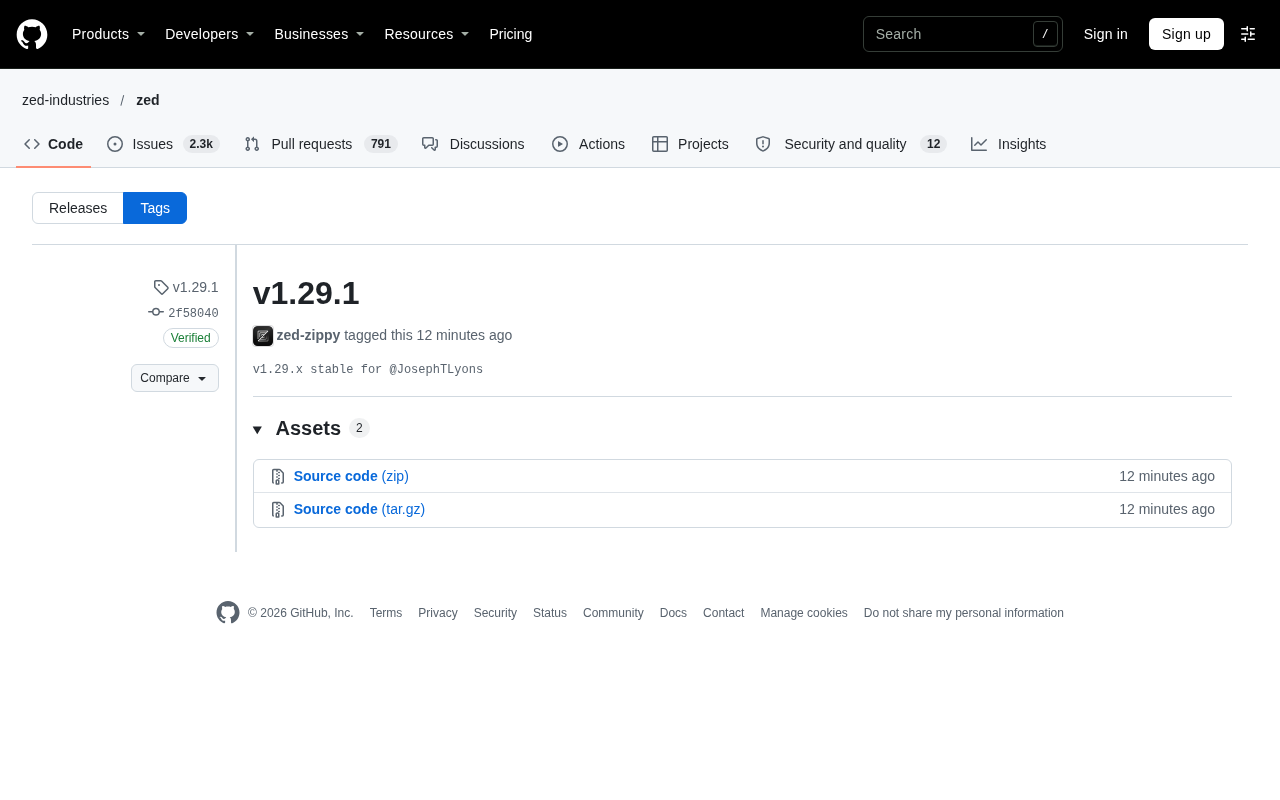
Zed editor has released version v1.29.1, tagged by the GitHub account zed-zippy with commit hash 2f58040. This is a minor update on the v1.29.x stable branch, and based on the release form, it looks more like a patch and confirmation of the existing stable line rather than a feature release introducing new capabilities.
Basic Facts of the Release
The GitHub release record confirms that the commit for v1.29.1 carries a GitHub verified signature with GPG key ID B5690EEEBB952194. This indicates the tag comes from GitHub's official signing system and the commit's origin is traceable. The release notes label this version as "v1.29.x stable for @JosephTLyons", meaning this stable line is explicitly pointed to a specific maintainer in this release.
The version number going from 1.29 to 1.29.1 is a patch-level update. For a high-frequency iteration tool like an editor, such minor versions typically carry stability fixes, edge-case handling, or maintenance commits paving the way for larger updates. The source material does not disclose specific change items, so one should not speculate about which issues were fixed.
The Place of Patch Versions in Editor Iteration
A code editor is a typical long-term maintenance product. Users write, debug, and switch projects on the same interface every day, and any regression can interrupt the workflow. Therefore, mature editors generally adopt a dual-track strategy of "mainline development + stable branch": new features advance quickly on the trunk, while the stable branch only receives verified fixes.
v1.29.1 is precisely a product of the stable branch. Its existence itself conveys a signal—the v1.29 line is still being looked after. For users who rely on Zed as their daily primary tool, the timely appearance of patch versions is more meaningful than any specific fix: it shows the maintenance rhythm has not been interrupted and the issue feedback channel is still operating.
Semantic Versioning (SemVer) specifies version numbers in the form MAJOR.MINOR.PATCH, where incrementing the patch position represents backward-compatible bug fixes. Although Zed's version numbers may not strictly follow all SemVer rules, the increment from 1.29 to 1.29.1 suggests its release rhythm roughly follows the convention of major versions advancing new features and patch positions handling fixes. Understanding this helps users judge update risk: patch versions usually do not change existing APIs or configuration formats, so upgrade costs are low; while minor versions (such as 1.30) may introduce behavioral changes and require more careful evaluation.
Signature Verification and Release Credibility
One detail of this release deserves separate attention: the commit is verified by GitHub signature. In open-source toolchains, signature verification addresses the question of "whether this tag was indeed created by the project team." For automatic update mechanisms, this directly relates to distribution security—when the editor client pulls updates, it needs to confirm the downloaded build artifacts come from a trusted source.
The public record of the GPG key ID allows this verification process to be reviewed by third parties. For teams that use the editor as a production tool and operate in controlled environments, such auditable release chains are an implicit bonus in selection.
GPG (GNU Privacy Guard) signature verification works as follows: developers generate digital signatures for commits or tags with their private keys, and anyone can verify whether the signature matches using their public key. GitHub's "Verified" badge means the platform has verified the signature using the public key uploaded by the user, confirming the commit indeed comes from the bound account. The GPG key ID is a short identifier of the public key (here B5690EEEBB952194), which third parties can use to look up the corresponding public key on key servers and independently verify the authenticity of the signature. For tools like editors that come with automatic update mechanisms, clients typically also perform signature checks on build artifacts to ensure the downloaded binaries have not been tampered with.
How to View This Update
The information provided by the source material is limited; the release record only retains the tag, commit hash, signature status, and stable line description, with no change details beyond the asset list. Therefore, a reasonable judgment is: v1.29.1 is a routine stable-line maintenance release, suitable for users already on v1.29.x to follow at their usual pace.
For potential users still observing, a single patch version is not sufficient reason to migrate; what is truly worth tracking is whether the v1.29 stable line continues to produce patch versions, and how quickly new features advance on the mainline branch. An editor's competitiveness ultimately depends on the density and quality of long-term iteration, not on a single version number jump.
One-line Summary
Zed editor releases v1.29.1 patch, stable line continues maintenance and commits are signature-verified.
Paragraph Summary
Zed editor releases v1.29.1, a patch-level update on the v1.29.x stable branch, with commit hash 2f58040 and a GitHub verified signature (GPG key ID B5690EEEBB952194), indicating the release origin is traceable. The article notes that patch versions typically carry stability fixes and edge-case handling, and their timely appearance itself indicates the stable line is still being looked after and the maintenance rhythm has not been interrupted. Signature verification is especially important for automatic update distribution, and an auditable release chain is an implicit bonus for controlled teams when selecting tools. Since the source material does not disclose specific change items, the article suggests treating it as a routine maintenance release; v1.29.x users can follow at their usual pace, and a single patch version is not sufficient reason to migrate.
Related articles

ChatGPT Plus Subscription Pitfall Guide: Go/Plus/Pro Tier Comparison and Quick Activation
A complete ChatGPT Plus subscription guide based on a Bilibili tutorial: from registering an account, comparing Go/Plus/Pro tiers, to the practical steps for quickly completing your subscription.

GPT-6.2 Sol/Astra Released! A Step-by-Step ChatGPT Plus Subscription Guide and Tier Comparison
GPT-6.2 Sol/Astra is out—here's a ChatGPT Plus subscription guide: register an account, compare Go/Plus/Pro tiers, and subscribe in a minute.

Comparing Three Channels for Subscribing to GPT Plus in China: Is Website Top-Up the Easiest?
How to subscribe to GPT Plus in China? This article compares website top-up, credit card, and mobile top-up channels—process, cost, and risk—with steps and tips to help you choose wisely.