Zed Editor Releases v1.30.2 Stable: The Maintenance Signals Behind a Minor Update
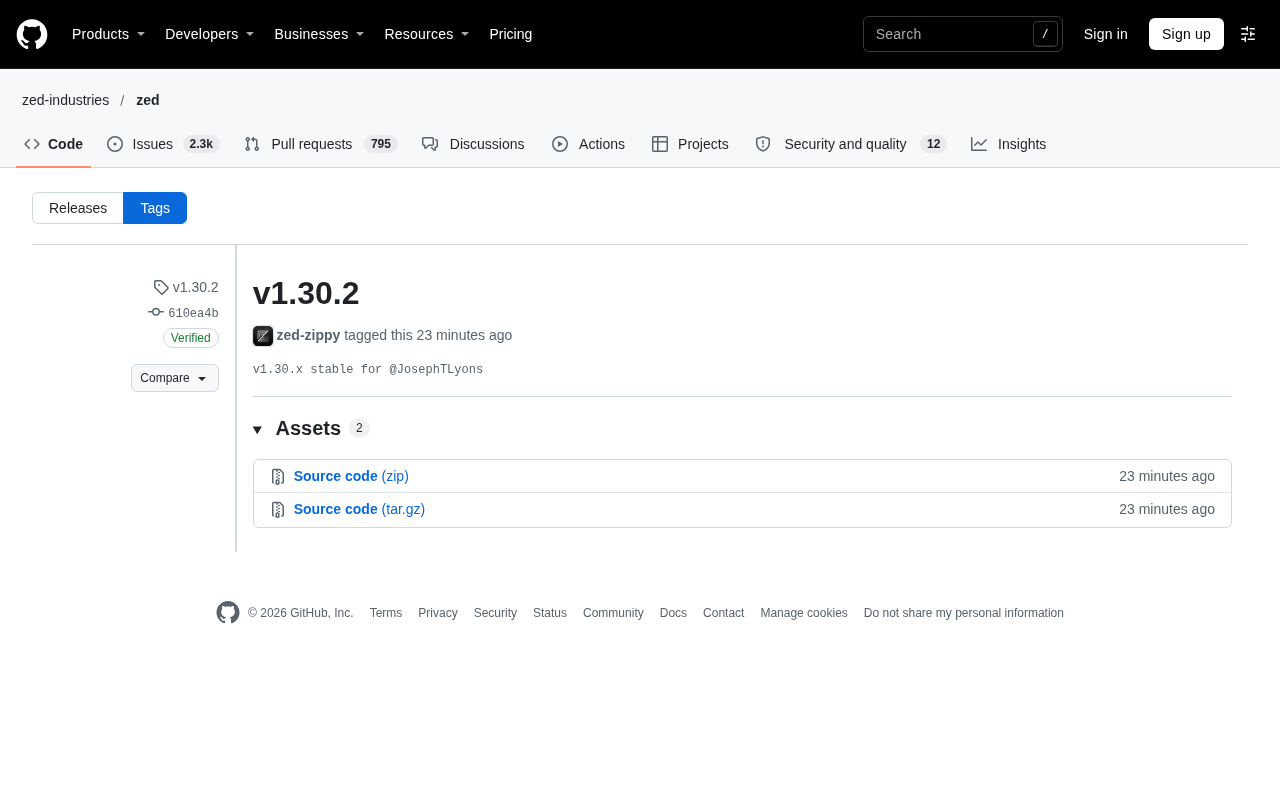
Zed releases v1.30.2 stable patch, reflecting maintenance responsiveness and release rigor.
Zed editor has released v1.30.2, explicitly labeled as a patch version of the v1.30.x stable branch. The article notes that under semantic versioning conventions, patch-position updates are primarily aimed at bug fixes and stability improvements rather than new features, sending the signal that the v1.30.x branch has entered a continuous maintenance rhythm. The release commit carries GitHub signature verification and a GPG key ID, indicating that the project values its release process and supply chain trustworthiness. For developers who treat the editor as their primary tool, the value of a patch version lies not in the length of the changelog but in the smooth experience after problems disappear; continuous iteration on the stable branch also reflects the maintenance team's responsiveness and project health. The article recommends that users on the v1.30 series upgrade, especially those who have encountered stability issues.
A Seemingly Ordinary Version Number That Reveals an Editor's Maturity
Zed editor has released v1.30.2, tagged by contributor zed-zippy and explicitly labeled as "v1.30.x stable." The version number itself isn't flashy—no grand feature announcements, no overwhelming release notes—but for users who have long followed Zed, the significance of this kind of patch-level stable release lies precisely in "nothing going wrong": it means stability issues on the v1.30 mainline are being continuously closed out.
From the GitHub release record, the commit corresponding to this tag carries a Verified badge, indicating that the commit passed GitHub's signature verification with GPG key ID B5690EEEBB952194. Such details may be trivial to ordinary users, but for engineers who rely on the editor for daily development, a verifiable release source means the downloaded build artifacts are more trustworthy at the supply chain level.
What a Patch Version Update Usually Means
The "Wrapping-Up Actions" of a Stable Branch
Under semantic versioning conventions, an update to the patch position (the last digit) is primarily aimed at bug fixes and stability improvements rather than introducing new features. As a patch version, v1.30.2 sends the signal that the v1.30.x branch has entered a maintenance rhythm, with the development team or maintainers providing ongoing fix support for users on that branch.
Compared with projects that "go a long time without patches after a major release," continuous minor version iterations often reflect the responsiveness of the maintenance team. As a code editor focused on high performance, Zed's user base includes many developers who code in long immersive sessions—editor crashes or interruptions from minor issues come at a high cost, and timely patching of the stable branch is exactly what these users care about most.
Semantic Versioning (SemVer) is a widely adopted version numbering convention with the format MAJOR.MINOR.PATCH. The MAJOR position increments when incompatible API changes occur, the MINOR position increments when functionality is added in a backward-compatible manner, and the PATCH position increments when backward-compatible bug fixes are made. Therefore, when only the last digit changes (such as from v1.30.1 to v1.30.2), by convention it means the release introduces no new features, breaks no existing interfaces, and contains only bug fixes and stability improvements. Understanding this convention helps users quickly judge whether an update is worth following immediately: patch versions typically carry the lowest risk, while major version changes require attention to migration notes.
A stable branch is a common branching strategy in version control: alongside the main development line (such as main or master), a separate branch is created for a released minor version that accepts only bug fixes and security patches, with no new features merged in. The benefit is that users who wish to stay on an older version can continue to receive fixes without being forced to upgrade to a new version that might introduce behavioral changes. Maintainers typically tag this branch with a series like v1.30.x and release with incrementing patch numbers. How long a stable branch is maintained and whether patches are timely are important windows for gauging the level of maintenance investment in an open-source project.
Details of the Tag and Branch Strategy
The release record contains the phrase "v1.30.x stable for @JosephTLyons," along with traces of various tag comparison and filter interfaces. These may appear to be redundant text generated during GitHub page loading, but they indirectly indicate that this release is directly related to the stable branch maintenance strategy—the publisher explicitly positions v1.30.2 as a stable version of the v1.30.x series rather than an independent feature release.
For development teams, this habit of explicit branch labeling helps users determine which update line to follow: those who want to try new things can watch the pre-release versions on the main branch, while those seeking stability can lock onto stable tags like v1.30.x.
Why Patch Versions Deserve Serious Attention
The Stability of Development Tools Directly Affects Productivity
A code editor is not an ordinary application—it is the "workbench" where developers spend almost their entire day working. A patch version may only fix a few issues triggered under specific operation paths, but for users who encountered those issues, upgrading to v1.30.2 could mean going from "getting stuck several times a day" to "running smoothly all day." The value of a patch version is not reflected in the length of the changelog but in the "imperceptible" experience after the problems disappear.
The Rigor of the Release Process Is an Indicator of Open-Source Project Health
This release shows elements such as signature verification, stable tags, and explicit maintainer attribution. Whether a project takes its release process seriously often reflects its long-term reliability better than its claimed feature list. Signed commits and GPG verification, though transparent to end users, form the chain of trust from source code to binary artifacts. For users who treat the editor as their primary tool, choosing a product with a rigorous release process and timely maintenance response is itself a form of risk control.
GPG (GNU Privacy Guard) signature verification is a fundamental mechanism in the open-source software supply chain. Developers can sign Git commits or release tags with their private keys, and anyone can verify the signature with the corresponding public key, thereby confirming that the code indeed comes from the claimed author and that the content has not been tampered with. GitHub displays a Verified badge next to commits and provides the GPG key ID used for signing. For tools like editors that require downloading binary build artifacts, making every link from source commits to release artifacts verifiable can significantly reduce the risk of malicious code being implanted. Although ordinary users do not need to verify manually, whether the publisher consistently signs is one aspect of judging its engineering rigor.
How Users Should View This Kind of Update
If you are using the v1.30 series of Zed, v1.30.2 is worth upgrading to, especially if you encountered occasional stuttering or abnormal behavior in previous versions. If you are still on the fence about switching to Zed, this kind of continuously released patch version is actually a positive signal: it shows that someone is on duty on the stable branch, rather than moving on to the next gimmick after a major release.
Patch versions are never headline material, but they are the daily pulse of a software lifecycle. Releases like v1.30.2 are a footnote to Zed's continued investment in stability and trustworthy releases.
One-line Summary
Zed releases v1.30.2 stable patch, reflecting maintenance responsiveness and release rigor.
Paragraph Summary
Zed editor has released v1.30.2, explicitly labeled as a patch version of the v1.30.x stable branch. The article notes that under semantic versioning conventions, patch-position updates are primarily aimed at bug fixes and stability improvements rather than new features, sending the signal that the v1.30.x branch has entered a continuous maintenance rhythm. The release commit carries GitHub signature verification and a GPG key ID, indicating that the project values its release process and supply chain trustworthiness. For developers who treat the editor as their primary tool, the value of a patch version lies not in the length of the changelog but in the smooth experience after problems disappear; continuous iteration on the stable branch also reflects the maintenance team's responsiveness and project health. The article recommends that users on the v1.30 series upgrade, especially those who have encountered stability issues.
Related articles
GLM-5.4 vs. Opus and Neon: How Far From the Top?
No official benchmarks for GLM-5.4. Based on a YouTube deep test and developer trials, we analyze its gap vs. Claude Opus 5.5 and Gemini Neon, the speed bottleneck from marathon-style thinking, and its real position in enterprise agent scenarios.

From Gobbler to Sloppy Joe: The Hit-Making Playbook of a New Jersey Deli Institution
NYT Cooking visits Milburn Deli in New Jersey to break down the hit logic behind the Gobbler turkey sandwich and the local Sloppy Joe: bread sliced to order, house-made sauces, a group shout culture, and customer co-creation behind six locations.
In the Age of AI Programming, When Do You Still Need to Write Code by Hand?
Is handwritten code still valuable once AI programming agents are widespread? This article outlines three scenarios where handwriting is essential—learning, style development, and prototype validation—and provides a division-of-labor framework between AI and humans to help developers balance efficiency and skill growth.