Zed Editor Releases v1.31.0-pre Preview: New Developments in Developer Collaboration

Zed releases v1.31.0-pre preview, a routine engineering milestone reflecting rapid iteration and a transparent release process.
Zed editor released the v1.31.0-pre preview on GitHub, tagged by zed-zippy and assigned to @JosephTLyons for verification. The corresponding commit 45c1fa2 is GitHub-verified, reflecting the team's engineering standards and open source governance transparency. v1.31 is the 31st minor version in the 1.x series, indicating a fast iteration pace, with the preview paving the way for the official release.
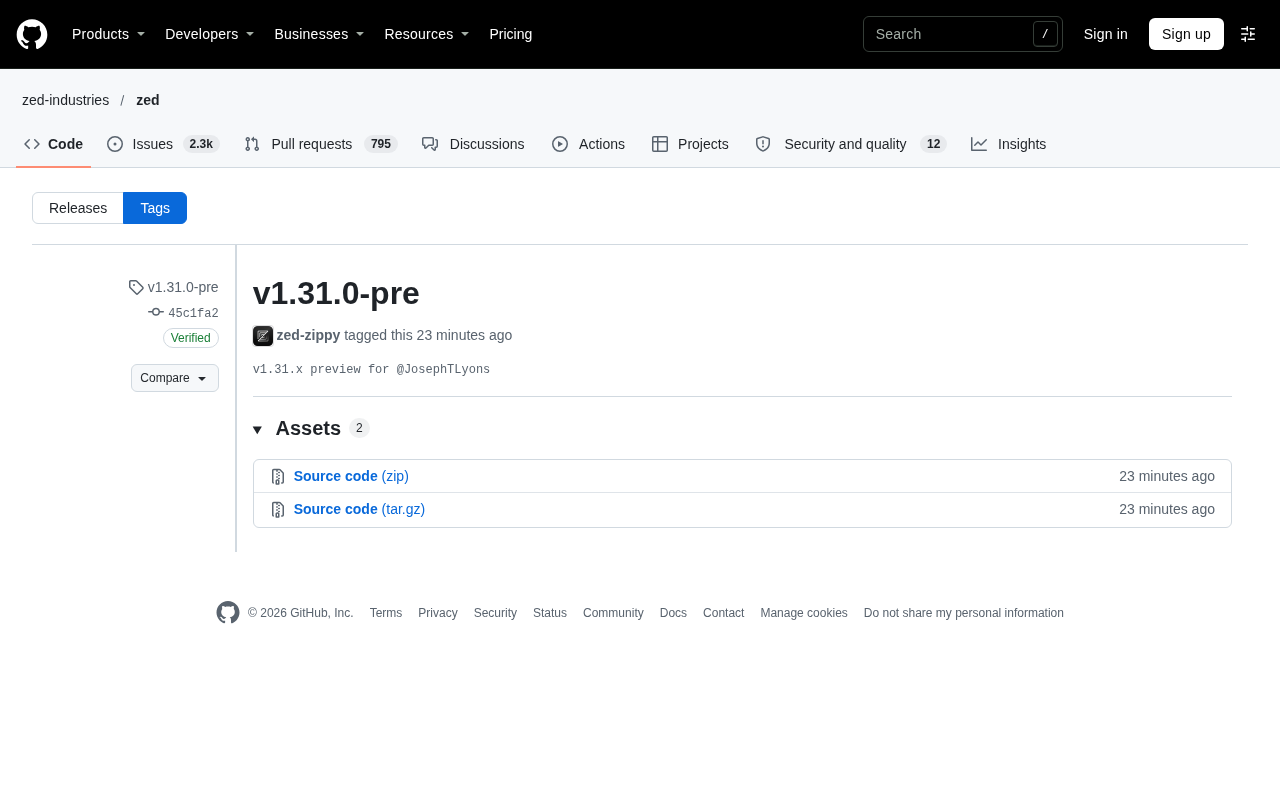
Zed editor has published a v1.31.0-pre preview release on GitHub. The version was tagged by zed-zippy and explicitly labeled "v1.31.x preview for @JosephTLyons". As a code editor written in Rust that emphasizes high performance and collaboration, every iteration of Zed draws developer attention.
Preview Release: The Big Rhythm Behind a Small Version Number
According to the GitHub commit records, v1.31.0-pre corresponds to commit hash 45c1fa2, which has been verified by GitHub's signature with GPG key ID B5690EEEBB952194. This means the code's integrity and origin are trustworthy, consistent with the engineering standards the Zed team has always upheld.
Preview releases are typically testing grounds that pave the way for official versions. The creation of the v1.31.x branch indicates the team is making its final push toward the next stable release. Directly associating the preview release with a specific contributor (@JosephTLyons) also reveals the "owner system" common in open source projects—where a particular maintainer leads version verification and issue fixes.
Semantic Versioning (SemVer) and pre-release
v1.31.0-pre uses a naming convention close to Semantic Versioning (SemVer). SemVer specifies version numbers in the form MAJOR.MINOR.PATCH: the major version increments on incompatible API changes, the minor version increments on backward-compatible feature additions, and the patch version increments on backward-compatible bug fixes. The -pre suffix is a "pre-release identifier". Under SemVer rules, a version with such a suffix has lower precedence than the corresponding official release 1.31.0, and package managers (such as Cargo and npm) typically won't select it when resolving dependencies by default unless explicitly specified. This precisely explains why ordinary users should continue using the stable version: 1.31.0-pre and 1.31.0 are treated as having different precedence, and the former does not constitute a replacement for the latter.
Git Tags and GPG Signature Verification
The "tag", "commit hash", and "GPG key ID" mentioned above involve the fundamental mechanisms of open source supply chain security. A Git tag is an immutable reference pointing to a commit object, commonly used to mark release points; annotated tags can also carry signatures. GPG (GNU Privacy Guard) signatures let developers sign tags or commits with a private key, and others can verify origin and integrity using the corresponding public key. The GPG key ID B5690EEEBB952194 that appears here is the last segment of the key fingerprint, which GitHub uses to display the "Verified" badge. A signature cannot prove the code has no vulnerabilities, but it can confirm that the commit indeed came from the maintainer holding the corresponding private key and that the content has not been tampered with—especially important for an editor project that relies on automated pulls for builds.
Reading the Product Rhythm from the Version Number
Zed's version iterations have always maintained a brisk pace; v1.31 means this is already the 31st minor version in the 1.x series. For an editor still in a rapid growth phase, this frequency is not surprising. Frequent minor updates both respond quickly to user feedback and reduce the risk of any single release.
The existence of preview releases gives developers willing to try new things an opportunity to validate new features early. For teams that rely on Zed for daily development, following pre releases can help surface compatibility issues in advance and avoid passive upgrades after the official release.
Collaboration DNA and Open Source Governance
Since its inception, Zed has made real-time collaboration a core selling point, with its underlying architecture designed around multi-user editing scenarios. The release process for this preview also reflects the transparency of open source governance: tags, signatures, and designated owners—every step is traceable.
One detail worth noting: this release announcement did not disclose a specific list of feature changes. This aligns with common practice for preview versions—before official release notes come out, preview builds are mostly intended for internal and community early adopters. Developers who want to know the specific changes need to follow the repository's commit history or wait for the official release announcement.
Zed's Collaboration Architecture and Rust Tech Stack
Zed's real-time collaboration is not simply a sync plugin layered on top of the editor; it is designed from the ground up around "multiple people editing the same buffer simultaneously". Its core dependencies include a proprietary collaboration service and a CRDT (Conflict-free Replicated Data Type) approach—CRDTs allow multiple replicas to each accept edit operations and then converge through mathematically commutative and associative merge rules, avoiding conflict pop-ups under weak networks or concurrent editing. Combined with Rust's ownership model and zero-cost abstractions, Zed can handle text buffers, syntax highlighting, and multi-user cursor updates on a low-latency path—this is the technical foundation of its "high performance + collaboration" positioning. Understanding this makes it clear why its version iterations favor small, rapid steps: the collaboration protocol and the client need to evolve in sync, and frequent minor versions make regression risk easier to control than one-off big changes.
How Developers Should Respond
For ordinary users, we recommend continuing to use the stable version and upgrading after the official v1.31.0 release. For power users and plugin developers, you can download the pre version for compatibility testing, paying particular attention to how your commonly used plugins perform in the new version.
Preview releases of open source projects are essentially part of community collaboration. Timely feedback helps maintainers fix defects before the official release, and this is also a low-barrier way to participate in open source.
Conclusion
The release of v1.31.0-pre is itself a routine engineering milestone, but it reflects the Zed team's steady iteration rhythm and transparent release process. In an era of increasingly fierce competition among AI programming tools, the editor's fundamental experience and collaboration capabilities remain key to retaining developers. The feature details of the upcoming official release are worth continued attention.
One-line Summary
Zed releases v1.31.0-pre preview, a routine engineering milestone reflecting its rapid iteration and transparent release process.
Paragraph Summary
Zed editor has released the v1.31.0-pre preview on GitHub, tagged by zed-zippy and assigned to @JosephTLyons for verification. The corresponding commit 45c1fa2 has been verified by GitHub's signature, reflecting the team's engineering standards and open source governance transparency in tags, signatures, and the owner system. v1.31 is the 31st minor version in the 1.x series, indicating a fast iteration pace, while the preview release serves to pave the way for the official version and surface compatibility issues early. This release did not disclose specific feature changes, so you'll need to follow the commit history or wait for the official announcement. The article recommends that ordinary users continue using the stable version, while power users and plugin developers can test the pre version early and provide feedback.
Related articles

A 19-Year-Old's Rental Horror Story: Ceiling Collapse, Bug Infestation, and the Lessons It Taught Me
At 19, my first off-campus rental brought bug infestations, no heat, a collapsed ceiling, and a ruined laptop with no renter's insurance. Here are the hard-won lessons for first-time student renters.

Veda Nurse's Cranial Nerve Exam: Why ASMR Role-Play Is Going Viral
Bilibili creator Veda's cranial nerve exam ASMR video goes viral, blending humor and sensory triggers through nurse role-play. This article analyzes its unique appeal and the audience psychology behind ASMR role-play.

LG Cinebeam AI Review: 120-Inch Giant Screen + 3000 Lumens, a New Choice for the Living Room Theater
LG Cinebeam AI projector review: 3000 ANSI lumens, 4K, 100 inches from about 8 cm and 120 inches from about 18 cm. Built-in webOS, AI Concierge voice recommendations, AI Sound Pro 11.1.2 virtual surround, and Game Optimizer—positioned for fixed living room installation, complementing the portable Cinebeam S.