Zed Editor v1.25.3 Released: The Iteration Logic Behind a Minor Patch

Zed releases v1.25.3 patch, reflecting its small-steps-fast-pace maintenance cadence and signature verification practices.
Zed editor has released patch version v1.25.3, driven by core maintainer JosephTLyons, with commit hash 8dd255c and a GitHub-verified signature. This is a patch-level update in the three-part version number, typically introducing no new features but fixing defects, performance regressions, or upgrading dependencies, so its value for 1.25.x users mainly lies in stability. The article also highlights the GPG signature on the release commit, considering it a good practice for open-source supply chain security. Zed was built by the original Atom and Tree-sitter team and focuses on Rust-native high performance and multiplayer collaboration, with a high iteration frequency, but this release lacks a detailed changelog, leaving room for improvement in transparency.
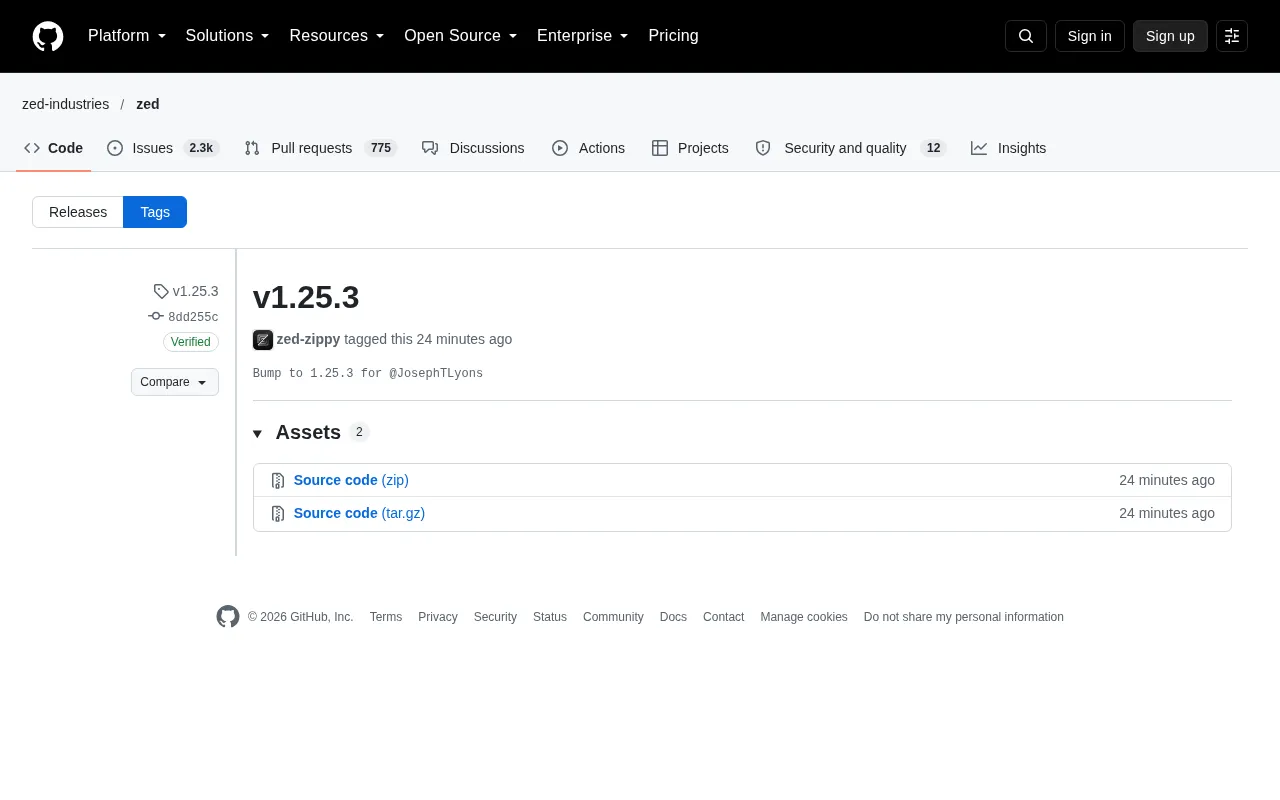
Zed editor has released version v1.25.3. According to the original information on the GitHub release page, this is a patch version update driven by core maintainer JosephTLyons, with commit hash 8dd255c and a GitHub-verified signature. The release page does not include a lengthy changelog, but the version number itself and the submission workflow reveal the current maintenance cadence of this open-source code editor.
What a patch version means
v1.25.3 is a patch-level update in the three-part version number. In Zed's versioning strategy, such releases typically do not introduce new features but address defects left over from the previous version, performance regressions, or dependency upgrades. The wording "Bump to 1.25.3" in the release information confirms this: it is more of a smooth version progression than a user-facing feature announcement.
For developers who use Zed daily, the value of such minor versions often lies in stability. Issues like lag, crashes, and syntax highlighting anomalies in editor tools are usually fixed one by one in patch releases. So there is no need to skip an update just because it is "only a minor version"—especially if you are already on the 1.25.x series.
Signature verification and release process
One detail of this release is worth noting: GitHub shows that the commit has a verified signature, with GPG key ID B5690EEEBB952194. For open-source projects, signature verification is a foundational element of supply chain security. It allows downstream users to confirm that the code indeed comes from the project maintainer rather than a tampered or forged commit. As an editor that handles large amounts of local code and configuration, Zed's habit of maintaining signatures in its release process is a commendable engineering practice.
GPG (GNU Privacy Guard) is encryption software based on the OpenPGP standard, widely used to digitally sign commits, tags, and release packages. Developers use a private key to generate a signature over content, and others verify the signature with the corresponding public key, thereby confirming that the content was indeed created by the private key holder and has not been tampered with. GitHub's "Verified" badge indicates that the commit's signature matches a GPG public key registered on the committer's account. The key ID is usually the last 16 hexadecimal characters of the public key fingerprint—for example, B5690EEEBB952194 mentioned in this article—and can be used to look up the full public key on a keyserver. In open-source supply chain security, signature verification reduces the risk of malicious commits being injected after a code repository is compromised, and is one of the foundational practices recommended by frameworks such as SLSA.
Zed's product positioning and iteration cadence
Zed was built by the original team behind Atom and Tree-sitter, and focuses on a high-performance Rust-native architecture and multiplayer collaborative editing. Its update frequency is relatively high, with multiple patch versions interspersed between major versions. This cadence is suited to rapidly responding to community feedback, but it also means users need to pay closer attention to version changes more frequently.
This release shows that the Zed team adopts a "small steps, fast pace" maintenance approach: individual maintainers drive version number increments, with CI and signature verification completing the release. This process is common in small and medium-sized open-source projects. Its advantage is flexibility; its challenge is the completeness of release notes. This release page lacks a detailed changelog, so for users who want to know exactly what was fixed, the information is not transparent enough.
How to keep up with such updates
If you use Zed, it is recommended to subscribe to version notifications via the GitHub Releases page or follow the project's changelog file. For patch versions, you can prioritize checking fix-related commits in the commit history to determine whether they involve the feature modules you commonly use. For actively developed tools like Zed, staying reasonably up to date is usually less troublesome than remaining on an old version for a long time.
Tree-sitter is an incremental parsing framework initiated by Max Brunsfeld and others, with core members of the Zed team also participating. It can generate a concrete syntax tree for source code and supports re-parsing only the changed parts during editing, making it highly suitable for real-time features in editors such as syntax highlighting, code folding, and structural selection. Traditional editors often rely on regular expressions or TextMate grammars for highlighting, whereas Tree-sitter provides structured, queryable syntax information with higher precision and easier extensibility to new languages. Zed uses Tree-sitter for syntax-aware editing, which is one of the important technical foundations for its high performance and collaboration capabilities.
Semantic Versioning (SemVer) specifies version numbers in the form MAJOR.MINOR.PATCH: the major version increments on incompatible changes, the minor version increments when backward-compatible functionality is added, and the patch number increments for backward-compatible bug fixes only. Under this convention, v1.25.3 is a patch release that in theory contains only fixes and no breaking changes, so the upgrade risk is low. However, real projects do not always strictly follow SemVer—especially when a project has not yet reached 1.0 or when the maintenance cadence is very fast—and minor version numbers may also carry behavior changes. Therefore, reading the changelog or commit history remains the most reliable way to judge the impact of an upgrade.
Summary
v1.25.3 itself does not contain much dramatic content; it is a microcosm of a healthy open-source project proceeding step by step. What is really worth noting are the signals behind it: signature verification is in place, a maintainer personally drove the release, and the version number increments according to convention. For readers interested in AI programming tools and the open-source editor ecosystem, Zed's iteration cadence and engineering standards are more valuable to observe than the specific changes in any single patch version.
Related articles

Can Nuclear War Really End Civilization? A Scientific Look at Common Misconceptions
Can nuclear war end civilization? This article examines the physics of nuclear weapons—blast, fallout, and urban fires—distinguishing airbursts from groundbursts, dose from contamination, and explaining why nuclear war is a massive disaster but not an extinction event, while exploring key factors for post-strike social reconstruction.

The Truth Behind Titanic's Sinking: Key Decisions and Communication Failures in the National Geographic Documentary
National Geographic's The Unsinkable Ship uses survivor testimony to reconstruct Titanic's fatal decisions—from the missing MSG telegram prefix and the broken boiler-room-to-bridge link to how 'unsinkable' thinking delayed damage control and evacuation.

74M-Parameter Open-Source Model Partially Outperforms Jev AI in Testing
Fastino AI's Glider 2.5 models, with just 74M–300M parameters, reportedly outperform Jev AI in some guardrail benchmarks per YouTube testing, run on consumer hardware, and even play Doom. We analyze small models' competitiveness and deployment value on specific tasks.