Zed v1.22.0-pre Released: BYOK Support for Frontier Models and Enhanced Subagent Capabilities

Zed v1.22.0-pre brings BYOK frontier model support and smarter subagent capabilities to the AI-native editor.
Zed v1.22.0 preview centers on AI upgrades: BYOK support now covers three GPT-6 variants and Claude Opus 5.5, letting users connect directly via their own API keys. Subagents gain a new `model` parameter in `spawn_agent` plus auto-compaction for better long-session context management. Community contributions expand the ecosystem with Grok 4.7 as the xAI default and Z.ai GLM via Mistral. The release also fixes Git diff views, a terminal memory leak, and cross-platform gestures, alongside breaking changes to dock shortcuts and Threads Sidebar settings.
Zed editor has released v1.22.0 preview, with this update's focus clearly centered on AI capabilities. From BYOK (Bring Your Own Key) support for the latest frontier models to on-demand model switching and auto-compaction for subagents, Zed is positioning its AI agent system as a core workflow rather than an add-on feature.
AI Capabilities: BYOK for Frontier Models, More Flexible Subagents
The most attention-grabbing addition in this update is BYOK support for several frontier models. Users can now access GPT-6 Astra, GPT-6 Sol, and GPT-6 Luna via their own OpenAI API keys, and Claude Opus 5.5 via their Anthropic keys. This bring-your-own-key approach means users aren't tied to Zed's subscription service — they draw directly from their own provider quotas, offering both flexibility and cost control.
Beyond the official OpenAI and Anthropic integrations, community contributions have expanded the model ecosystem: Grok 4.7 has been added to the SuperGrok and xAI providers and set as the recommended default, while Z.ai's GLM has been integrated via the Mistral provider. This multi-vendor approach keeps Zed's model selection notably open.
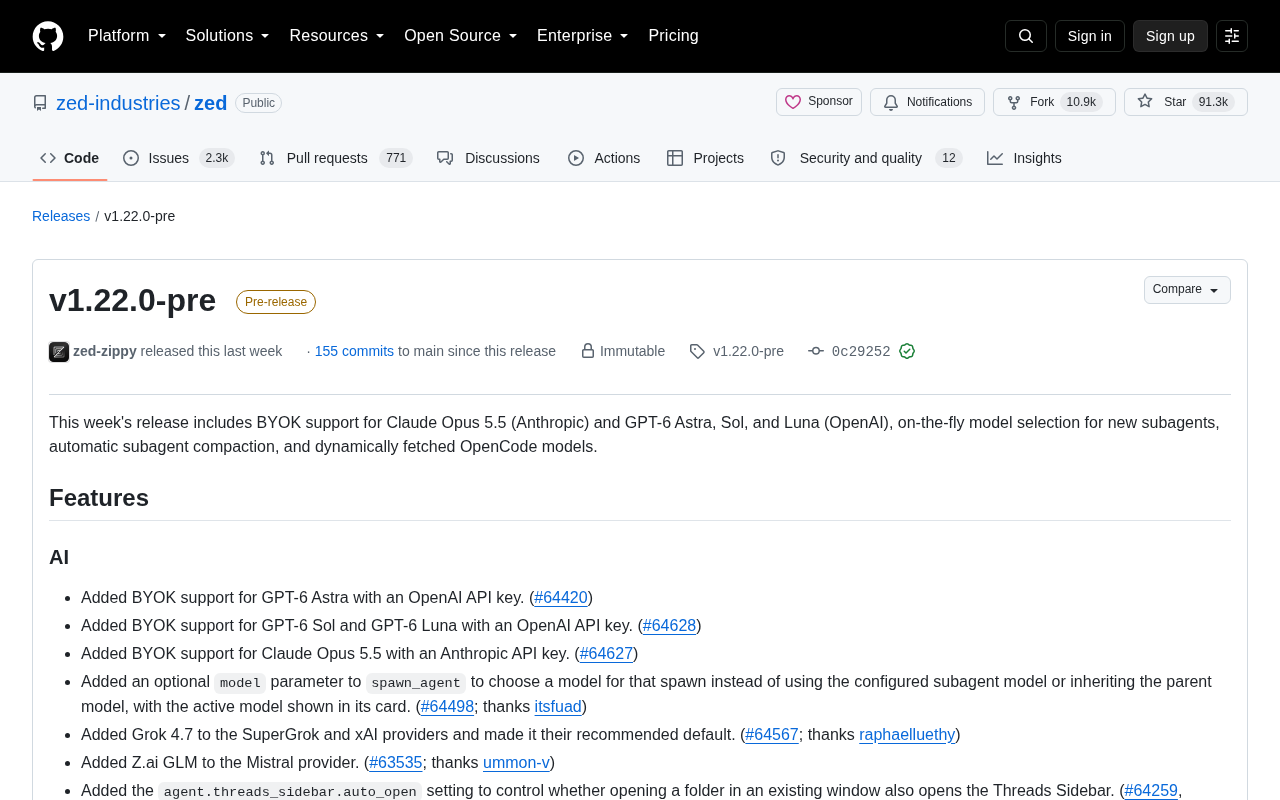
The subagent improvements are equally noteworthy. The new release adds an optional model parameter to spawn_agent, allowing each spawned subagent to be assigned its own model rather than inheriting from the parent agent or the default configuration — the currently active model is displayed on its card. Combined with auto-compaction now enabled for subagents, context management during long sessions becomes significantly more efficient. Additionally, OpenCode's model list now dynamically fetches the Zen and Go manifests instead of relying on a static list bundled with Zed, ensuring real-time model availability.
BYOK (Bring Your Own Key) refers to users supplying their own API keys obtained directly from AI service providers, rather than routing requests through an editor platform's subscription service. In this model, requests go directly from the user to the model provider, costs are billed to the user's account at actual usage rates, and the platform doesn't need to mark up prices or throttle access. For heavy AI users, BYOK is typically more cost-effective than subscription tiers and provides immediate access to a provider's newest models without waiting for platform-level support. Zed's BYOK support essentially hands full model-selection control back to developers, preventing lock-in to any single platform's model catalog.
Subagents originate from multi-agent frameworks: a primary orchestrator agent, when handling complex tasks, can use the spawn_agent instruction to spin up specialized agent instances for subtasks. Each subagent has its own independent context window and tool-calling capabilities without interfering with others. This architecture suits scenarios that require parallel exploration of multiple approaches, or separating steps like code generation, testing, and documentation. Allowing each subagent to specify its own model further lets developers choose the most appropriate model for each subtask's characteristics — such as reasoning depth, speed requirements, or cost considerations — rather than forcing all subagents to share a single configuration.
Git, Terminal, and Cross-Platform Refinements
On the Git side, diff views opened via zed --diff <old> <new> now support toggling between unified and split layouts. For branches that have drifted significantly from their baseline, branch diffs now surface the first batch of changes more quickly — a practical improvement for developers who frequently conduct code reviews and branch comparisons.
Terminal improvements include terminal.path_hyperlink_regexes now supporting the "..." syntax to extend inherited regexes without having to rewrite them. Also worth noting: this release fixes a bug where the terminal was retaining roughly 2MB of memory after a command finished — a meaningful resource saving for users who rely heavily on the integrated terminal.
On the cross-platform front, macOS gains support for three-finger lookup and translation gestures on focused text in Markdown previews. Windows adds MicaBackdrop and MicaAltBackdrop options for the background.appearance theme setting, giving window backgrounds a more native system feel.
Extensive Bug Fixes and Breaking Changes
This preview includes a substantial number of bug fixes spanning the editor core, Git panel, language servers, and AI panel. Key fixes include: a crash when typing in the blank side of a merge conflict, new ChatGPT subscription models not appearing in the model selector, language servers failing to start when opening files via UNC paths on Windows, and the Git panel unexpectedly switching repositories in multi-repo projects.
Editing experience refinements are also plentiful: column selection landing in the wrong column near non-ASCII text, tabs, and soft-wrapped lines has been fixed, as has the block cursor obscuring the character beneath it until the animation completed. These seemingly minor fixes are precisely the kinds of friction points that affect day-to-day coding flow.
Developers should pay attention to the breaking changes in this release. The shortcut for closing the active dock has changed from cmd-w/ctrl-w to the platform-unified ctrl-alt-w, while cmd-w/ctrl-w now correctly closes the active panel item. The Threads Sidebar settings have been reorganized into three properties — agent.threads_sidebar.position, default_width, and auto_open — grouped together in the settings editor, with existing settings automatically migrated. Additionally, a top-level "..." entry in terminal.path_hyperlink_regexes now inserts the inherited regexes; to preserve the previous three-character regex behavior, rewrite it as ["..."]. Zed also no longer imports VS Code's files.watcherInclude as file_scan_inclusions.
UNC paths (Universal Naming Convention) are the Windows path format used to access network-shared resources, in the form \\servername\sharename\filepath. In enterprise development environments, code repositories are sometimes hosted on network drives or NAS devices, requiring developers to open projects via UNC paths directly. Previously, Zed could not properly start language servers (LSP) under such paths, causing core features like code completion and go-to-definition to fail. This fix is a meaningful improvement for users running Zed in Windows enterprise environments.
Auto-compaction is a mechanism in AI editors for managing long-context sessions: when conversation history exceeds the model's context window limit, the system automatically summarizes or truncates earlier content, preserving key information while freeing up token space so the session can continue without hitting the limit. For longer-running agent tasks — such as large-scale refactoring or cross-file debugging — auto-compaction is critical infrastructure for maintaining task continuity.
Community-Driven Development Pace
Looking through the contributor list for this update, a large number of features and fixes came from community contributors. From the subagent model parameter to the terminal memory fix and various editor details, the number of credited external contributors is quite substantial. This reflects the vitality of Zed as an open-source project (now over 90,000 stars on GitHub) — with a model where the core team sets the direction and community contributions fill long-tail needs, the collaboration is running efficiently.
As a pre-release, the features in v1.22.0 have not yet reached the stable channel, and developers who opt in should be prepared for the possibility of instability. But given the density of this update, Zed's pace of progress toward becoming a truly AI-native editor is well worth watching.
Related articles

Gaussian Process Bandit Optimization: Exploration Strategies and Inference Regret Guarantees
Cumulative regret guarantees in Bayesian optimization fail to reflect final recommendation quality. This article examines a new study that provides inference regret guarantees for Gaussian process bandit optimization through exploration query strategies and fill distance analysis, validated on hyperparameter optimization and control tasks.

The Most Detailed Codex Guide on Bilibili: From Installation to Real-World Practice
The most detailed Codex guide on Bilibili: from app store installation to daily work mode configuration, with a real coffee shop project demonstrating file organization, data extraction, dashboard creation, and other practical tasks. Learn to use Plan Mode and desktop pets to leverage Codex efficiently.

Appearance Compensation in Volume Rendering: Why RGB Accuracy Cannot Guarantee Density Correctness
Volume rendering research reveals that volumetric data perfectly reproducing external RGB views may still contain density errors: appearance compensation can double central density and keep external rays unchanged even when L2 error exceeds 14.52%. Density recovery depends on appearance capacity, spatial resolution, and measurement design.