Zernio: Marketing Infrastructure for Products and AI Agents

Zernio unifies 16 social platforms and multiple ad/messaging channels under a single API, with native support for AI agent integration.
Zernio is a developer tool positioned as "marketing infrastructure," replacing the need to individually integrate 16 social platforms, 7 ad networks, and channels like WhatsApp and iMessage with a single unified API — while handling integration maintenance and compliance approvals on the developer's behalf. Its most forward-looking feature is support for MCP servers and CLI, enabling AI coding agents to autonomously invoke marketing capabilities, aligning deeply with the current AI toolchain ecosystem. The product topped its Product Hunt category on launch day with 185 upvotes, and the team claims 200,000 developers are already using it. For early-stage teams and indie developers, it meaningfully lowers the engineering barrier for multi-channel marketing — though the inherent limitations of a unified abstraction layer, platform policy uncertainty, and unverified user numbers remain key variables to evaluate before adopting.
One API Across 16 Social Platforms
Zernio, which topped Product Hunt's daily rankings on its launch day, is tackling a problem that has long frustrated developers: the fragmentation and integration costs of marketing channels. The tool positions itself as "Marketing Infrastructure" and claims to have 200,000 developers building on top of it.
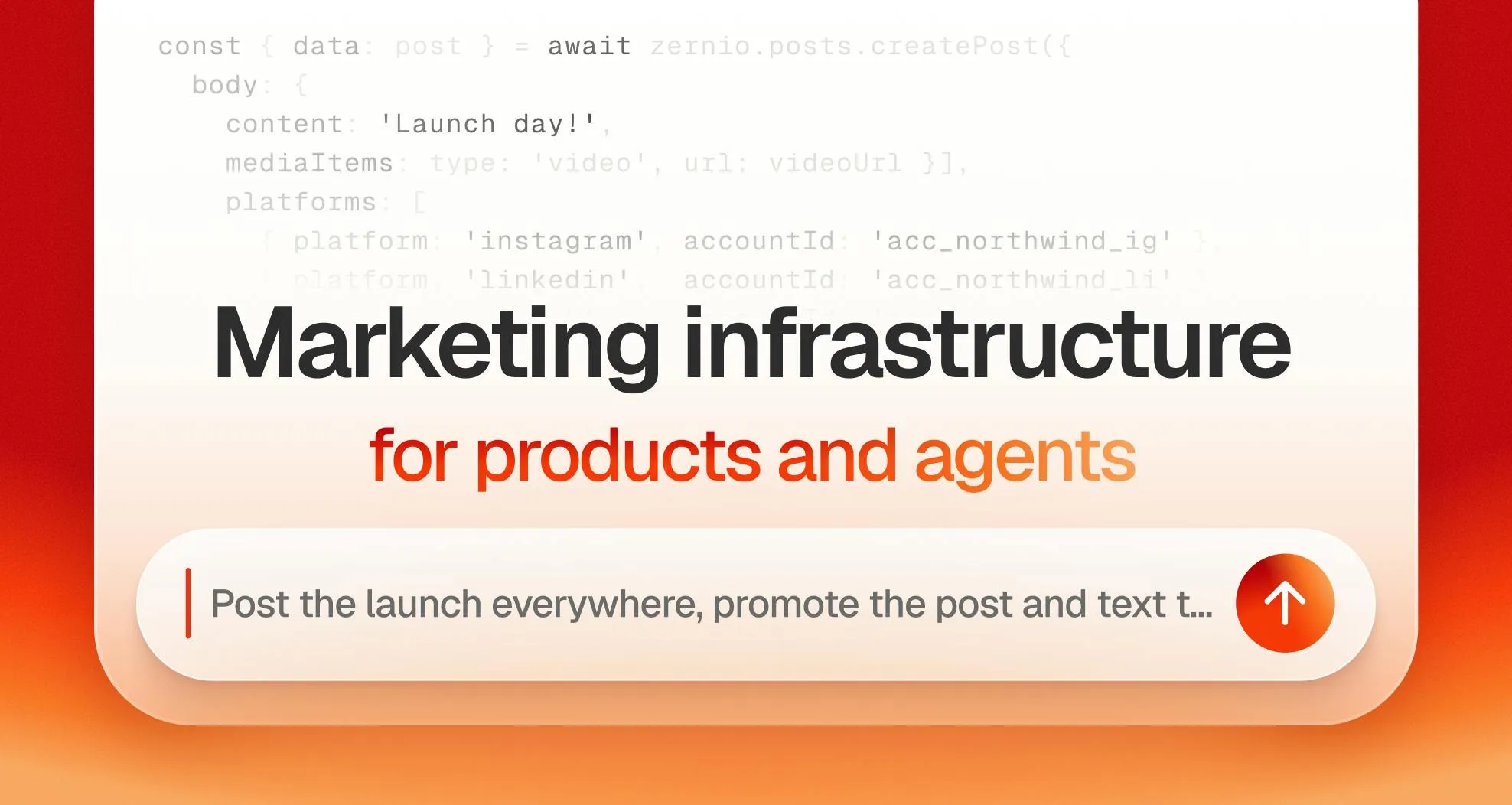
Its core value proposition is straightforward — a single API covering 16 social platforms, 7 ad networks, WhatsApp, iMessage, and phone numbers purchasable directly within Zernio (supporting both calls and SMS). For any team that has dealt with multi-channel marketing integrations, the weight of that promise is hard to miss.
What Pain Points Does It Actually Solve
Traditionally, if a product wants to simultaneously post across multiple social platforms, run ads, and send marketing messages, the development team has to integrate with a dozen different platform APIs individually. Each platform has its own authentication mechanisms, approval processes, rate limits, and version updates — just maintaining these integrations can consume enormous engineering resources.
Zernio's approach is to absorb that complexity. According to the official description, it handles the integration work behind each channel, platform approvals, and ongoing maintenance — all built on each platform's official API. This means developers no longer need to apply for permissions on a per-platform basis or deal with compliance issues; they simply call Zernio's unified interface to go live.
Coverage
- Social Platforms: 16 mainstream social channels
- Ad Placement: 7 ad networks
- Messaging: WhatsApp, iMessage
- Voice & SMS: Purchase phone numbers directly on the platform, supporting calls and SMS
Designed for AI Agents
One of Zernio's most distinctive features is that it doesn't just serve human developers — it explicitly targets agents. In addition to REST API calls in code, it also offers an MCP server and CLI tools, allowing coding agents to operate these marketing channels in the same way.
This design reflects the current direction of AI toolchain evolution. As MCP (Model Context Protocol) gradually becomes the standard interface for connecting AI models to external tools, Zernio packages marketing capabilities into services that agents can call directly. In theory, an AI agent could autonomously complete a full marketing workflow — from posting and ad placement to customer outreach — without step-by-step human intervention.
For teams building automated marketing pipelines or AI-driven products, this "code-first + agent-first" dual access model lowers the barrier to embedding marketing capabilities directly into products.
MCP (Model Context Protocol) is an open standard proposed and open-sourced by Anthropic in late 2024, designed to provide large language models with a unified "tool-calling" interface specification. Before MCP, every AI application that wanted its model to call external services (checking weather, writing files, sending messages, etc.) had to implement its own proprietary function-calling bridge, leading to a highly fragmented ecosystem. The core idea behind MCP is to have external services expose standardized interfaces as "MCP servers," which AI clients (such as Claude, Cursor, etc.) can discover and invoke without any custom development. This is analogous to how USB unified peripheral connectivity. Today, hundreds of tools — including GitHub, Slack, and database drivers — have published official MCP servers, and MCP is rapidly becoming the de facto standard for AI toolchain integration. By providing an MCP server, Zernio enables AI coding tools that support MCP to incorporate marketing channel operations into automated workflows with zero configuration.
Market Performance and Team
Zernio's performance on Product Hunt was impressive: 185 upvotes, 34 comments, and the top spot in its daily category rankings across API, Marketing, and Developer Tools. Behind it is a sizable production team including Darya, Miquel Palet, Pau, Òscar Pérez, and others — indicating a project with meaningful investment behind it.
That said, some healthy skepticism is warranted. Numbers like "200,000 developers" come from official marketing copy and lack third-party verification. And the promise of "one API for all channels" often runs into real-world challenges — platform policy changes, feature disparities, and so on. The convenience of a unified abstraction layer sometimes comes at the cost of fine-grained control over advanced features on individual platforms.
Practical Value for Developers
Zernio's positioning addresses a real and widespread need. For early-stage products, indie developers, or lean teams, outsourcing the integration and maintenance of multi-channel marketing to a unified infrastructure can save significant engineering time and let teams focus on their core product.
For teams embracing AI workflows, MCP and CLI support makes it one of the few tools that brings "marketing" as a category directly into the agent ecosystem. Whether it's worth adopting ultimately depends on its depth of coverage across specific channels, its pricing model, and how quickly it responds when official API policies change — all of which need to be validated through hands-on use.
The Unified Abstraction Layer is the core architectural pattern for this category of infrastructure products — its essence is providing a homogeneous interface on top of heterogeneous systems. The inherent trade-off is that an abstraction layer can only expose the "greatest common denominator" of features across underlying platforms, while platform-specific differentiating capabilities (such as LinkedIn's precise job-targeting or TikTok's creative A/B testing API) are often difficult to map fully into a generic interface. Historical precedents include the early social aggregation platform HootSuite API and the cross-channel SMS gateway Twilio — the latter built its reputation as trustworthy infrastructure by deeply focusing on a single category (voice and SMS) and continuously tracking carrier policies. For Zernio, the breadth of covering 16 social platforms is eye-catching, but the asynchronous policy changes across those platforms (such as Twitter/X's repeated revisions to API pricing and permissions) will be the ongoing pressure test for its maintenance capabilities.
Related articles

Amphibious Transforming Drone: Beyond 100x Power Savings, What Are the Real Needs?
Is the amphibious transforming drone just a gimmick? Starting from the 100x power difference of the M4 Morphobot, explore real application scenarios and thesis topic ideas, analyzing boundary conditions where pure drones and pure ground robots both fail.

Warhound Raises $200 Million: Genetically Engineered "War Dogs" Paired with Anduril Gear
Warhound raises $200M, backed by Ben Lamm and Palmer Luckey, to genetically engineer dogs for military and law enforcement use and equip them with Anduril gear. This article analyzes its technology direction, funding logic, and ethical controversy.

Claude API Comes to Google Cloud: IAM Integration and SDK Access Guide
Anthropic hosts the full Claude API on Google Cloud with IAM-controlled permissions and unified billing. This guide covers the Vertex AI and Anthropic-hosted entry points, IAM role configuration, and SDK access.