Zero API Costs! Build a Fully Offline RAG System on Your Laptop with Ollama

A developer builds a fully offline RAG system on a laptop with Ollama—zero API fees and data never leaves the device.
The article covers a local offline RAG practice shared by a developer on Reddit: using Ollama to run open-source large models on a consumer laptop for a zero-API-cost, fully localized retrieval-augmented generation system. It covers the Ollama inference engine, embedding models, and vector stores (Chroma, FAISS, LanceDB), and emphasizes how RAG reduces hallucinations in closed-book models by retrieving document fragments. The developer provides a GitHub repo and video tutorial for reproduction and seeks community advice on embedding configurations. The article analyzes the approach's boundaries: suitable for privacy-sensitive individual developers and learners, but not for high-concurrency production environments, and notes that inference speed, context windows, and non-English embedding support remain open challenges.
Why Run RAG Locally?
Cloud-based RAG services are convenient, but API call costs, data privacy concerns, and network latency remain persistent pain points. Recently, a developer on Reddit shared their practice of running a fully offline RAG system on a laptop using Ollama, complete with a video and GitHub repository. The core appeal of this approach: zero API costs, data never leaves the local machine, and full control over the pipeline.
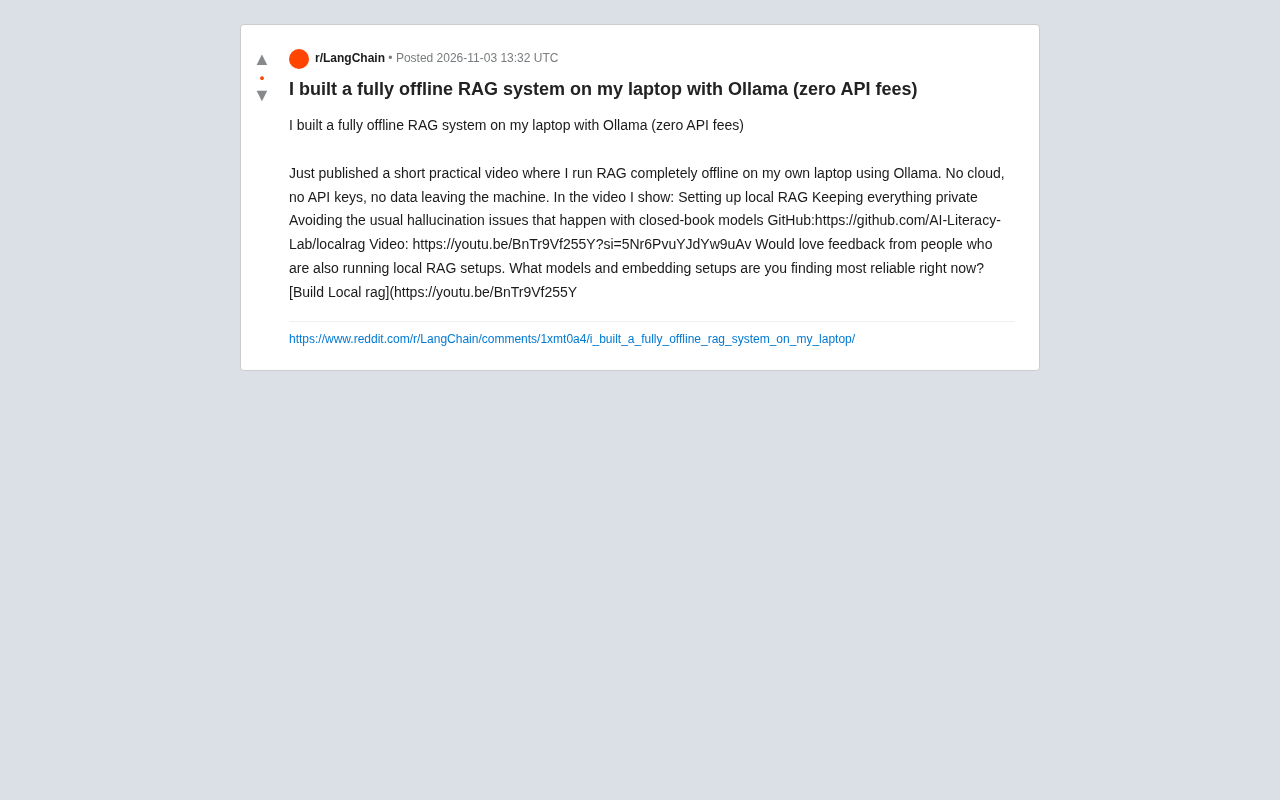
The developer mentioned that the video demonstrates local RAG setup, privacy protection, and how to avoid the hallucination problems common in closed-book models. This hits exactly on two major needs of current RAG applications: cost control and trustworthy results.
Tech Stack Choices for Local RAG
Ollama as the Inference Engine
Ollama provides a clean model management interface that lets users run open-source large models on consumer-grade hardware. It supports multiple model formats and automatically handles GPU/CPU resource allocation, lowering the barrier to local deployment. For RAG scenarios, Ollama can handle both generation tasks (LLM) and embedding tasks, though the latter typically requires pairing with a dedicated embedding model.
Ollama is an open-source tool for running and managing local large models, allowing users to pull, run, and remove models via the command line. It includes inference backends tailored to different hardware—leveraging Metal acceleration on macOS, supporting CUDA and ROCm on Linux/Windows, and automatically offloading some layers to CPU when GPU memory is insufficient. Ollama also provides an OpenAI-compatible local API interface, making it easy for existing RAG frameworks to integrate directly. Note that Ollama's default context window is limited; when processing long document retrieval, you need to explicitly increase num_ctx in the model parameters, otherwise the excess will be truncated, affecting generation quality.
Embedding Models and Vector Stores
The original post didn't specify a particular embedding model, but the developer asked the community: "What models and embedding setups do you find most reliable right now?" This suggests that the choice of embedding solution remains an active discussion point. Common local embedding options include Ollama-supported embedding models (such as nomic-embed-text) or open-source models loaded via Sentence Transformers. For vector stores, lightweight solutions like Chroma, FAISS, or LanceDB are all suitable for running on a laptop.
Embedding models map text fragments into high-dimensional vectors, making semantically similar content closer in vector space, thereby supporting similarity-based retrieval. Common local embedding models typically have parameter counts ranging from tens of millions to hundreds of millions—for example, nomic-embed-text has about 137 million parameters and can complete document embedding relatively quickly even on a laptop CPU. When choosing an embedding model, pay attention to its maximum input length (typically 512 to 8192 tokens), multilingual support, and whether it has been fine-tuned for retrieval tasks.
Vector stores are responsible for storing these vectors and supporting approximate nearest neighbor (ANN) search. Chroma runs as an embedded database, suitable for rapid prototyping; FAISS, open-sourced by Meta, offers multiple index types with excellent performance but requires self-managed persistence; LanceDB is based on columnar storage and supports disk indexing, suitable for scenarios with larger data volumes where you want to reduce memory usage. All three can run offline in a laptop environment, and the choice mainly depends on data scale, query latency requirements, and operational preferences.
Privacy and Hallucination Control
Fully offline means documents never leave the device, eliminating data leakage risks. Regarding hallucination, the developer emphasizes that RAG uses retrieval-augmented generation to let the model answer based on retrieved document fragments rather than relying solely on internal knowledge in a "closed-book" manner. This can significantly reduce factual errors, especially for domain-specific knowledge or the latest information.
Closed-book models refer to language models that answer questions relying solely on knowledge固化 in their parameters during training. Since training data has a cutoff date and models may not firmly memorize low-frequency facts, closed-book answers are prone to plausible-sounding but incorrect "hallucinations." RAG's retrieval-augmented mechanism essentially provides the model with "open-book reference material" before generation, anchoring answers to retrieved original text fragments and thereby reducing fabrication risk. However, note that RAG cannot completely eliminate hallucination—if retrieval results are irrelevant or prompts are poorly guided, the model may still misquote or over-generalize. Therefore, retrieval quality (embedding models and chunking strategies) and prompt design together determine the actual effectiveness of hallucination control.
How to Reproduce: Key Steps and Resources
The developer provided a GitHub repository (AI-Literacy-Lab/localrag) and a YouTube video but didn't elaborate on specific code in the post. Based on common local RAG workflows, reproduction typically includes:
- Environment setup: Install Ollama and pull the required models (such as Llama series, Mistral, etc.).
- Document processing: Load local documents, split into fragments, generate embedding vectors, and store in a vector store.
- Retrieval and generation: Receive user questions, retrieve relevant fragments, concatenate prompts, and hand off to Ollama for answer generation.
- Optimization: Adjust chunk size, retrieval count, prompt templates, etc. to reduce hallucination.
The repository and video are the main learning resources; interested readers are encouraged to refer to them directly.
Community Feedback and Open Questions
After posting, the developer hoped to get feedback from others running local RAG. Current discussion centers on the reliability of models and embedding setups. This is a typical practitioner community interaction: there's no single answer—different hardware, document types, and task requirements lead to different optimal configurations.
Notable challenges include: inference speed on consumer-grade hardware, context window limitations for long documents, and the degree of support for non-English languages like Chinese in embedding models. These factors all affect the actual experience of local RAG.
Who Is It For? Who Is It Not For?
Suitable for: Individuals or small teams sensitive to data privacy, developers looking to avoid API costs, and learners wanting to deeply understand the RAG pipeline.
Not suitable for: Enterprises needing high-concurrency, low-latency production environments (local hardware may become a bottleneck), and ordinary users without technical backgrounds (still requires some configuration work).
Conclusion
Local RAG is becoming part of the democratization of AI applications. Tools like Ollama lower the barrier, enabling individual developers to build usable retrieval-augmented generation systems on their laptops. While performance can't compare to large cloud clusters, for many scenarios, being offline, free, and private is reason enough. If you have a spare laptop and a bit of tinkering spirit, start with the GitHub repository from the original post.
Related articles
 Tech Frontiers
How Do You Stop AI Agent Emails From Sounding Like AI? One Developer's Solution
AI agent emails always sound like AI? A developer shares reright: a rewrite step that validates numbers, names, and links, preventing humanizers from tampering with key info. Test data and integration details inside.
 Tech Frontiers
Starlink Mobile: SpaceX's Carrier Ambitions and the 5G Deployment Challenge
SpaceX plans to make Starlink Mobile a mainstream carrier, deploying thousands of direct-to-cell satellites and building a terrestrial 5G network to challenge AT&T, Verizon, and T-Mobile. This article analyzes its dual-track strategy, 5G deployment challenges, and the competitive landscape.
 Tech Frontiers
OpenAI Raises Another $11 Billion, Valuation Hits $1.25 Trillion
OpenAI has raised an additional $11 billion in a new funding round at a valuation of $1.25 trillion. The deal is not yet closed and is expected to be completed in the coming weeks, further consolidating its leading position in AI.