Zero-Background AI Programming in Practice: From Vibe Coding to Superpowers, the Complete Workflow
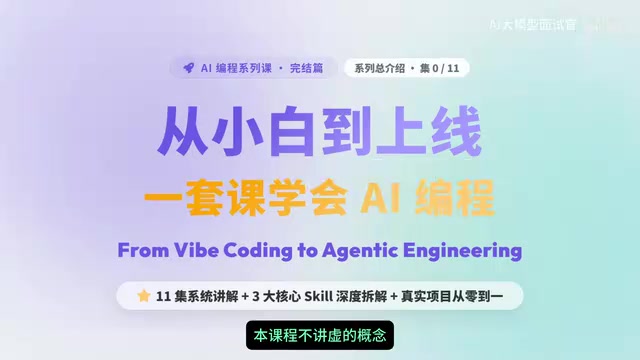
Bilibili course argues AI programming bottlenecks lie in collaborative workflow, not syntax, with 11 episodes of closed-loop teaching for real project deployment.
The article introduces Bilibili creator Bai Li's AI programming course series, whose core idea is that many people get stuck with AI programming due to collaboration, requirement breakdown, and instruction conversion rather than code foundations. The course rejects toy demos, builds a deployable OpenRoot project, dissects Brainstorming, Read and Play, and plugin collaboration, and targets four audiences with 11 episodes across four stages, forming a closed loop from introduction to deployment.
Is the barrier to AI programming really just a foundation in code? Bilibili creator Bai Li offers a counterintuitive answer in his latest AI programming course series: many people get stuck with AI programming not because of syntax, but because of the "anti-corruption theory of interpersonal collaboration"—that is, they don't know how to collaborate with AI, how to break down requirements, or how to turn vague ideas into executable instructions. This course starts from the most basic "screen-decides-code" approach and upgrades all the way to standardized AI development, ultimately completing a full project that can be genuinely deployed and launched.
Course Positioning: No Toy Demos, Only Real Projects
This course explicitly rejects toy demos like "spoon snake" and has only four hardcore labels. First is real implementation: fully building an OpenRoot project that can actually be deployed and accessed. Second is deep dissection of three core skills: Brainstorming, Read and Play, and "sa bai jian" collaboration, as well as how to hand-build a plugin. Third is zero-tech friendliness: no need to know how to write code, only to describe requirements and make multiple-choice decisions. Fourth is one-click deployment: not only teaching how to write code, but also how to get AI to help with one-click launch.
From the course design perspective, it attempts to cover the complete chain of AI programming from requirements analysis to launch and operations, rather than stopping at the level of "letting AI generate a piece of code."
OpenRoot in this course refers to a type of open-source web application project template oriented toward real deployment scenarios, typically including front-end pages, back-end interfaces, database connections, and basic deployment configuration. It differs from the "toy projects" common in teaching (such as to-do lists or snake games) because OpenRoot has complete routing, authentication, environment variable management, and build scripts. Learners need to handle real engineering issues such as cross-file dependencies, interface integration, and differences in online environments. Choosing this type of project as the practical carrier means the course must cover the complete chain from local development to server deployment, including how to get AI to generate a Dockerfile, configure Nginx reverse proxy, and set up continuous integration. This also explains why the course emphasizes "one-click deployment" and "AI helps with launch"—these are precisely the steps where zero-background learners most easily get stuck when developing independently, while toy demos usually avoid them entirely.
Three Core Skills: Brainstorming, Read and Play, and Plugin Collaboration
The course breaks AI programming into three core skills. Brainstorming corresponds to the requirement divergence and solution exploration stage, letting AI help sort out product logic and technical selection; Read and Play emphasizes alternating between reading code and hands-on experimentation, avoiding only looking without practicing or blindly trial-and-error; "sa bai jian" collaboration points to the combined use of multiple tools and plugins, and the course even teaches learners how to hand-build a plugin to extend the AI programming workflow.
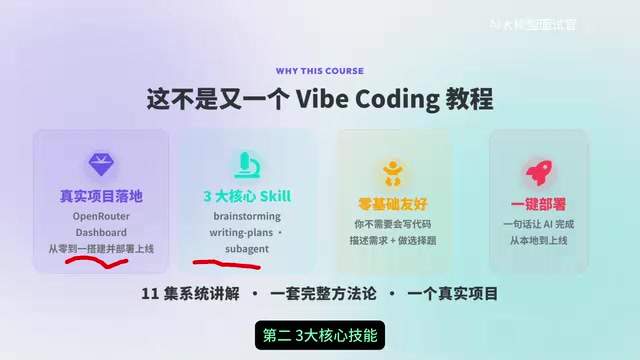
The combination of these three skills actually corresponds to the most easily stuck links in AI programming: the transformation from ideas to requirements, code understanding and verification, and customization and connection of the toolchain. The course does not stop at "prompt techniques" for a single tool, but teaches AI programming as a reusable workflow.
In the context of AI programming, "hand-building a plugin" usually refers to writing a custom extension for AI programming tools (such as Claude Code, Codex, or IDE plugins) to extend their capability boundaries. Such plugins can be a simple script that lets AI automatically execute test commands in a specific directory, or an MCP (Model Context Protocol) service that provides AI with the ability to access databases, call internal APIs, or query documentation. The core value of hand-building plugins lies in solidifying repetitive workflows, such as automatically generating API documentation, automatically running lint and fixing it, or converting design mockups into component code. The course lists it as one of the three core skills because it represents the leap from "using AI tools" to "customizing AI workflows"—learners need to understand the basic structure of plugins (input parameters, execution logic, output format) and learn to describe plugin requirements to AI in natural language, then have AI generate plugin skeleton code. This better reflects the engineering mindset of AI programming than simply writing prompts.
Who It's For: Efficiency Leaps for Four Types of People
The course targets four types of people: zero-tech beginners who want to use AI to build their own products; developers who want to use AI to increase development efficiency by 5-10x; agile leaders or project managers who hope to introduce AI programming workflows to their teams; and tech enthusiasts who want to systematically understand the most cutting-edge AI programming tools and methods.
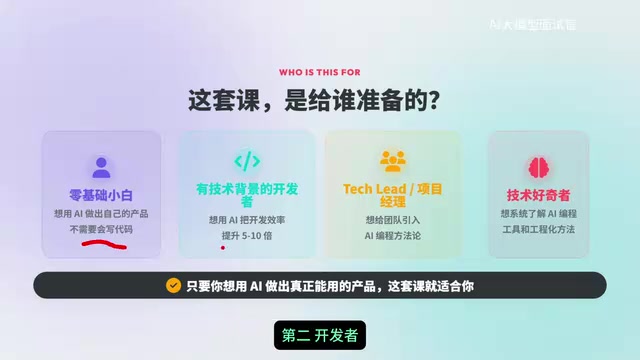
You may not have noticed that the course puts "zero-tech beginners" and "developers" in the same set of content, which means its teaching logic is not layered by code ability but by workflow—beginners learn requirement description and multiple-choice decision-making, while developers learn how to embed AI into existing development processes. Whether this design can satisfy both groups at the same time depends on the course's granularity control in the hands-on sessions.
Course Structure: 11 Episodes in Four Stages, from Cognition to Launch
The entire course has 11 episodes, divided into four stages: foundational cognition, core skills, practical advancement, and launch finale. From the introductory operation of "screen-decides-code" to the deep dissection of core skills such as Brainstorming, then to the practical advancement of a complete project and final deployment and launch, it forms a closed-loop path. Course materials and complete project source code are provided as a package, making it convenient for learners to follow along.

The division of the four stages corresponds to the four steps of progressive AI programming ability: first establish basic cognition of AI programming tools and methods, then master core collaboration skills, then practice requirements analysis, code generation, and test troubleshooting in real projects, and finally complete deployment and launch. For those who want to systematically get started with AI programming, this "cognition—skills—practice—delivery" structure has more practical value than scattered tool tutorials.
Toolchain Perspective: The Place of Claude Code and Codex
From the course description, Brainstorming, Read and Play, and plugin collaboration constitute the "soft skills" layer of AI programming, while tools such as Claude Code and Codex are the "hard tools" layer that carries these skills. The course's core proposition is: tools will iterate, but this collaboration method of requirement breakdown, code reading and verification, and toolchain customization can be transferred to different tools. This is also the ability that "zero-background" learners truly need to establish—not memorizing how to use a certain tool, but learning how to collaborate with AI to complete a full project.
For readers who are currently watching AI programming from the sidelines, the reference value of this course lies in how it pushes "Vibe Coding"-style casual attempts into a structured, deliverable engineering process. As for whether it can truly enable zero-background learners to independently complete deployment, that still depends on the density of guidance in the hands-on sessions.
One-line Summary
The Bilibili course argues that the sticking point in AI programming is not syntax but collaborative workflow, using 11 episodes of closed-loop teaching to complete real project deployment.
Paragraph Summary
The article introduces Bilibili creator Bai Li's AI programming course series. Its core viewpoint is: many people get stuck with AI programming not because of code foundations, but because of the "anti-corruption theory of interpersonal collaboration"—that is, the ability to collaborate with AI, break down requirements, and turn vague ideas into executable instructions. The course rejects toy demos and chooses to fully build a deployable OpenRoot project, deeply dissecting the three core skills of Brainstorming, Read and Play, and plugin collaboration, and teaching learners to hand-build plugins to extend workflows. The course targets four groups—zero-background beginners, developers, agile leaders, and tech enthusiasts—and layers by workflow rather than code ability. It has 11 episodes divided into four stages: foundational cognition, core skills, practical advancement, and launch finale, forming a closed loop from introduction to deployment. The article believes its value lies in pushing casual Vibe Coding into a structured, deliverable engineering process, but whether zero-background learners can independently complete deployment still depends on the density of hands-on guidance.
Related articles

The Gemini 4 Trio and 3.8 Flash: A Full Comparison of Positioning, Pricing, and Benchmarks
A comparison of Gemini 4 Neon, Carbon, Argon, and Gemini 3.8 Flash: positioning, context, API pricing, Artificial Analysis and Arena benchmark scores, and available entry points.

AI Coding Model Leaderboard: Opus 5.5 Crowned, Gemini Neon Stages a Comeback
Tech blogger Matthew Berman releases an AI coding model tier list: Claude Opus 5.5 holds S-tier, Gemini Neon surprises with A-tier, OpenAI Astra lands B-tier. How do open-source models like DeepSeek fare? We break down the scoring logic and practical takeaways.

New Jersey Joe Sandwich: Meat and Coleslaw on Triple-Decker Rye
New Jersey Sloppy Joe isn't a ground beef burger—it's triple-decker rye bread with meat, Swiss cheese, and coleslaw, plus Russian dressing. Learn the authentic Essex County method and family recipe.