Zero-Click Remote Android DoS: A New Attack Without User Interaction

A zero-click, silent, remote Android DoS project trending on Hacker News highlights security challenges in a fragmented ecosystem.
The article introduces a "Zero click, silent, remote Android DoS" project that earned 257 points and 141 comments on Hacker News, whose core is that an attacker can remotely send an Android device into a denial-of-service state without the victim clicking or being aware. The article breaks down the threat model formed by the three keywords—zero-click, silent, remote—and notes that such attacks bypass the user-interaction premise. Android fragmentation and the multi-layer patch distribution chain significantly lengthen fix cycles; DoS does not steal data but can render devices unusable and disrupt business operations. HN discussion centers on disclosure ethics, security model boundaries, and actual scope of impact, with the article concluding with implications for users, developers, and researchers.
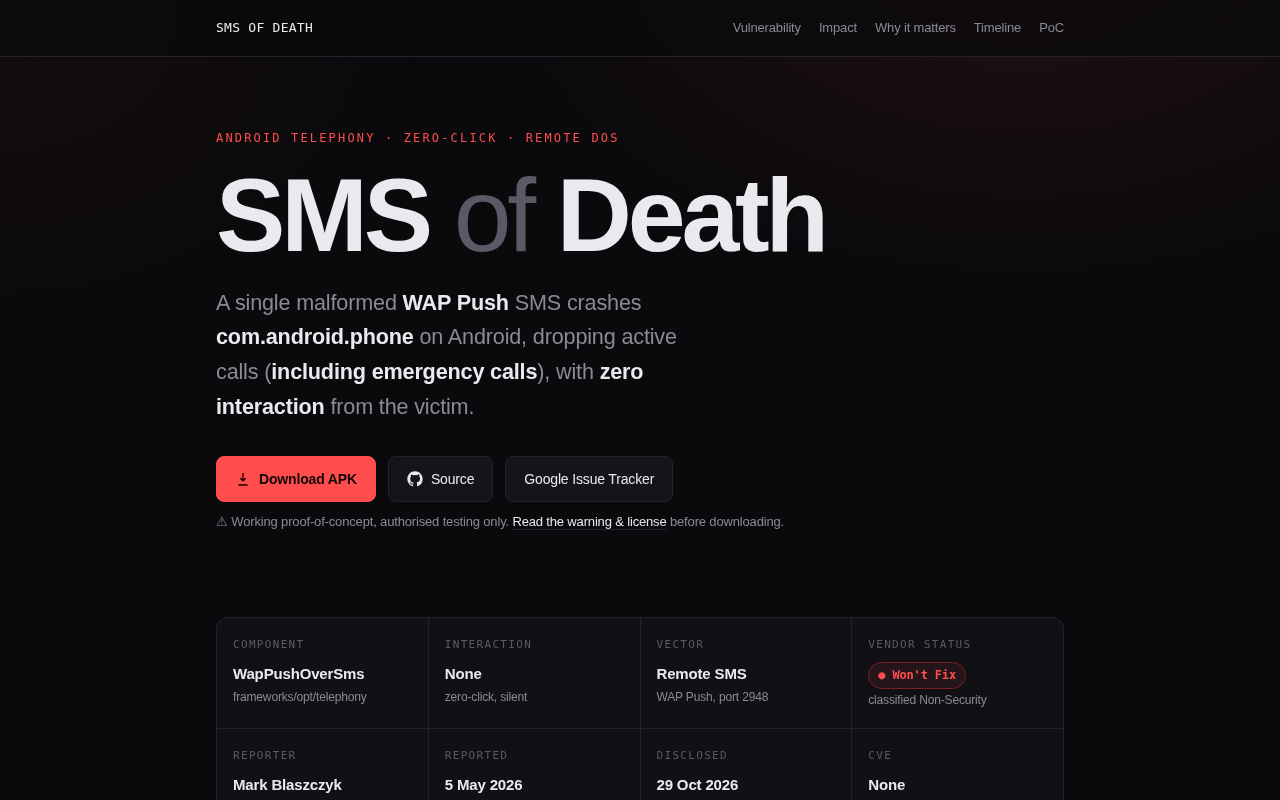
A project called "Zero click, silent, remote Android DoS" sparked heated discussion on Hacker News, earning 257 points and 141 comments. Its core selling point is straightforward: an attacker can send a remote Android device into a denial-of-service state without the victim clicking any link or even being aware.
The Attack's Keywords: Zero-Click, Silent, Remote
The project title itself is an accurate summary of the threat model. Zero-click means the attack chain does not rely on phishing lures or fake app installations—the victim does not need to take any active action; silent means the attack process does not trigger obvious prompts or cause abnormal animations or notifications on the device interface; and remote means the attack surface lies in network-reachable components, not local interfaces that require physical contact.
Combined, these three traits amplify both the stealth and the reach of the attack. Traditional Android security discussions tend to focus on malicious apps requesting permissions, sideloaded packages, or social engineering lures, whereas this type of attack bypasses the premise of "did the user click something wrong" and pushes the problem back to the system's default trust in network input.
DoS (Denial of Service) refers to attacks that exhaust a target's compute, memory, network bandwidth, or connection count, rendering it unable to respond to legitimate requests. In the mobile device context, typical DoS symptoms include system services repeatedly crashing and restarting, UI freezing and becoming unresponsive, interruption of calls and SMS, and anomalies in the baseband or network stack. Unlike traditional server DoS, DoS on Android is often triggered by a single malformed input that crashes a critical system process—or even causes a cascading reboot loop, leaving the user with no recovery option other than a factory reset or reflashing. DoS is typically not considered a high-severity vulnerability (CVSS scores are often lower than RCE), but its availability impact directly affects users and business scenarios that rely on phones for payments, communications, and scheduling.
RCE (Remote Code Execution) refers to an attacker's ability to execute arbitrary code on the target device, usually enabling further backdoor implantation, data theft, or privilege escalation—one of the most dangerous vulnerability types in mobile security. The article contrasts DoS with RCE to illustrate the difference in severity: DoS does not involve code execution or data leakage, but it can equally render a device unusable. Understanding this distinction helps in prioritizing vulnerabilities and also explains why some vendors respond relatively slowly to DoS vulnerabilities.
Android Fragmentation Makes the Problem Harder to Contain
The Android ecosystem is characterized by a wide version span, deep vendor customization, and a long patch distribution chain. The same underlying defect may manifest inconsistently across different OEM ROMs, basebands, and system service implementations; fixes must also pass through multiple layers—AOSP, chip vendors, device vendors, carriers—and the time lag before reaching users can be measured in months or even quarters.
This means that "zero-click remote DoS" is not a topic that a single patch can fully close. DoS itself does not steal data or implant backdoors and appears lower in severity than RCE, but it can render a device unusable: calls interrupted, system services repeatedly restarting, critical apps unresponsive. For individual users it is an availability loss; for business scenarios that depend on mobile devices, it is a tangible risk of disruption.
AOSP (Android Open Source Project) is the Android open-source codebase maintained under Google's leadership, forming the foundation for vendor-customized systems. Device vendors typically layer their own UI, system services, and drivers on top of AOSP, then adapt baseband and firmware provided by chip vendors to form the final ROM. The security patch distribution chain is therefore very long: after Google fixes AOSP, chip vendors must adapt low-level components, device vendors must merge and test, and carriers must complete network certification before patches finally reach users via OTA. This chain means the fix time for the same vulnerability can differ by months or more across devices, and is the fundamental reason why "fragmentation" has long been a challenge for Android security.
OTA (Over-the-Air) updates refer to the mechanism for pushing system or security patches to devices over wireless networks. OTA coverage is affected by vendor support cycles, user willingness to update, and carrier review; older models often remain unpatched long after vendor support ends, becoming potential exposure surfaces for zero-click remote attacks.
Three Areas of Concern Revealed by the HN Discussion
Across the project's 141 comments, discussion roughly centered on three directions.
The first is vulnerability disclosure and ethics: if researchers publicly release a reproducible remote DoS, will it be abused? Many favor disclosing to vendors first, giving a fix window, and then publishing details; others argue that only public disclosure can force the fragmented ecosystem to respond faster.
The second is the boundaries of the Android security model: when an attack requires no user interaction, can common defenses such as permission prompts, sandbox isolation, and app store review still cover it? A judgment that recurred throughout the discussion is that input validation in the network protocol stack and system services is the more forward line of defense.
The third is the actual scope of impact: many commenters asked about the specific affected components, OS version ranges, and whether mitigations exist. The original project page provides limited information, which left some discussion at the level of speculation.
Responsible Disclosure is a common practice in security research: before publicly revealing vulnerability details, researchers privately notify the vendor and allow a reasonable fix window (commonly 90 days), then publish after the deadline, balancing users' right to know against the risk of attack abuse. Disclosure of zero-click remote DoS is particularly sensitive because once reproduction materials are public, they may be used directly to attack devices that have not yet been patched. The disagreement in the discussion over "disclose first or publish first" is essentially a trade-off between vendor response speed and user risk in a fragmented ecosystem.
Input validation and the network protocol stack are the core defense against zero-click attacks. Android's network-reachable components (such as baseband protocol parsing, system network services, and Bluetooth/Wi-Fi protocol stacks) directly process packets from the outside; without strict length, format, and state validation, malformed input can trigger crashes or resource exhaustion. Because these components typically run with system privileges, once they are brought down the impact spreads across the entire device—making boundary checks and process isolation a more forward defensive layer than permission prompts.
Implications for Developers and Ordinary Users
For ordinary users, what can be done remains limited: keep up with system and security patch updates and avoid staying long-term on old versions lacking maintenance. But the very nature of this type of attack is that user behavior is not a variable—one cannot rely on "don't click strange links" to avoid it.
For developers and device vendors, the more worthwhile focus is governing the input surface: whether network-reachable services perform strict boundary checks on anomalous input, whether critical system processes have sufficient isolation and degradation mechanisms, and whether a single component being brought down can be prevented from causing cascading crashes. The core of DoS defense is not "blocking entry" but "preventing a single point of failure from spreading after entry."
For security researchers, this project once again demonstrates the value of low-interaction attack surfaces. Zero-click vulnerabilities are usually more costly to discover, but once established, their impact is broader. Disclosure pacing, the discretion of reproduction materials, and coordination with vendors are all parts that need to be designed in advance.
Project URL: https://smsofdeath.com/ ; the original discussion can be found in Hacker News item 50285452. Currently, public information is still mainly from the project page; for specific affected components and fix progress, refer to vendor announcements.
One-line Summary
A zero-click, silent, remote Android DoS project trending on Hacker News highlights security challenges in a fragmented ecosystem.
Paragraph Summary
The article introduces a "Zero click, silent, remote Android DoS" project that earned 257 points and 141 comments on Hacker News, whose core is that an attacker can remotely send an Android device into a denial-of-service state without the victim clicking or being aware. The article breaks down the threat model formed by the three keywords—zero-click, silent, remote—and notes that such attacks bypass the user-interaction premise, pushing the problem back to the system's default trust in network input. Android version fragmentation and the multi-layer patch distribution chain significantly lengthen fix cycles; although DoS does not steal data, it can render devices unusable and disrupt business operations. HN discussion centers on three issues: disclosure ethics, security model boundaries, and actual scope of impact; the article concludes with implications for users, developers, and researchers.
Related articles

T3 Code: The Open-Source AI Coding Assistant's Comeback Story
T3 Code is an open-source AI coding assistant that unifies subscriptions like Codex and Claude, with powerful remote control and parallel task management.

Never Elected, Yet Ruled New York for 30 Years: The Ultimate Case Study in the Mechanics of Power
Robert Caro's biographies reveal how unelected Robert Moses ruled New York for 30 years through legal drafting and public authorities, and how Lyndon Johnson built leverage as a "powerless" Senate Majority Leader. Unpacking the underlying logic of accumulating and sustaining power.

The CPython 3.10 Recursion Trap and Synthetic Recovery in TokenGuard, an LLM Circuit Breaker
TokenGuard's author recounts a recursion crash caused by OrderedDict.pop in CPython 3.10 and introduces v0.3.0's Loop Nudge synthetic recovery, inline DLP scanning, and other new LLM agent circuit-breaker capabilities.