Zero-Code Xianxia Game Development: A Head-to-Head Comparison of Four Major AI Models

One creator used Vibe Coding to build a 2D xianxia game, benchmarking GPT, Claude, Grok, and Doubao with identical prompts.
A Bilibili creator used Vibe Coding to develop a 2D xianxia game without writing any code, testing GPT, Claude, Grok, and Doubao with the same 3,000-line prompt. Claude led in programming ability with the richest features, GPT offered balanced performance, Grok struggled with asset integration, and domestic model Doubao surprised with smart SVG usage. The key insight: model selection depends on use case, and precise prompt writing is the real developer skill.
From Watching Anime to Building a Game: One Person's AI Development Experiment
"Vibe Coding" is rapidly gaining traction in developer circles — building an entire application through natural language alone, without writing a single line of code. The concept was formally introduced and named by OpenAI co-founder Andrej Karpathy in early 2025. Its core idea is that developers drive programming through "feel" and "intent," using natural language as the sole input interface while large language models handle the translation of intent into executable code. This paradigm shift is directly enabled by a dramatic leap in code generation capabilities — mainstream models like GPT-4 and Claude 3 now exceed 85% pass rates on programming benchmarks like HumanEval, making end-to-end automated generation of complex applications a reality rather than a concept.
Bilibili creator Xiao Liu put this approach to the test in a hands-on experiment: inspired by the popular anime A Record of a Mortal's Journey to Immortality, he attempted to build a 2D xianxia-themed mini-game from scratch using AI — without writing any code himself.
The choice of 2D over 3D was a deliberate cost-and-efficiency decision. As the creator noted, 3D games demand significant time and resources, while a 2D format using the HTML5 tech stack allows for rapid results and instant debugging — "you can have a prototype done in an hour." The HTML5 + Canvas/WebGL stack is the go-to choice for quick 2D game prototyping, offering zero installation friction, cross-platform support, and instant browser preview. For AI-generated projects, HTML5 carries an added hidden advantage: the entire game can be packaged into a single .html file, making it easy for AI to output all at once and for humans to test directly — eliminating the complexity of engineering setup. This rapid iteration approach is precisely where AI-assisted development shines.
The Complete AI Development Workflow
The entire development process can be broken down into several key stages, forming a reusable methodology.
Asset Generation: Solving the Art Problem with AI Image Generation
The first step was using image generation tools to batch-produce game assets — characters, enemies, scene maps, skill effects, UI elements, item components, and more. This step directly addressed the biggest pain point for solo developers: art resources. Work that would previously require a professional art team and several weeks can now be produced in a short time through AI image generation.
Prompt Engineering: 3,000 Lines of Documentation as the Real Source Code
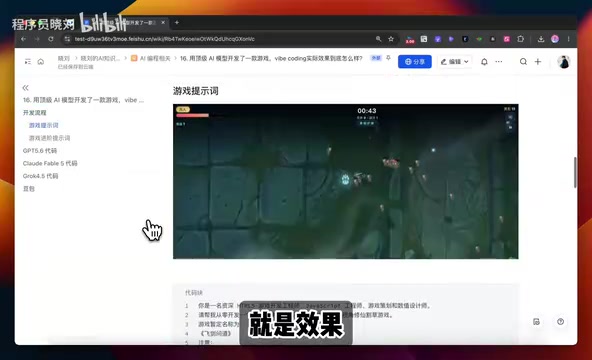
What truly determines game quality is a prompt document stretching over three thousand lines. Prompt Engineering has evolved into its own technical sub-discipline. In a game development context, high-quality prompts typically need to cover four layers: "world-building," "mechanical rules," "numerical balance," and "technical constraints." A 3,000-line prompt means the document already has the completeness of a Game Design Document (GDD) — the core document that professional game studios must complete before formal development begins.
The creator first used AI to refine the game's settings, detailing key content such as map types, leveling systems, advancement states, and combat mechanics (health points, kill timers, count tracking). He also prepared an "advanced" version of the prompt, adding more refined elements like ultimate skill mechanics and boss spawn systems.
This detail deserves emphasis: in Vibe Coding, the level of detail in your prompts directly determines the completeness of the final product. From this perspective, the developer's role has fundamentally shifted from "programmer" to "game designer + product manager" — the focus moves from "writing code" to "precisely describing requirements." This is a migration of skills, not their disappearance.
Code Generation and Debugging: AI Thinks Independently for Five to Six Hours
Once the prompt was handed to the AI model, the model autonomously reasoned through the requirements and generated the complete HTML5 game code. The process took the AI approximately five to six hours — a time cost that reflects the real computational expense of long-context, high-complexity reasoning in large language models. A fully functional HTML5 game generated by Claude 3.5 Sonnet, for example, can easily exceed 50,000 lines of code, corresponding to hundreds of thousands of output tokens. Some high-end models also incorporate a "Chain-of-Thought" reasoning mechanism — the model internally decomposes steps before generating the final code. This further increases time consumption, but it's also one of the key reasons high-end models demonstrate stronger programming ability. While human effort is essentially zero, AI reasoning and generation still demands substantial compute time.
Head-to-Head Testing of Four Major Models
The most valuable part of this experiment was the creator's use of the same prompt set to test four mainstream models, producing a highly informative comparative result.
GPT: The Well-Rounded, Reliable All-Rounder
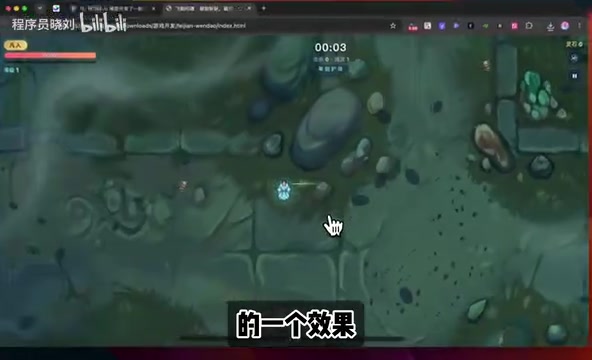
GPT's generated game, "Flying Sword Path," was functionally complete — covering advancement, temporary breakthrough materials, a three-element system, game instructions, settings, save files, and music. The generated file size was approximately 1MB, with relatively lean code. The creator noted that at the prototype stage, "being playable is enough" — there's no need to demand an unreasonably high level of polish.
Claude: The Undisputed #1 in Programming Ability
Claude was rated the strongest model for programming ability in this test — a well-deserved distinction. Anthropic's training of Claude placed strong emphasis on "Constitutional AI" and instruction-following, giving it superior context retention when handling long and complex prompts. On SWE-bench (a software engineering benchmark), the Claude 3.5 series also demonstrates significantly higher problem-solving rates than contemporary competitors.
The game Claude generated was the most feature-rich, encompassing complex systems like permanent upgrades, divine abilities, cultivation techniques, equipment, and inner realm layers. Multiple maps correspond to different cultivation levels (e.g., requiring Core Formation or God Transformation to enter), and combat features skill cooldowns and ultimate ability activation.
However, Claude did expose a bug: too many maps were generated, requiring a certain value to be set to 90 before earlier maps would display — and the issue wasn't auto-fixed. Additionally, its generated file was over 70 times larger than the GPT version. This is a direct reflection of Claude's strong instruction-following ability — its implementation completeness for every feature requirement in the prompt is higher, but this comes with a trade-off between code bloat and potential bug risk. The creator speculated this might also be partly related to the version used not being the top-tier option.
Grok: Clearly Lacking in Asset Integration

Grok put in the weakest performance. Despite the creator explicitly providing a full set of assets — backgrounds, characters, flying swords, and a boss (the Iron-Back Mystic Turtle) — Grok failed to properly integrate them into the game visuals. All the resources were present, but could not be coordinated and assembled correctly. The creator specifically clarified this was "not a problem with the assets" but rather a fundamental capability gap in the model when it comes to coordinating and assembling multiple resources.
Doubao: The Surprising Dark Horse from China
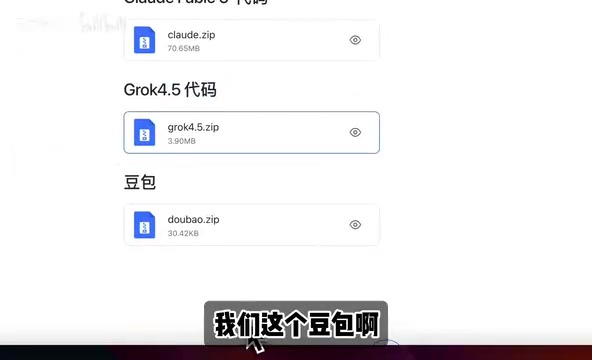
As the only domestic Chinese model in the lineup, Doubao exceeded expectations. Notably, Doubao opted for SVG (Scalable Vector Graphics) rather than bitmap rendering for the game. SVG is an XML-based vector description language that's naturally suited to AI text generation — the model can directly "write" graphics without calling external image files, fundamentally sidestepping the asset dependency problem. This technical path choice is essentially the model making an autonomous trade-off between "reducing external dependencies" and "avoiding asset integration complexity" — neatly bypassing the exact weakness that Grok exposed.
While its programming ability doesn't rank highly on international leaderboards, and the final result was a simple "small circles + small flying swords" prototype, the functionality was largely complete and the SVG usage was appropriate. The creator even felt Doubao performed slightly better than Grok in this test, while acknowledging there may have been some element of luck involved.
Overall Rankings and Model Selection Recommendations
Based on this hands-on testing, the creator offered ranking conclusions across two dimensions:
Programming Capability: Claude > GPT > Grok, with Doubao discussed separately as a non-specialist programming model.
Everyday Use Cases: Doubao ranks first. The creator explained that Doubao has low cost, a low barrier to entry, is universally accessible, and is more convenient and practical than other options for daily life scenarios (such as photographing and identifying vegetables).
This conclusion highlights a commonly overlooked truth: there is no single right answer for model selection. Claude is the top choice for technical development, but for everyday applications aimed at general users, low-barrier, easily accessible domestic models offer greater practical value.
Conclusion: The Boundaries and Lessons of AI Development
This experiment offers a clear picture of where AI-assisted development stands today. On one hand, from asset generation to code writing, AI can genuinely enable a single person to produce a playable game prototype in a few hours, dramatically lowering the barrier to creation. On the other hand, the massive differences between models — file sizes varying by a factor of 70, and wildly different asset integration capabilities — make it clear that Vibe Coding is far from a mature, stable, production-grade solution. Its results still carry a significant degree of unpredictability.
For everyday creators, the true core competency has shifted from "coding skills" to the ability to describe requirements precisely and the judgment to select the right model. That three-thousand-line prompt is the real "source code" of this game.
Key Takeaways
Related articles
Understanding GitHub's Availability Report: Platform Stability and Developer Response Strategies
Deep dive into GitHub's monthly availability report: analyzing service degradation impacts, CI/CD fault tolerance, and platform dependency risk strategies for resilient development.

OpenAI's Claim of Solving a Millennium Prize Problem Sparks Academic Controversy
OpenAI claims its AI solved a Millennium Prize Problem, sparking debates over attribution, verification, and AI's role in reshaping mathematical research.
Ledoit-Wolf Covariance Shrinkage in Practice: 57% Lower Turnover + 10x GPU Acceleration
Learn how Ledoit-Wolf covariance shrinkage reduces portfolio turnover by up to 57% and how cuML GPU acceleration cuts backtest time from 1.5 hours to 9 minutes.