Zero-Shot Multilingual ABSA: Which LLM Prompting Strategy Wins?

Zero-shot multilingual TASD evaluation finds monolithic prompting beats multi-step pipelines; aspect term recall is the hard bottleneck.
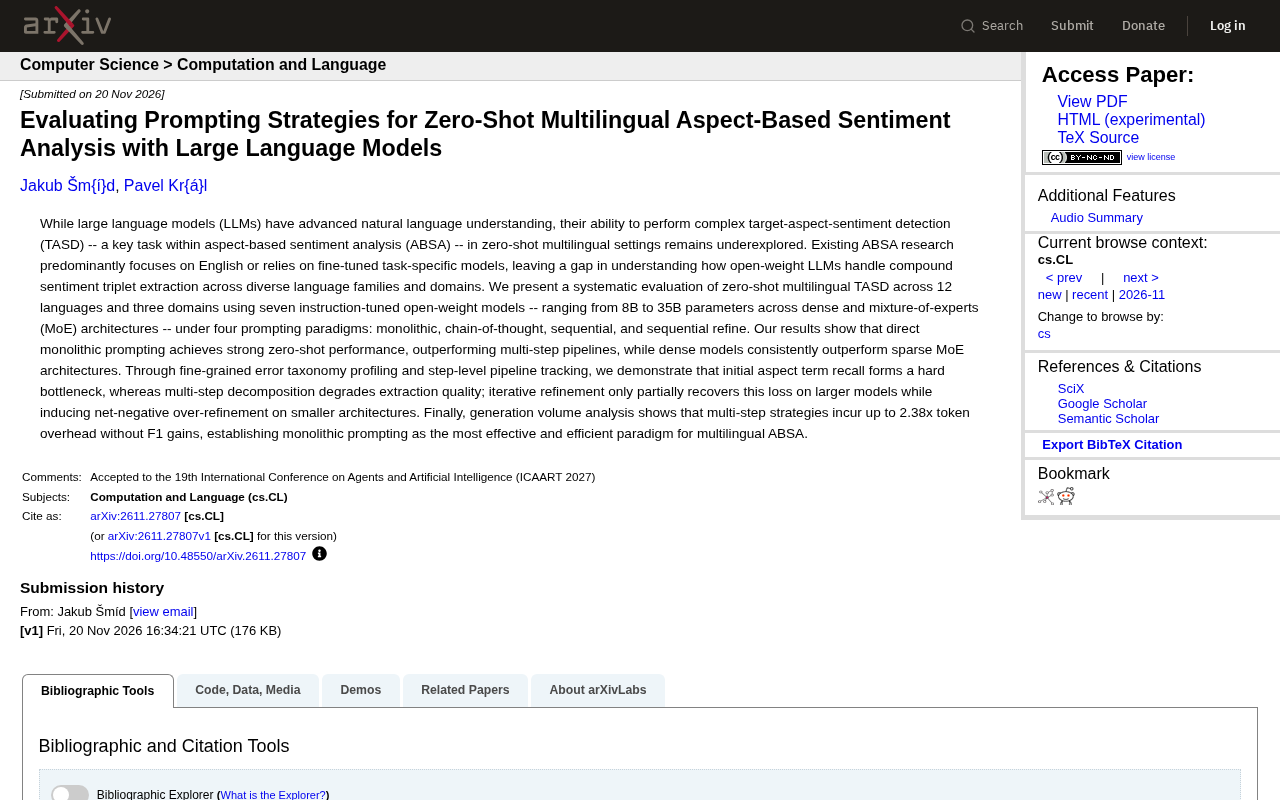
A systematic evaluation tested zero-shot multilingual TASD across 12 languages and 3 domains with 7 open-weight models (8B-35B, dense and MoE). Comparing monolithic, chain-of-thought, sequential, and sequential-refine prompting, it found that monolithic prompting is strongest, dense models consistently beat sparse MoE, and initial aspect term recall is a hard bottleneck. Multi-step decomposition degrades extraction quality and adds up to 2.38x token overhead with no F1 gain.
Large language models (LLMs) have made rapid strides in natural language understanding, but getting them to perform complex Target-Aspect-Sentiment Detection (TASD)—the core task in aspect-based sentiment analysis (ABSA)—in zero-shot, multilingual settings remains an underexplored challenge. Most existing ABSA research focuses on English or relies on fine-tuned task-specific models, so we know little about how open-weight LLMs extract compound sentiment triplets across language families and domains. A recent systematic evaluation fills this gap, and its conclusions may overturn your intuition that "multi-step prompting is more powerful."
Evaluation Design: 12 Languages, 3 Domains, 7 Open Models
The study systematically evaluates zero-shot multilingual TASD across 12 languages and 3 domains, using 7 instruction-tuned open-weight models ranging from 8B to 35B parameters, covering both dense and mixture-of-experts (MoE) architectures.
Four prompting paradigms were tested:
- Monolithic: Have the model output triplets directly in one step
- Chain-of-thought: Guide the model to reason step by step
- Sequential: Decompose into multiple sub-steps executed in order
- Sequential refine: Iteratively correct on top of the sequential approach
This cross-lingual, cross-architecture comparative design makes the conclusions more compelling than studies limited to a single language or a single model.
Target-Aspect-Sentiment Detection (TASD) is one of the most challenging variants of aspect-based sentiment analysis (ABSA). Traditional ABSA tasks typically only require identifying aspect terms and their sentiment polarity (e.g., "screen→positive"), whereas TASD further requires simultaneously extracting the target entity, aspect category, and sentiment polarity to form a triplet (e.g., "phone→screen→positive"). This compound structure demands that the model possess entity recognition, aspect classification, and sentiment judgment capabilities at once, while maintaining semantic consistency across triplets. In zero-shot multilingual settings, the model cannot rely on annotated data in the target language and must complete the task entirely through instruction understanding and cross-lingual transfer ability, making TASD a rigorous touchstone for testing the true generalization capability of LLMs.
Mixture-of-Experts (MoE) architecture differs from dense architecture primarily in how parameters are activated. In dense models, all parameters are activated during each forward pass; in MoE models, a gating network dynamically selects a small number of "expert" subnetworks for each token to compute, thereby maintaining low inference cost despite a large total parameter count. For example, a MoE model with 35B total parameters may activate only about 8B parameters per inference. This sparse activation mechanism can improve capacity efficiency during pre-training, but in zero-shot tasks requiring finely structured outputs, its routing mechanism may introduce instability, leading to less task consistency than a dense model with equivalent activated scale. The finding in this study that dense models consistently outperform MoE hints at the potential cost of this architectural difference in downstream structured extraction tasks.
Key Finding: Monolithic Prompting Is Actually Strongest
The results point to a counterintuitive conclusion: direct monolithic prompting performs strongly in zero-shot settings, outperforming multi-step pipelines. Dense models also consistently outperform sparse MoE architectures.
Why didn't multi-step decomposition deliver the expected gains? The study provides an explanation through fine-grained error classification and step-level pipeline tracing: initial aspect term recall constitutes a hard bottleneck. Once the first step misses an aspect term, no amount of sophistication in subsequent steps can compensate. Multi-step decomposition actually degrades extraction quality; iterative refinement can only partially recover losses on large models, while on smaller architectures it triggers net-negative over-refinement.
In other words, breaking the task into pieces doesn't make the model smarter—it may actually cause it to introduce new errors at each step.
Aspect term recall here refers to the model's ability to correctly identify all evaluation targets (aspect terms) from the input text, which is the first step in the TASD pipeline. In multi-step sequential prompting, subsequent target identification and sentiment classification depend on the aspect term list output by the first step. If the first step misses an aspect term, subsequent steps have no way to generate a triplet for that aspect, creating irreversible error propagation. This "recall bottleneck" effect is particularly pronounced in zero-shot cross-lingual settings, because the model's judgment of vocabulary boundaries and entity references in non-English text is inherently weaker, leading to higher miss rates in initial recall. Therefore, the key to improving TASD performance is not to add more reasoning steps, but to enhance the model's sensitivity to and coverage of aspect terms within a single step.
Over-refinement refers to the negative effect produced by iterative refinement strategies when model capability is insufficient: in each round of correction, the model not only fails to fix existing errors but actually changes originally correct predictions to incorrect ones, causing overall performance to decline round by round. This phenomenon is especially evident in smaller architectures (such as 8B models), because small models lack sufficient instruction-following and error-diagnosis capabilities to accurately judge when the original output should be retained. In contrast, large models possess stronger self-evaluation capabilities and can obtain partial net gains from refinement. This finding reveals the applicable boundary of iterative refinement strategies: it is not a universal efficiency tool but a conditional technique strongly correlated with model scale.
Efficiency Comparison: Token Costs of Multi-Step Strategies Don't Match Returns
Generation volume analysis shows that multi-step strategies incur up to 2.38x token overhead without any F1 gain. This establishes a pragmatic conclusion: for multilingual ABSA, monolithic prompting is the most efficient and effective paradigm.
This finding has direct implications for practical deployment. In cost-sensitive production environments, blindly stacking prompt steps not only wastes compute but may also harm accuracy. The research suggests that rather than designing complex prompt pipelines, it's better to prioritize ensuring the model can recall aspect terms with high quality in the first step.
Practical Implications and Limitations
For developers working on multilingual sentiment analysis or aspect-level extraction, this study sends a clear signal: try monolithic prompting first, and focus optimization efforts on aspect term recall; if using small models, be cautious about introducing iterative refinement to avoid performance regression from over-refinement.
Of course, this evaluation is limited to open-weight models and specific domains—closed-source commercial models may perform differently; future research could further explore methods to enhance aspect term recall and the potential of MoE architectures on the TASD task.
One-line Summary
Zero-shot multilingual TASD evaluation finds: monolithic prompting outperforms multi-step pipelines, and aspect term recall is a hard bottleneck.
Paragraph Summary
A systematic evaluation tested zero-shot multilingual Target-Aspect-Sentiment Detection (TASD) across 12 languages and 3 domains using 7 open-weight models (8B-35B, including dense and MoE architectures). The study compared four prompting strategies—monolithic, chain-of-thought, sequential, and sequential refine—and reached a counterintuitive conclusion: monolithic direct prompting performs strongest, outperforming multi-step pipelines; dense models consistently outperform sparse MoE. Error analysis shows that initial aspect term recall constitutes a hard bottleneck, multi-step decomposition actually degrades extraction quality, iterative refinement only partially recovers losses on large models while producing net-negative over-refinement on small models, and multi-step strategies incur up to 2.38x token overhead with no F1 gain. The study recommends prioritizing monolithic prompting and focusing optimization on aspect term recall.
Related articles

GLM-5.4 vs. Opus and Neon: How Far From the Top?
No official benchmarks for GLM-5.4. Based on a YouTube deep test and developer trials, we analyze its gap vs. Claude Opus 5.5 and Gemini Neon, the speed bottleneck from marathon-style thinking, and its real position in enterprise agent scenarios.

From Gobbler to Sloppy Joe: The Hit-Making Playbook of a New Jersey Deli Institution
NYT Cooking visits Milburn Deli in New Jersey to break down the hit logic behind the Gobbler turkey sandwich and the local Sloppy Joe: bread sliced to order, house-made sauces, a group shout culture, and customer co-creation behind six locations.
In the Age of AI Programming, When Do You Still Need to Write Code by Hand?
Is handwritten code still valuable once AI programming agents are widespread? This article outlines three scenarios where handwriting is essential—learning, style development, and prototype validation—and provides a division-of-labor framework between AI and humans to help developers balance efficiency and skill growth.