Zero-to-Hero Agent Development Roadmap: Three Steps to LLM Application Mastery

A three-stage roadmap guiding application developers from prompt basics to enterprise-grade Agent development.
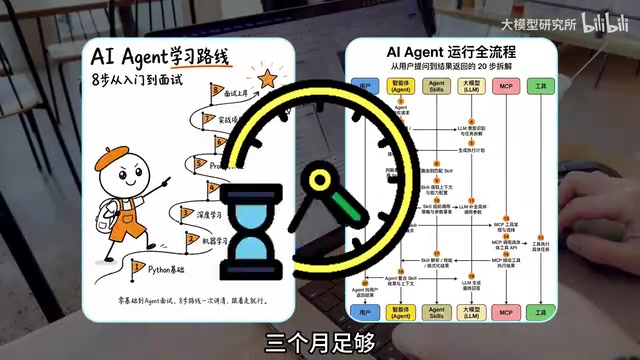
This article outlines a three-stage LLM learning roadmap for application developers: first, master prompt engineering and API calls with a real mini-project as proof; second, learn RAG to build knowledge-base Q&A systems grounded in private data; third, develop Agents that autonomously plan, use tools, and collaborate in multi-agent architectures. The roadmap's "get it working first" logic is sound, though claims of becoming enterprise-ready in three months should be taken as marketing hype — real proficiency requires sustained project-based practice.
From prompt engineering to multi-agent collaboration, the barrier to entry for Agent development is dropping fast. This article breaks down a widely-shared LLM learning roadmap on Bilibili, distilling it into a clear path from zero experience to enterprise-grade production, with key concept explanations to help beginners understand what skills they're actually building at each stage.
The Core Logic: Get It Working First, Go Deeper Later
When most people hear "learn about large language models," their first instinct is to dive into model training and hyperparameter tuning. But for the vast majority of application developers, that's precisely the part you don't need to tackle upfront. This learning roadmap makes a direct call: learn to write good prompts and understand how API calls work — that's enough to ship something genuinely useful.
This philosophy deserves credit. In the age of LLMs, the skill that matters has shifted from "training models" to "using models effectively." Mastering Prompt Engineering and API calls is the foundation of application-layer development. The original material notes that after this first step, you can build a "viral copywriting generator" — a tool that's essentially a structured prompt template packaged as a product. Low barrier, fast results.
What You Actually Need to Master in Step One
- Prompt design: Understand core techniques like role-setting, task decomposition, and few-shot examples
- API fundamentals: Get comfortable with token pricing, context windows, temperature parameters, and other key concepts
- One deliverable mini-project: Something like a copywriting generator — proof that you can take an idea all the way to execution

Step Two: RAG and Knowledge Bases — Making AI Answer Your Domain Questions
With the basics down, the second phase of the roadmap shifts to "learning to get things done" — and the centerpiece is RAG (Retrieval-Augmented Generation). This is currently the most mainstream technical approach for enterprise LLM deployment, and it marks the dividing line between "can chat" and "can actually work."
The value of RAG is that it lets a general-purpose LLM answer questions based on a company's private data, rather than hallucinating answers from the model's own "memory." Building a functional knowledge-base Q&A system requires connecting several components: data cleaning, text chunking, vectorization, storing in a vector database, and then passing retrieved content to the LLM to generate answers.
The practical advice from the original material is spot-on: feed industry reports and company manuals to the AI, then ask questions and get accurate answers directly. This is exactly how RAG plays out in enterprise use cases like internal knowledge management, customer support, and legal operations.

Key Tech Stack for This Stage
- Data processing: Document parsing, chunking strategies, data cleaning
- Vector databases: Basic usage of tools like Milvus, Chroma, Pinecone
- Retrieval optimization: Understanding embeddings, similarity search, and reranking
- Extended concepts: Initial exposure to knowledge graphs and how structured knowledge supports retrieval
A word of caution: RAG looks simple on the surface, but getting answers that are actually accurate is hard. Chunk granularity, retrieval recall, and how context is assembled all directly affect the final output quality — and this is where engineering skill gets tested the most.
RAG (Retrieval-Augmented Generation) works by decoupling the "retrieval" and "generation" steps: first, find the most relevant text chunks from an external knowledge base; then pass those chunks as context to the LLM, so the model generates answers grounded in real sources rather than relying on knowledge baked into its parameters during training. This effectively reduces LLM "hallucinations" — where the model confidently makes things up when uncertain. Compared to fine-tuning, RAG requires no model retraining, is lower cost, and allows knowledge to be updated at any time. That's why it's become the go-to enterprise deployment approach. Understanding the RAG workflow is essentially understanding the engineering architecture of "plugging in external memory."
Embedding is one of the core steps in the RAG pipeline, and understanding it reveals the fundamental mechanism behind the entire retrieval process. Embedding converts text into high-dimensional numerical vectors, where semantically similar texts end up close together in vector space. Vector databases like Milvus and Chroma operate on this principle — by computing cosine similarity or dot products between a query vector and stored vectors, they quickly locate the most semantically relevant text chunks. Reranking then takes the initial pool of retrieved candidates and uses a more refined model to re-score and re-sort them, improving the quality of the context ultimately passed to the LLM. These three components — Embedding, vector retrieval, and Rerank — collectively determine whether a RAG system can "find the right information," and are the key levers for engineering quality.
Step Three: Agent Development — Letting AI Plan and Use Tools on Its Own
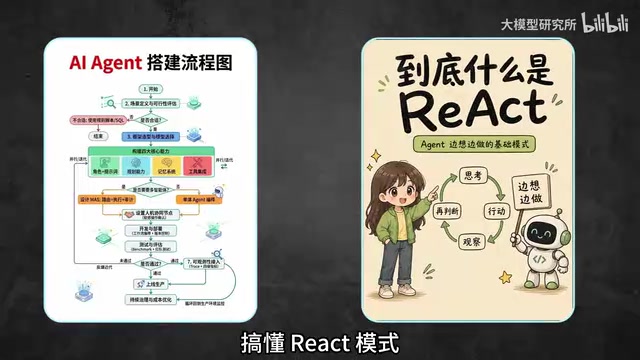
The third step of the roadmap enters true Agent (intelligent agent) development. Compared to the first two steps, this is where the biggest capability leap happens — instead of having AI passively generate content, you're building AI that autonomously plans, makes decisions, and calls tools to complete complex tasks.
A typical Agent operates in a "perceive–plan–act" loop. When the material mentions "letting the AI pick its own tools," it's referring to an Agent's Tool Use / Function Calling capability: the AI independently decides whether to invoke a search engine, calculator, database, or other external interface based on the task at hand.
From Single Agent to Multi-Agent Collaboration
A single Agent can only solve so much. More complex scenarios call for multiple Agents working in parallel. For example: a "Researcher Agent" that gathers information, an "Analyst Agent" that processes data, and a "Writer Agent" that produces the final report — each coordinating via message passing. This Multi-Agent System architecture represents one of the most frontier and imaginative directions in the current Agent landscape.
After completing this stage, the material claims you can build a conversational bot or deliver a complete AI solution proposal to a company. That's a somewhat optimistic framing, but the direction is right — someone with full Agent development capability can genuinely cover most enterprise-level AI application needs.
Designing a Multi-Agent System isn't simply "running several AIs at once" — the core challenge lies in the coordination mechanism between agents. Common architectural patterns include the "orchestrator–executor" model (a primary Agent handles task decomposition and scheduling, while sub-Agents handle specialized execution) and the "peer-to-peer" model (Agents pass messages directly and invoke each other). Popular development frameworks like LangGraph, AutoGen, and CrewAI each offer different approaches to multi-Agent orchestration. It's worth noting that while multi-Agent systems improve complex task handling, they also introduce significantly higher debugging complexity: errors in a single Agent can propagate and amplify down the chain. Designing fault-tolerance mechanisms and ensuring task observability are real engineering challenges you'll need to face in practice.
An Honest Assessment of This Roadmap
Overall, the three-stage "Prompt Engineering → RAG → Agent" structure is logical, well-sequenced, and aligned with how application developers naturally grow. It sidesteps the high-barrier content of training LLMs and stays focused on application-layer skills that can produce real value quickly — making it genuinely beginner-friendly.
That said, it's worth reading past the marketing language with a clear head. Claims like "go from zero to an AI talent companies are fighting over in three months" are attention-grabbing copy more than realistic promises. RAG retrieval optimization and Agent stability debugging are both hard problems that take significant hands-on practice to internalize. Building a complete conceptual framework in three months is already an accomplishment — reaching true "enterprise-grade" proficiency takes sustained effort over time.
For beginners, the advice is: treat this roadmap as a directional guide, and at every stage, set your benchmark as "build something that actually runs." Learn by doing, rather than collecting tutorials and mistaking that for learning.
Related articles

DeepSeek Harness: A Beginner's Installation and Testing Guide
A DeepSeek Harness tutorial for test engineers: set up Node.js, launch with one NPX command, configure official and third-party models, and explore web search, file I/O, and trace-view agent observability.
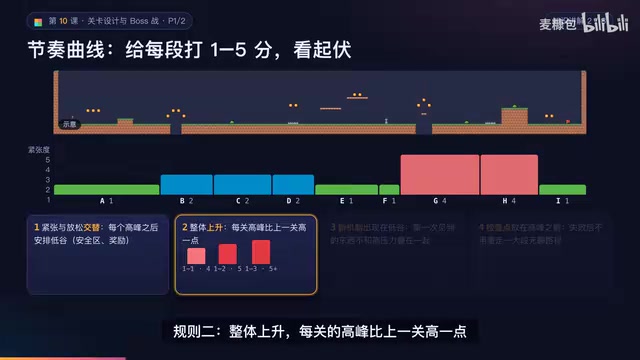
AI Game Development in Practice: Designing Levels with the Four-Step Method and Pacing Curves
AI game development lesson 10: design levels with the four-step method (teach, practice, combine, test) and a 1-5 pacing curve, plus sightline guidance and safety zones—implement Animatable Body 2D moving platforms and generate ASCII sketches for 1-2 Underground Cavern and 1-3 Guard Hall.

AI Game Development in Practice: Two-Phase Boss State Machines and Death Heatmap Tuning
AI game development lesson 10: implement a two-phase Boss with a state machine, guarantee fairness with color signals and a 0.4-second warning floor, locate difficulty cliffs with a death heatmap, and apply lightest-to-heaviest fixes one at a time, with an acceptance checklist and common pitfalls.