Zero to Hero: Core Concepts for AI Large Model Application Development
A clear conceptual framework for beginners entering large model application development.
This article lays out the foundational concepts every beginner needs before diving into large model application development. It clarifies the hierarchical relationships among AI, machine learning, deep learning, and generative AI, traces AI's evolution through Deep Blue, AlphaGo, and ChatGPT, and explains the three machine learning paradigms and the Transformer architecture. The key takeaway: your goal is 'large model application development,' not 'building large models from scratch' — understand enough fundamentals, leverage open-source models, and focus on applying RAG, Agents, and fine-tuning to real-world scenarios.
For beginners with no background trying to break into large model application development, the most common frustration is the overwhelming variety of online tutorials and scattered knowledge points — you can finish studying RAG, Agents, and model fine-tuning and still feel like you've never built anything real. This article is based on the first lesson of a systematic Bilibili tutorial series. It organizes the foundational concepts you need to internalize before developing large model applications, helping beginners build a clear knowledge framework and avoid unnecessary detours.
From Artificial Intelligence to Large Language Models: Clarifying the Core Concepts
Many people conflate artificial intelligence, machine learning, deep learning, and generative AI — but these terms actually form a clear hierarchical relationship.
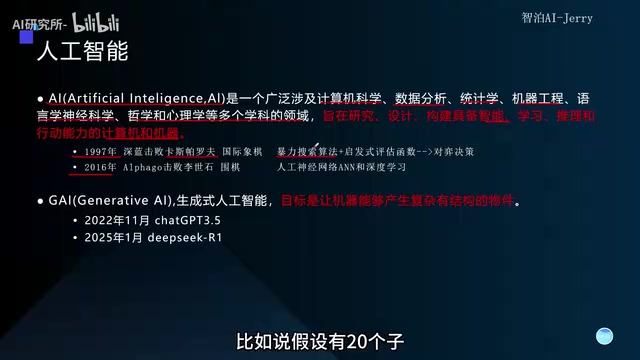
Artificial Intelligence (AI) is a broad interdisciplinary field spanning computer science, data analysis, statistics, linguistics, neuroscience, and even philosophy and psychology. Its goal is to research, design, and build machines capable of intelligent learning, reasoning, and action. There's a key insight here: why do some people say today's AI is basically "artificial stupidity," while others claim it's powerful enough to replace humanity? The root cause is a difference in expectations — some people want AI smarter than Einstein, something like Doraemon from a sci-fi movie, while pragmatists just want it to solve concrete problems in a specific domain.
From a scientific standpoint, both AI and generative AI are essentially "goals" — the difference is that generative AI proposes a more detailed and specific goal: enabling machines to produce complex, structured artifacts. Before generative AI, machines were mainly doing multiple-choice, true/false, and fill-in-the-blank tasks. They couldn't generate content "from scratch," couldn't write an essay, and were fundamentally just "slightly better than a search engine."

Three Landmark Events: Key Milestones in AI Development
A few unavoidable milestones mark the moments when AI truly entered the lives of ordinary people.
1997: Deep Blue defeated chess world champion Garry Kasparov. This sent shockwaves, but technically it wasn't that sophisticated — Deep Blue used a brute-force search algorithm, exhaustively computing every possible move the opponent could make. Since chess has a limited number of pieces and moves, the combination space is manageable (for example, 20 pieces with 2 possible moves each gives 1,600 possibilities in two moves, and about 64,000 in three). The computers of that era could handle this, supplemented by heuristic evaluation functions hard-coded by programmers.

2016: AlphaGo defeated top Go player Lee Sedol; a 2017 upgrade defeated Ke Jie. Go's combinatorial space far exceeds chess, making brute-force search completely unworkable. AlphaGo therefore used deep learning and artificial neural networks — even though the Transformer architecture didn't exist yet at the time.
November 2022: ChatGPT 3.5 was born; DeepSeekAd R1's release sounded the starting gun for the large model "hundred-model war." DeepSeek's open-sourcing in particular made the previously walled-off large model space accessible to everyone — developers could stand on the shoulders of giants, simply feed in data and fine-tune to get their own large model up and running. This is a major reason why the large model wave has genuinely touched ordinary people's lives.
Three Paradigms of Machine Learning
Machine learning was the primary training methodology in early AI, and it encompasses three main approaches. Understanding them is genuinely helpful for tuning large models later on.
Supervised Learning
Training is performed using labeled data. For example, giving the model large numbers of images labeled as "cat" or "dog" — the machine doesn't truly "know" what cats and dogs are, but extracts feature data from the images and builds associations with the labels. During testing, it uses the learned features to classify new images. It's like a primary school teacher working through every step of example problems for you — the more examples you see, the better you learn.
Unsupervised Learning
Think of this as "self-study." The model is given unlabeled or even incomplete data. A key concept here is "completion": intentionally masking a few words in a sentence or a portion of an image, then having the machine fill in the missing content — this both tests and trains its learning ability.
Reinforcement Learning
Built on top of the previous two, reinforcement learning is used to constrain or enhance a model's output behavior. The core mechanism is positive and negative feedback: if the model answers well, it gets a thumbs-up or a checkmark (positive feedback); if it answers poorly, it gets an X or a lower score (negative feedback). Through multiple rounds of interaction, the machine gradually learns how to respond better to similar questions.

These three paradigms don't exist in isolation within large model training — they're used in combination across different stages. Take ChatGPT as an example: the pre-training stage relies heavily on unsupervised learning (having the model predict the next word on massive text corpora); the instruction fine-tuning stage introduces supervised learning (using labeled question-answer pairs to teach the model to follow instructions); and finally Reinforcement Learning from Human Feedback (RLHF) further aligns model outputs to make them safer and more helpful. This is precisely why understanding the three paradigms matters so much when tuning your own large model — in practice, you often need to choose the right combination of training strategies for your specific scenario.
Deep Learning and the Transformer Architecture
Deep learning is a branch of machine learning whose core is neural networks (NN), which simulate the brain's layered information processing. The "depth" refers to the number of layers through which information is processed — data passes through the first layer, second layer, third layer, extracting features at each stage.
One misconception needs clearing up: depth doesn't represent intelligence — it represents different dimensions of analysis. Take the number sequence "123456" as an example: the first layer might identify "six digits"; the second layer sees the maximum, minimum, and average; the third layer discovers it's an arithmetic sequence; the fourth layer predicts the next value might be 7, 8, 9. Each layer understands the data from a different dimension.
Early deep learning suffered from a "depth collapse" problem: when too many layers were stacked, the output would converge toward a homogeneous result regardless of input, losing all meaning. He Kaiming's Residual Connection effectively solved this problem, giving deep learning a new lease on life.
The Transformer architecture that emerged later still belongs to deep learning at its core, but introduced an entirely new structure. Today, over 80% of mainstream large models — including ChatGPT and DeepSeek — are trained on Transformer or one of its variants.

For application developers, there's no need to dig deep into these underlying principles. As the tutorial emphasizes: we are learning "large model application development," not "developing large models" — the latter requires extensive mathematics and multidisciplinary knowledge with an extremely high barrier to entry. An application developer's goal is to stand on the shoulders of giants: use the large model as an "engine" and deploy it to solve real problems in work and daily life.
The Transformer architecture was introduced by the Google team in their 2017 paper Attention Is All You Need. Its core innovation is the Self-Attention mechanism. Traditional recurrent neural networks (RNNs) process sequences word by word and struggle to capture long-range dependencies. Transformer, by contrast, allows the model to simultaneously "see" the relationships between all words in the entire sequence when processing each word, dynamically assigning attention weights based on importance. This parallel processing approach not only dramatically improves training efficiency but also enables the model to better understand contextual semantics. GPT series, BERT, DeepSeek, and virtually all modern large language models are evolved from Transformer's Encoder or Decoder structures. For application developers, internalizing the intuition that "attention mechanisms help the model understand context" is helpful for later understanding why the way you write prompts significantly affects the quality of model outputs.
A Survey of Major Domestic and International Large Models
Knowing what large model products are available is the starting point for application development. On the domestic side:
- Alibaba Qwen (通义千问Ad): Currently very capable, with Qwen Max ranking among the top performers in China.
- Zhipu ChatGLM (智谱清言): Backed by Tsinghua University, with solid capabilities.
- Baidu ERNIE Bot (文心一言): The tutorial jokes it "woke up early but still missed the bus" — hitting every key technical milestone without converting them into a first-mover advantage.
- DeepSeek (深度求索): Its open-sourcing has driven industry-wide progress.
- Tencent Hunyuan, ByteDance Volcano, iFLYTEK Spark each have their own footprint.
- Moonshot AI Kimi: Its Thinking model was recently released, with benchmark results placing it alongside Qwen Max at the top of the domestic leaderboard.
Internationally, Google Gemini, Anthropic Claude, and OpenAI's ChatGPT 5.1 are in fierce competition. The tutorial's view: a hundred schools of thought competing is great for users — competition for users drives prices down and generates more benefits for everyone, preventing a single dominant player from forcing users to open their wallets.
On the technical roadmap, these large models can broadly be divided into two categories: closed-source models (such as ChatGPT, Claude, Gemini) and open-source models (such as DeepSeek and Meta's Llama series). Closed-source models are accessed via API; developers cannot inspect the weights and pay per token. Open-source models allow downloading the full weights, enabling deployment on local machines or private servers — ideal for enterprise scenarios with data privacy requirements. DeepSeek's significance lies in achieving performance close to closed-source frontier models at a fraction of the training cost, shattering the assumption that "powerful models require burning money." This makes it feasible for small and medium-sized teams to deploy and fine-tune locally at an acceptable compute cost, dramatically lowering the barrier to large model application development.
Conclusion: Riding the Wave or Getting Swept Under
The emergence of large models has been described as "humanity's moment of discovering fire" — it has opened up an entirely new space for exploration. In the natural sciences, humans are often constrained by the limits of our own knowledge and perspective, but large models can help expand our limited two-dimensional field of view into a full panorama — for instance, inputting research data and asking it to identify possible molecular combinations for anti-cancer drugs.
OpenAI's iteration from 1.0 to 3.5 validated one direction: the more data you give the model, the more capable it becomes. That path is at least correct. For beginners, mastering these foundational concepts is just the first step. The real value lies in what comes next: taking technologies like RAG, Agents, and model fine-tuning and applying them to real-world use cases.
Related articles

CSS Anchor Positioning: A New UI Positioning Approach Without JavaScript
A deep dive into CSS Anchor Positioning: from anchor-name and position-anchor to the anchor() function, position-area shorthand, position-try-fallbacks, anchor-size, and upcoming anchor queries.

New AI Chart Interaction: Continuous Follow-up Questions and Visualization in Conversation
Explore a new AI interaction method for continuously generating charts in conversation. Use the /visualize command to ask follow-up questions and visualize answers in the same chat window, improving data analysis efficiency.

Cursor Merges Into X Subscription: Paid Plans Share Unified Usage Pool, Grok Model Coding Usage Doubled
Cursor joins The X Subscription with a unified usage pool and doubled Grok coding quota. Third-party models shift to API pricing. Existing users can keep or migrate plans.