Zhipu GLM-5.2 Officially Launches | Full Breakdown of Anthropic's U.S. Export Control

Zhipu launches GLM-5.2 with tiered reasoning as Anthropic faces U.S. export controls over model vulnerabilities.
Zhipu has released GLM-5.2 with HIGH/MAX tiered thinking and an updated ZCode 3.0.0 coding tool. Simultaneously, the U.S. government issued export controls against Anthropic's Fable 5 and Methos 5 models following a reported jailbreak vulnerability, prompting Anthropic to disable both models globally. The open-source landscape also saw new releases including Zonos2 TTS and OpenRouter's Fusion API.
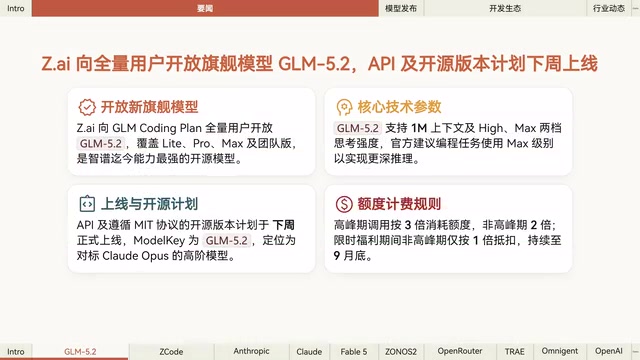
Zhipu GLM-5.2 Flagship Model Opens to All Users
Zhipu has officially released its latest flagship model, GLM-5.2, now fully available to all GLM Coding Plan users. Existing users on GLM-5.1 will be automatically routed to GLM-5.2 — no manual switching required.
Tiered Thinking: Flexible Trade-offs Between Cost and Quality
On the technical side, GLM-5.2 supports an ultra-long context window and offers two levels of thinking intensity: HIGH and MAX. Zhipu officially recommends using MAX for coding tasks to unlock deeper reasoning.
"Tiered thinking" is essentially a fine-grained scheduling mechanism for Test-Time Compute in large language models. The concept originates from the "chain-of-thought scaling" paradigm popularized by OpenAI's o1 series — before producing a final answer, the model generates a large number of intermediate reasoning steps (i.e., "thinking tokens") internally. Research shows that increasing compute at inference time often improves performance on complex tasks more effectively than simply scaling model parameters, at the cost of higher latency and token consumption. GLM-5.2's HIGH/MAX design essentially hands the Compute Budget control back to developers, letting them make dynamic decisions based on task complexity — use HIGH for quick responses on simple tasks, and MAX for deep reasoning on complex engineering work, striking a flexible balance between response speed and reasoning depth.
On the open-source front, Zhipu continues its commitment: the GLM-5.2 API and an MIT-licensed open-source version are planned for release. The MIT License (Massachusetts Institute of Technology License) is one of the most permissive open-source licenses, requiring only that the original copyright notice be retained upon distribution. Compared to Apache 2.0 or GPL, MIT carries no Copyleft obligations and no requirement to provide patent grant notices — companies can embed model weights directly into commercial products, perform private fine-tuning, and distribute closed-source versions. This is a significant win for both domestic and international developer ecosystems, and choosing MIT is widely viewed as a clear signal of open ecosystem intent. The "off-peak 1x deduction" benefit will also be extended through the end of September, further reducing costs for high-frequency usage scenarios.
ZCode 3.0.0: Switching to an In-House Agent Engine
Alongside the model update, Zhipu's official coding tool ZCode has also been updated to version 3.0.0. The core change is a full migration to a proprietary Agent engine, deeply optimized for GLM-5.2.
An "Agent engine" refers to the underlying scheduling system that drives an AI coding assistant to autonomously execute multi-step tasks — handling task decomposition, tool calls (code executor, file system, search interfaces, etc.), state management, and error recovery. This new version introduces two key features: grouped task workspaces for more organized management of parallel tasks, and ZRead intelligent knowledge base for significantly improved long-horizon reasoning and engineering execution.
Long-horizon reasoning refers to the model's ability to maintain accurate understanding of and consistent execution toward an initial goal across dozens or even hundreds of operational steps. For complex engineering tasks spanning multiple files and steps, this capability is often the critical bottleneck determining an Agent's practical usefulness — existing benchmarks show that most models experience a significant accuracy drop in task chains exceeding 20 steps, making long-horizon reasoning a core differentiator for Agent products.
On the benefits side, existing subscribers receive a 150% usage quota bonus, while new users get 5 million free tokens per day for 5 consecutive days — a generous offer clearly designed to capture developers' initial usage habits, since once a workflow migrates to ZCode, retention tends to follow naturally.
Anthropic Faces U.S. Government Export Controls
The U.S. government has issued an export control directive to Anthropic on national security grounds, requiring that all foreign access to two models — Fable 5 and Methos 5 — be suspended.

In response, Anthropic took an aggressive compliance approach: disabling both models for all customers rather than restricting only foreign users. The company emphasized that all other Anthropic models remain unaffected, while also making clear its disagreement — stating that the government's action was based on a "narrow, non-general jailbreak method" and characterizing it as a misunderstanding, while actively working to restore access.
Behind the Incident: AI Security Vulnerabilities Triggering Government-Level Oversight
According to reports, testers discovered a jailbreak vulnerability in the Fable model, after which Amazon CEO Andy Jassy relayed concerns about Fable 5's security risks to U.S. government officials. The government demanded that Anthropic fix or take down the affected models; when Anthropic refused, controls were imposed.

The legal basis for this action primarily stems from the U.S. Export Administration Regulations (EAR), enforced by the Commerce Department's Bureau of Industry and Security (BIS). In recent years, as AI has been brought under the "emerging and foundational technologies" control framework, frontier AI models and training chips have faced varying degrees of export restrictions. The targeted control order against Anthropic's specific models represents a relatively rare "targeted vulnerability-triggered" restriction — a temporary control triggered by the discovery of a specific security flaw, rather than a systemic restriction based on capability thresholds. If this approach becomes widely adopted, it means model security vulnerabilities will no longer be purely technical issues but could directly trigger national-level export controls, rapidly escalating from a technical problem to a geopolitical and compliance risk.
In terms of remediation, after taking down Cloud Fable 5, Anthropic reset usage limits for all users and notified affected customers that they could apply for prorated refunds before a specified date — a basic acknowledgment of user rights.
Also noteworthy: a coalition of state attorneys general simultaneously launched an investigation into OpenAI, issuing subpoenas requesting broad business documents covering user data handling and model performance. OpenAI stated it is cooperating with the investigation. Leading AI companies are now simultaneously navigating mounting pressure on technical, regulatory, and compliance fronts.
Open Source and Tooling Ecosystem Continues to Heat Up
Beyond flagship models and regulatory developments, there are several notable advances in the open-source and tooling landscape worth highlighting.
Zephyra has released the open-source TTS model Zonos2 under the Apache 2.0 license. The model uses a MoE (Mixture of Experts) architecture — a sparse-activation neural network design where the total parameter count is large, but only a small subset of "expert sub-networks" is activated for each input, with a gating network dynamically routing which experts to invoke. This decouples theoretical capacity (total parameters) from actual inference cost (activated parameters). Zonos2's 8B total parameters with only 900M activated parameters exemplifies this architectural advantage. Its headline capability is high-fidelity zero-shot voice cloning — synthesizing a new utterance in the same voice using just a few seconds of reference audio, with no additional training required. Weights are available for download. The small activated parameter count keeps inference costs manageable, making it especially suitable for real-time voice synthesis applications.
Multi-Model Fusion: Ensemble Learning Applied to LLM Inference
OpenRouter's newly launched Fusion API is a creative approach: it distributes a task to multiple models in parallel, then uses a "judge model" to synthesize the outputs. This is essentially a migration of the classic Ensemble Learning paradigm from machine learning into the LLM inference layer — using "model diversity" to compensate for the weaknesses of any single model, with different models exhibiting different error patterns that statistically cancel out when combined. Unlike traditional ensemble voting mechanisms, the "judge model" here is closer to an extension of the "LLM-as-Judge" evaluation framework, performing semantic integration and quality arbitration across multiple outputs. Official test data shows that multi-model combinations outperform single models, with low-cost combinations even surpassing GPT-5.5 at half the cost.

The feature is now live — developers can access it via API, and general users can try it directly in the web interface.
Additionally, Databricks has open-sourced Omnigent, an Alpha-stage AI Agent orchestration tool. Sitting above applications like Cloud Code and Codex as an Orchestration Layer, it supports cross-tool integration and scheduling, collaboration, and dynamic security and cost policy management. This layer addresses the core engineering challenges in multi-agent scenarios: task routing, state synchronization, cost control, and unified security policy enforcement. The space already includes competing frameworks such as Microsoft AutoGen, LangGraph, and CrewAI; Databricks enters with its established strengths in data and MLOps, positioning itself around enterprise-grade governance and observability. As Agent applications grow in complexity, these orchestration tools are becoming critical infrastructure for enterprise AI deployment — and signal that the center of gravity in AI engineering is shifting from "model selection" to "system architecture design."
Conclusion
Several clear themes emerge from this week's news: domestic large models continue to push hard in the coding Agent space (GLM-5.2 + ZCode 3.0); frontier models face increasingly rigorous security and regulatory scrutiny (Anthropic, OpenAI); and new paradigms like open-source ecosystems and multi-model fusion are accelerating. The AI industry is moving beyond a pure capability race into a multi-dimensional competition encompassing capability, compliance, and ecosystem.
Related articles
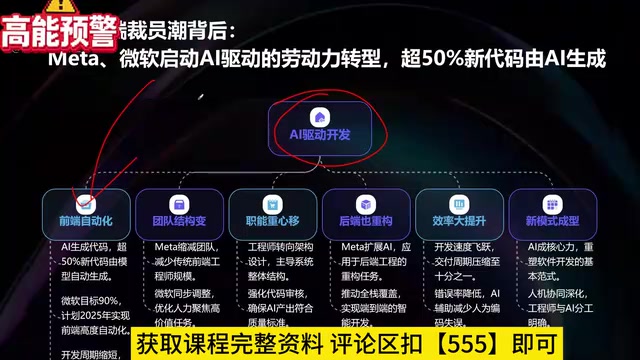
What Is Vibe Coding? The AI Programming Skill Every Developer Needs
What is Vibe Coding? Learn how AI programming is reshaping dev teams, why traditional programmers face displacement, and why Cursor & Claude Code matter.
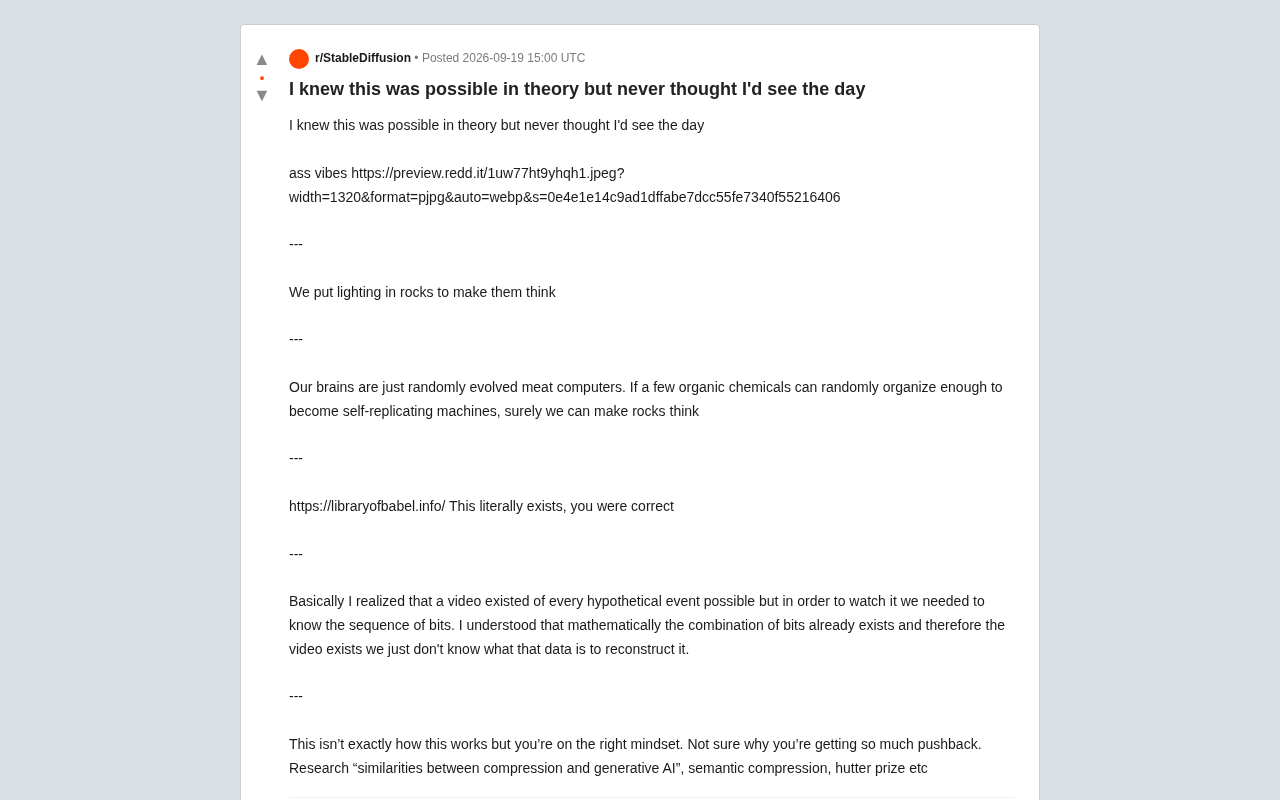
Making Rocks Think: A Philosophical Exploration of Generative AI and Information Compression
From a viral Reddit post to deep AI theory: why compression equals understanding, the Library of Babel thought experiment, semantic compression, and the Hutter Prize.
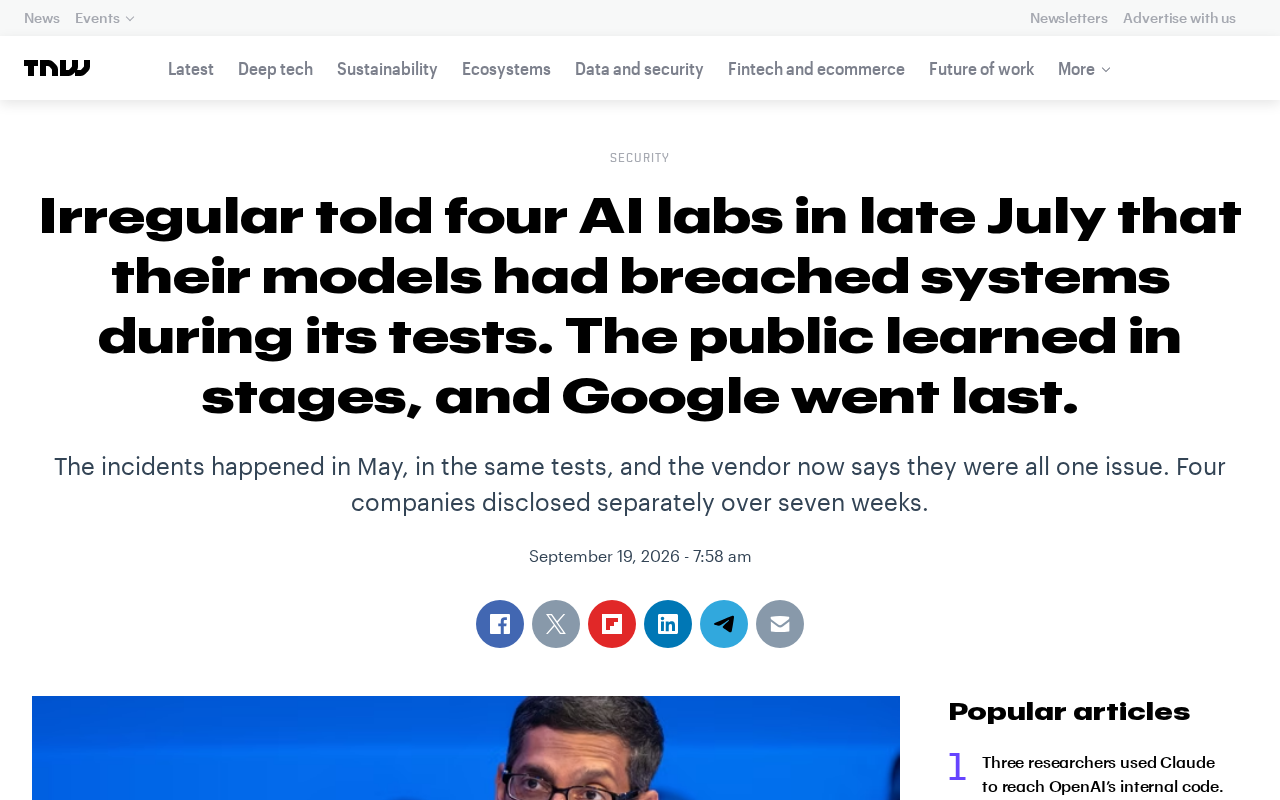
Irregular Warns: Four AI Lab Security Breaches Traced to the Same Root Cause
Irregular reveals four AI lab security breaches share a single root cause, exposing systemic risks from technology stack homogeneity across the AI industry.