Zoox Suspends Atlanta Test Fleet After Employees Report Suspected Toxic Gas Exposure

Zoox halts Atlanta test fleet after employees report suspected toxic gas exposure and file an OSHA complaint.
Amazon-backed autonomous vehicle company Zoox has suspended its Atlanta test fleet after multiple employees reported symptoms of suspected toxic gas exposure, with one employee filing a formal complaint with OSHA. Zoox adopted a cautious "suspend first, investigate later" approach to cut off potential ongoing health risks. The incident turns the spotlight on occupational health and safety management at autonomous vehicle companies, potentially exposing gaps in site ventilation, equipment emissions, or operational procedures. The OSHA complaint may also trigger external regulatory scrutiny, putting pressure on Zoox's compliance standing. The investigation is ongoing, and the cause, number of affected employees, and corrective actions have yet to be disclosed.
Amazon-backed autonomous vehicle company Zoox has suspended operations of its Atlanta test fleet after multiple employees reported symptoms consistent with toxic gas exposure. The company has launched an internal investigation following a formal complaint filed with the U.S. Occupational Safety and Health Administration (OSHA).
Incident Overview
According to available information, a number of Zoox employees working at the Atlanta test site developed health symptoms associated with toxic gas exposure. The pivotal moment came when one employee formally filed a complaint with OSHA — a step that typically signals the employee believes workplace safety concerns have not been adequately addressed through internal channels.
In response, Zoox chose to suspend the entire Atlanta test fleet and launch an investigation. This "suspend first, investigate second" approach is considered a relatively cautious response in situations involving employee health and safety — it prioritizes cutting off potential ongoing exposure rather than continuing operations before the cause is identified.
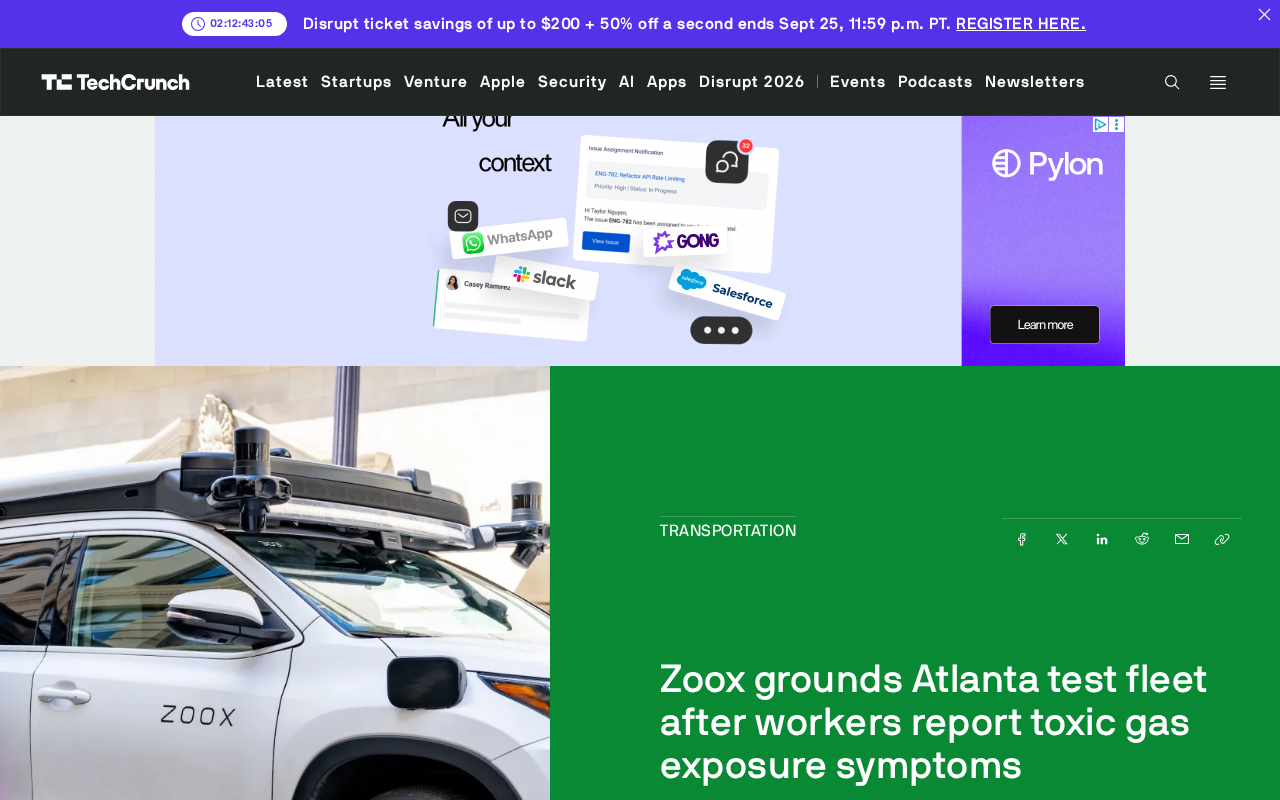
The Significance of the OSHA Complaint
The employee's decision to file an OSHA complaint is a notable element of this incident. OSHA is the federal agency responsible for regulating workplace safety and health in the United States, and employee complaints can trigger inspections of an employer's work environment. For Zoox, this is not only an internal safety matter — it could also attract scrutiny at the regulatory level.
For an autonomous vehicle company like Zoox, which is in a period of rapid expansion, test operations involve large numbers of ground staff, vehicle maintenance, and site work. Any exposure risk related to chemicals, exhaust, or other gas sources requires clearly defined protection protocols. The issues surfaced by this incident may be linked to site ventilation, equipment emissions, or operational procedures — though the specific cause remains unclear pending the outcome of the investigation.
OSHA (Occupational Safety and Health Administration) was established in 1971 under the U.S. Department of Labor and is responsible for setting and enforcing workplace safety standards. When an employee files a complaint, OSHA can conduct an on-site inspection of the employer. If violations are found, OSHA can issue citations and impose fines — the per-day penalty for serious violations can reach up to $15,625, while willful or repeat violations can result in fines as high as $156,259. Perhaps more significantly, OSHA investigation findings typically become part of the public record, directly affecting a company's compliance reputation. Employees who file OSHA complaints are protected by law from retaliation, which is a key reason workers turn to external complaints when they feel internal channels have failed to adequately address safety concerns.
Potential Impact on Zoox's Expansion Plans
As Amazon's major bet in the autonomous vehicle space, Zoox has been advancing testing and deployment across multiple cities. Atlanta is one node in its testing network, and while the fleet suspension is a localized measure, it will have some effect on the company's overall momentum.
The autonomous driving industry already faces mounting pressure around public trust, regulatory scrutiny, and operational safety. Unlike incidents involving vehicle behavior on public roads, this event centers on employee occupational health and safety — an internal operations management issue. If mishandled, such matters can still damage a company's reputation and compliance standing.
Zoox was founded in 2014 by Tim Kentley-Klay and Jesse Levinson, and was acquired by Amazon in 2020 for approximately $1.2 billion. Unlike competitors such as Waymo and Cruise, Zoox's core product is a purpose-built "bidirectional" electric vehicle pod with no traditional front or rear orientation — passengers sit facing each other. The vehicle is currently undergoing internal testing in San Francisco and Las Vegas, with Atlanta being one of the cities where Zoox has expanded its ground test operations. Ground operations teams handle daily vehicle maintenance, charging management, and test site activities, serving as an indispensable foundation for the safe deployment of autonomous driving systems.
Conclusion
Zoox's investigation is still ongoing, and the specific cause, the number of employees affected, and subsequent corrective actions have not yet been made public. This incident serves as a reminder to the industry that bringing autonomous driving technology to the real world is not only about the maturity of algorithms and hardware — it is also deeply dependent on the safety safeguards built into the testing and operations infrastructure behind the scenes. As more information emerges, observers will be better positioned to assess the full scope of this suspension and the effectiveness of Zoox's response.
(Note: Due to limited information in the source material, the details underpinning this article are relatively sparse. Further developments await official and regulatory disclosure.)
Related articles

uGAP: An AI Platform Unifying 100+ African Geospatial Datasets
uGAP is an African geospatial AI platform by a University of Cape Town team, unifying 120+ African datasets with a Python SDK for discovery, processing, and model training, already used in cyclone flood mapping.

Cursor Can Now Control Your Computer: AI Agents Can Drive Desktop Apps for Testing
Cursor adds desktop control: AI agents can drive desktop apps like the iOS Simulator to test their own features. We analyze the impact on dev workflows, possible technical approaches, and reliability concerns.

Vibecoding a Custom Inference Engine: High Hopes, Harsh Reality
A Reddit developer shares the real experience of vibecoding a custom inference engine: running GGUF Q4 models in the browser with WebGL2 and GLSL, only to fall into tokenizer debugging hell. This article analyzes the engineering challenges of browser-side LLM inference and why cloning llama.cpp is the more rational choice.