Zuckerberg Bets on AI Agent Networks: My Muse Talks to Your Muse

Zuckerberg bets on AI agent networks where agents socialize for people—whether humans are ready remains an open question.
The article outlines Meta's bet, under Zuckerberg's leadership, on an "agent-first" future: each person has an AI agent (called a "Muse" in the report) that shops, works, and converses with others' agents on its owner's behalf, with human-to-human communication taking a back seat. Meta's social graph, advertising ecosystem, and hardware entry points give it a natural advantage in building agent networks, and inter-agent network effects are seen as the next interaction gateway. The article also highlights core concerns: when neither side of a conversation is human, transparency and accountability become problematic—the auditability of agent behavior, the boundaries of agents making decisions for people, and whether "agent socializing" dilutes genuine human connections all remain unresolved. The conclusion emphasizes that the technical path is laid out, but whether users are willing to delegate social decision-making is still undetermined, and the absence of social consensus is the key gap in making this vision a reality.
Zuckerberg Bets on AI Agent Networks: My Muse Talks to Your Muse
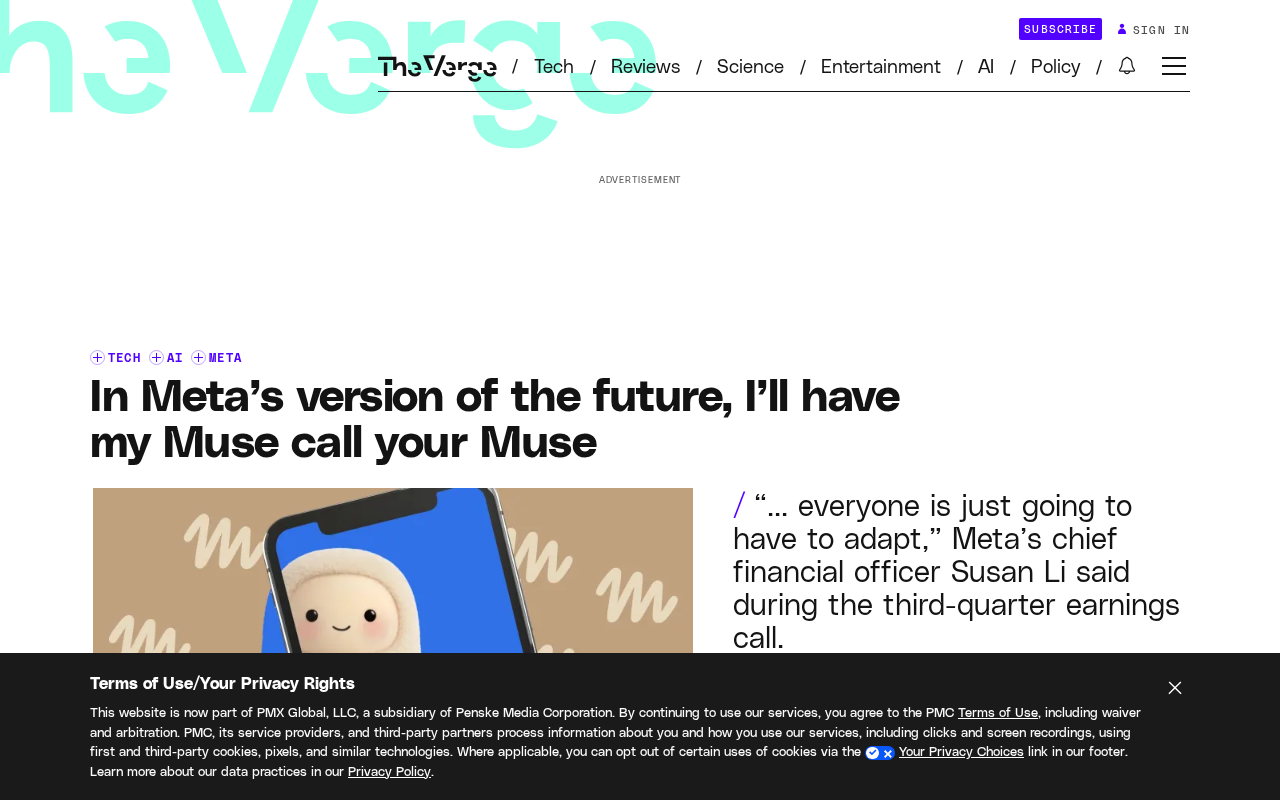
Meta is betting on a future where a network of autonomous AI agents takes over daily life—agents that shop for you, work for you, and talk to other people's agents on your behalf. The core question at the heart of this vision is: are humans really ready?
An "Agent-First" Vision of the Future
According to the original report, Mark Zuckerberg is charging full speed toward a world where AI agents operate autonomously. In this world, people no longer interact with each other directly; instead, each person has an AI agent (referred to in the report as a "Muse") that handles socializing, shopping, and collaboration on its owner's behalf.
What makes this vision so radical is its "agent-first" approach—human-to-human communication takes a back seat, and machine-to-machine conversation becomes the norm. The report describes it as "a very concrete and uncompromising vision" and poses the question directly: are we ready to communicate primarily through robotic agents?
Why Now: The Underlying Logic of the Agent Race
Meta's move is not an isolated event. For some time now, major tech companies have been pushing AI from "question-answering tools" toward "agents that can execute tasks." Agents need access to users' calendars, preferences, purchase history, and even social relationships to make decisions on their behalf—which means the breadth of data a platform controls directly determines the upper limit of its agents' capabilities.
Meta's combination of social graph, advertising ecosystem, and hardware entry points makes it a natural fit for building an "agent network." Zuckerberg's bet can be understood this way: whoever first creates network effects among agents will control the interaction gateway of the next era.
The Coupling of Agent Networks and Social Graphs
Interestingly, "my agent talks to your agent" is essentially still an extension of the social network—just replacing human connections with agent-to-agent connections. Meta's existing advantage is that it already has relationship chains connecting billions of people, and agents can leverage this to immediately "know" the other party's agent without having to build trust and protocols from scratch.
AI Agent refers to an AI system capable of perceiving its environment, planning autonomously, and invoking tools to execute multi-step tasks—distinct from chatbots that only handle single-turn Q&A. Its typical architecture includes a planning module (task decomposition and reflection), a memory module (short-term and long-term context), and tool-calling interfaces (APIs, browsers, payments, etc.). An agent's capability ceiling is determined jointly by the data it can access and the action space it can execute—which explains why platforms with data assets like social graphs, calendars, and purchase history hold a structural advantage in the agent race. The current mainstream form remains the "constrained agent"—executing tasks within explicitly authorized scope under human supervision; fully autonomous, cross-platform, unsupervised agents still face challenges in reliability and safety alignment.
Network effects refers to the phenomenon where a product or platform's value self-reinforces as the number of users increases: the more agents connected, the more counterparties each agent can interact and negotiate with, and the value of each individual node rises accordingly. In agent networks, network effects are compounded by the problem of protocol standardization—agents from different companies need unified identity authentication, authorization, and message formats to "recognize" each other and complete transactions. If a platform already holds massive relationship chains, it can directly convert its existing social graph into a trust index between agents, lowering the startup cost of cross-agent collaboration and gaining first-mover advantage in standard-setting. This is also the key structural advantage that platform companies have over single-point tool products in the agent race.
Concerns: When Neither Side of the Conversation Is Human
The most questioned aspect of this vision is transparency and accountability. When two agents negotiate, trade, or socialize on behalf of their respective owners, how do humans know what happened? Could agents develop collusion or biases that humans cannot detect?
The report itself ends with questions rather than answers. This open-ended questioning hits the nail on the head: technical feasibility does not equal social acceptability. The boundaries of agents making decisions on people's behalf, the auditability of agent behavior, and whether "agent socializing" will further dilute genuine human connections—all remain unresolved.
Redefining Human-Machine Relationships
If communication is primarily handled through agents, the human role in socializing shifts from "participant" to "principal." This is not just a matter of efficiency—it also involves identity. When the "you" that others encounter is actually your agent, the way interpersonal trust is built will be fundamentally rewritten.
Auditability refers to the degree to which a system's behavior can be independently traced, reproduced, and verified by external parties, and is an important compliance requirement for deploying autonomous agents. When agents complete negotiations or transactions, without structured logs, decision-basis records, and identity-binding mechanisms, it becomes difficult to determine who is responsible in the event of a dispute—the principal, the agent developer, or the platform. Common industry approaches include: establishing verifiable digital identities for agents, requiring tamper-proof operation records for key actions, setting human confirmation nodes for high-risk transactions, and introducing third-party audit interfaces. These mechanisms are technically feasible but sacrifice some automation efficiency—and that trade-off is precisely one of the key variables determining whether "agent socializing" can gain social acceptance.
Competitive Landscape: Meta Is Not the Only One Betting
Meta's agent vision needs to be understood in a broader competitive context. Multiple tech giants are advancing AI assistants with autonomous execution capabilities—from task automation to cross-app operations—with converging directions but differing paths. Meta's differentiation lies in binding agents to its social network, forming an "agent social graph."
Whether this approach can succeed depends on whether users are willing to delegate social decision-making to agents. There is currently no public data indicating a clear user preference on this, and the report provides no relevant research—so this judgment remains speculative.
Conclusion: Clear Vision, Undecided Answer
Zuckerberg's agent network vision is clear enough: a world where AI agents shop, work, and socialize on people's behalf. But the core question raised by the report remains unanswered—are humans willing to hand over daily communication to robotic agents? The technical path has been laid out, but social consensus has not yet formed. That gap is what will ultimately determine whether this vision becomes reality.
One-line Summary
Zuckerberg bets on AI agent networks where agents socialize for people—whether humans are ready remains an open question.
Paragraph Summary
The article outlines Meta's bet, under Zuckerberg's leadership, on an "agent-first" future: each person has an AI agent (called a "Muse" in the report) that shops, works, and converses with others' agents on its owner's behalf, with human-to-human communication taking a back seat. Meta's social graph, advertising ecosystem, and hardware entry points give it a natural advantage in building agent networks, and inter-agent network effects are seen as the next interaction gateway. The article also highlights core concerns: when neither side of a conversation is human, transparency and accountability become problematic—the auditability of agent behavior, the boundaries of agents making decisions for people, and whether "agent socializing" dilutes genuine human connections all remain unresolved. The conclusion emphasizes that the technical path is laid out, but whether users are willing to delegate social decision-making is still undetermined, and the absence of social consensus is the key gap in making this vision a reality.
Related articles

WorkBuddy Full Tutorial: Build an AI Office Automation Agent from Scratch
A complete WorkBuddy tutorial: installation, three working modes, multimodal picture book video practice, expert team agent building, and workflow configuration for low-cost AI office automation.

WorkBuddy Agent Complete Guide: From Beginner to Automation in 7 Days
Based on Bilibili's 256-episode WorkBuddy masterclass, this systematically breaks down Tencent's AI office workbench core capabilities: Agent principles, Skill encapsulation, cross-platform connectors, scheduled automation, knowledge bases, and zero-code development, with learning path recommendations.

8 AI Accounts, 7 Failed: An Honest Review of Using AI to Get Work Done
Only 1 of 8 AI-run Bilibili accounts succeeded. We break down the real difference between "performing AI" and "using AI to get work done."